

Olsztyn Castle: The Ultimate Guide to the Copernicus Stronghold
Last updated July 2026, this guide to Olsztyn Castle sorts out the confusion between two Polish landmarks that share a name. This entry covers the intact Brick Gothic stronghold in Warmia, northern Poland, where Nicolaus Copernicus worked as castle administrator and wrote his earliest astronomical calculations. Inside, a 40-meter tower and Copernicus's 1517 astronomical table remain the main reasons to visit.
Olsztyn Castle vs. the Eagle's Nest Ruins: Which One Are You Visiting?
Two different Polish landmarks answer to the name Olsztyn Castle, and search results mix them together constantly. The castle covered in this guide sits in the city of Olsztyn, in the Warmian-Masurian Voivodeship of northern Poland. It is the intact fortress where Nicolaus Copernicus lived and worked. A separate ruin, also called Olsztyn Castle, sits about 9 miles (15 kilometers) from Częstochowa, in the Silesian Voivodeship in southern Poland. Built for King Casimir the Great in the 14th century, that ruin is now reduced to wall fragments. A standing 35-meter (about 115-foot) round tower, once used as a prison, is the most intact part. It sits on the Trail of the Eagles' Nests, a route of medieval fortresses across the Kraków-Częstochowa Upland. The material tells the two apart at a glance. Red brick and the Brick Gothic style mark the northern castle, common across the old Warmian and Teutonic lands. Limestone rock outcrops define the southern ruins, set into the Kraków-Częstochowa Upland instead. If a map app or GPS search sends you toward Częstochowa instead of Warmia, that is the wrong Olsztyn Castle for this guide.
| Feature | Northern Castle (Warmia) | Southern Castle (Silesian Voivodeship) |
|---|---|---|
| Location | City center of Olsztyn, Warmian-Masurian Voivodeship | Village of Olsztyn, about 9 miles from Częstochowa |
| Condition | Intact Brick Gothic building, roofed and in use | Ruins: wall fragments and one standing tower |
| Main draw | Copernicus history and the Museum of Warmia and Mazury | Rock formations on the Trail of the Eagles' Nests |
| Best for | History, architecture, and indoor museum visits | Hiking and outdoor photography |
| Access | Level ground floor; stairs lead to the upper floors and tower | Steep, rocky paths; not wheelchair accessible |
History of the Castle of the Warmian Cathedral Chapter
The Warmian Cathedral Chapter built the castle between 1346 and 1353 as a stronghold against Lithuanian raids. Officially, it is still called the Castle of the Warmian Cathedral Chapter in Olsztyn. Builders raised one wing on the northeast side of the courtyard first. Fortifications and a ditch ringed the site, connecting to the Łyna River by a bascule bridge. A second wing, on the southeast side, followed in the 15th century. The castle's signature tower dates to the 14th century and stands in the courtyard's eastern corner. Masons rebuilt it in the early 1500s, adding a circular top on the original square base. Surrounding walls rose to about 39 feet (12 meters) in the process.
Built 1346 and 1353, the castle faced repeated military sieges from 1410 through 1521, its final confrontation led by Copernicus. His astronomical calculations created between these conflicts, including the 1517 table, represent his enduring legacy.
Its location on the Teutonic Order's border made it a repeated flashpoint. During the Battle of Grunwald in 1410, the garrison surrendered without a fight. Teutonic forces seized it after a short siege in 1414. Through the Thirteen Years' War from 1454 to 1466, the castle changed hands multiple times. Afterward, the region became part of Royal Prussia within the Crown of the Kingdom of Poland. The Teutonic Order threatened Olsztyn one final time in 1521, an episode tied directly to Nicolaus Copernicus, the castle's best-known administrator.
Its military role faded over the following centuries, and its use shifted toward administration and residence. Workers added a direct entrance from the town and a new palace wing in 1758, dismantling much of what remained of the old fortifications. Poet and prince-bishop Ignacy Krasicki stayed at the castle in 1779. After the First Partition of Poland in 1772, the Prussian state took control of the building. Napoleon Bonaparte visited on February 3, 1807, during the Eylau campaign, when the castle briefly served as French command headquarters. This was shortly before the Battle of Allenstein, as Olsztyn was then known in German. Workers later replaced the bridge over the old defensive ditch with a solid levee in 1845. Between 1901 and 1911, a renovation altered interior floor levels and added arched cloister windows. The castle became the Museum of Warmia and Mazury in 1946. In 1971, Poland's postal service featured it on a stamp honoring places connected to Copernicus.
Nicolaus Copernicus at Olsztyn Castle: Administrator and Defender
Nicolaus Copernicus administered the castle for the Warmian Cathedral Chapter from 1516 to 1521. As administrator, he managed the chapter's estates, kept financial records, and settled local disputes. In 1521, he organized and led the Polish defense of the castle during a Teutonic siege, the last time the Order threatened Olsztyn. Copernicus also held a canon post at nearby Frombork, another Warmian Cathedral Chapter site, but Olsztyn Castle is where he served as administrator and led that defense. He is remembered today primarily as an astronomer, but at the castle his duties were administrative and military first.
Between assignments, he used his time at the castle for early scientific work. He took a full inventory of the castle archive and drafted an economic treatise on currency. Astronomical observations and calculations from this period later fed his heliocentric model of the solar system.
Finding the Astronomical Table and the Diamond-Vaulted Refectory
On a cloister gallery wall, look closely for a grid of lines and numerals easy to miss at a glance. This is Copernicus's astronomical table, made in 1517 to track the sun's position through the year. Historians describe it as the only surviving astronomical instrument known to have been built and used by Copernicus himself. It is worth asking a staff member to point it out.
The castle's largest exhibition room is the refectory, built around 1520 with a diamond-patterned vaulted ceiling. It is the architectural centerpiece of the interior and a useful reference point between the courtyard and the upper galleries.
Inside the Museum of Warmia and Mazury
The castle has housed the Museum of Warmia and Mazury since 1946, alongside its historic rooms. Exhibits mix permanent collections on regional history and archaeology with temporary shows that rotate through the year. Regional archaeology finds, historic art, and rotating photography or craft exhibitions are typical of the museum's program, though specific themes change year to year. Check the museum's current listings before a visit.
In the 16th century, two Warmian bishops used the castle as their seat. Johannes Dantiscus was a diplomat, and Marcin Kromer wrote Latin hymns and scientific texts. Kromer consecrated the castle's Chapel of Saint Anne in 1580; it remains part of the museum's interior. The museum also hosts the Olsztyn Artistic Summer festival, Olsztyńskie Lato Artystyczne, a long-running program of concerts and events held on-site. Check current listings for this year's schedule. Climbing the 40-meter (about 130-foot) tower rewards you with a view over the castle courtyard and Olsztyn's rooftops. The route up follows a historic stone staircase, so confirm with the museum in advance if step-free access matters to your visit.
Essential Visitor Logistics: Hours, Tickets, and Getting There
Olsztyn Castle sits in the heart of the city, within walking distance of both the Old Town and the Olsztyn Główny train station. Opening hours shift between summer and winter, so confirm the current schedule on the official Museum of Warmia and Mazury website before visiting. Ticket prices run modest by the standard of Poland's regional museums, and the museum's own site lists current rates and any free-admission days. Check current PKP timetables and fares before booking, since both routes and journey times shift with the seasonal schedule. In September 2023, Poland's president designated the castle a Historic Monument, pomnik historii, formal recognition of its Brick Gothic architecture and its Copernicus connection.
While the castle sits within walking distance of Olsztyn Główny, allow about 25 to 30 minutes on foot if arriving there. Olsztyn Zachodni offers a closer approach, making it the recommended station despite being less prominent on journey planners.
- Nearest station: Olsztyn Główny, within walking distance of the castle and Old Town
- From Warsaw: direct PKP Intercity trains to Olsztyn Główny
- From Gdańsk: regional and intercity connections via Olsztyn Główny
- Historic Monument status: designated September 2023
How Much Time to Spend: Sample Itineraries
How much time to give the castle depends on what visitors want to see. Three options cover most trips. Travelers extending their stay often continue into the Mazury Lake District day trips that start from Olsztyn, since the region shares the same Warmian history.
- The 1-hour express: courtyard, astronomical table, and diamond-vaulted refectory.
- The half-day deep dive: full museum collection, tower climb, and a walk along the Łyna River.
- The regional add-on: pairing the castle with the wider Copernicus Trail through Warmia.
Mistakes to Avoid and Local Tips
A few small mistakes are common enough to flag directly. None of these change the visit dramatically, but each one is an easy way to lose time or a photo.
- Confirm which Olsztyn is set in the GPS route. Only the northern town, in Warmia, has this castle.
- Flash photography and tripods may be restricted inside the museum galleries, as at many Polish regional museums. Confirm current rules at the entrance.
- Look for the well in the castle courtyard. It is easy to walk past without noticing it.
Beyond the Castle Walls: Old Town and the Łyna River
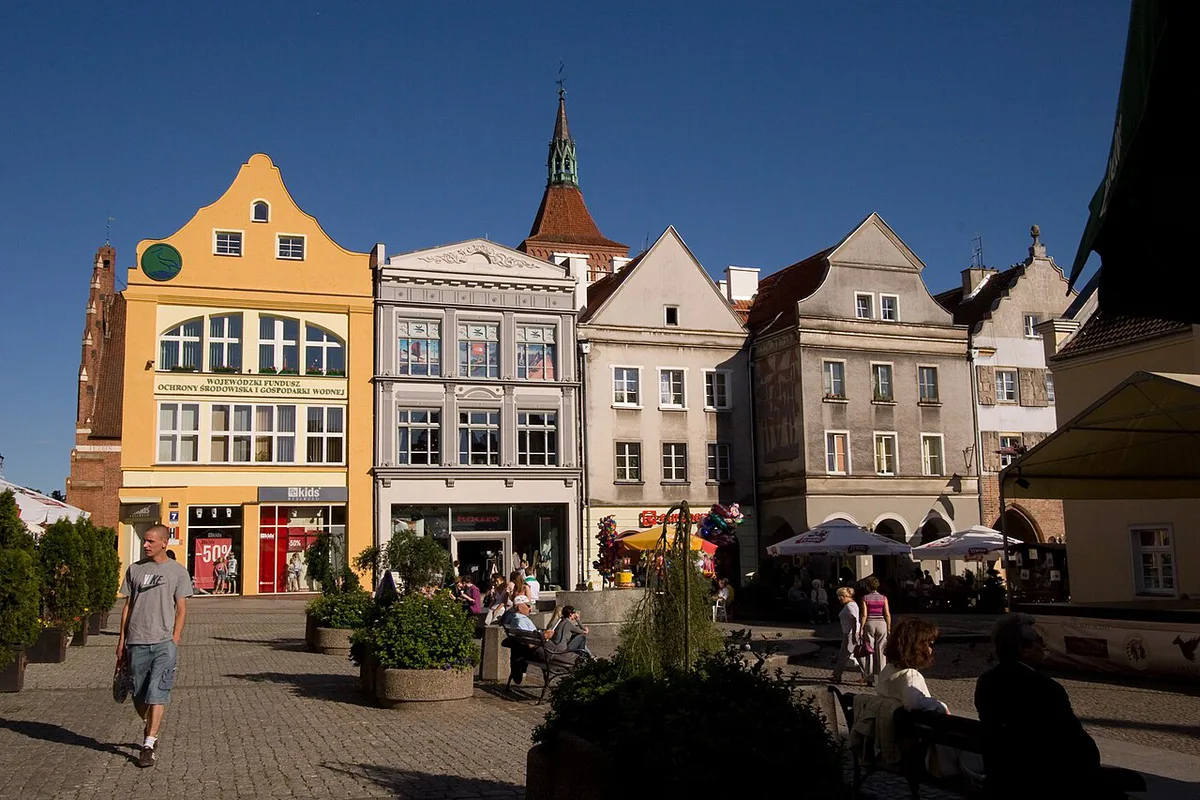
Outside the castle walls, a monument to Nicolaus Copernicus marks the site's connection to its best-known administrator. Castle Park and the paths along the Łyna River extend from the grounds, offering a walkable route back toward the Old Town. The Old Town's restaurants and cafes sit within the same walkable area, making it easy to combine the castle with a meal before or after. See the pillar guide for a fuller list of Olsztyn's other attractions, including the Old Town and nearby lakes. Combining the castle, the Old Town, and a short riverside walk covers Olsztyn's historic core in a single outing.
Which Olsztyn Station Is Best for the Castle?
Olsztyn Zachodni is the most convenient railway station for the castle, despite many journey planners defaulting to Olsztyn Główny. The western station is roughly a ten-minute walk from the Old Town.
From Olsztyn Zachodni, follow signs toward the city center and cross into the historic district near the Łyna River. The castle entrance is at 2 Zamkowa Street, beside Castle Park and the Nicolaus Copernicus Monument.
Olsztyn Główny is the city’s main transport hub, but it is farther from the historic center. Allow about 25 to 30 minutes to reach the castle on foot. Local buses and trams can shorten the journey toward the High Gate, called Wysoka Brama. From there, the castle is a short walk through the Old Town.
Drivers should expect limited parking beside the medieval center. Look for marked public parking outside the Old Town, then approach on foot through Castle Park. Never leave a vehicle on unmarked streets near the pedestrian zone.
Further reading: Olsztyn on Wikivoyage · Olsztyn on Wikipedia
Frequently Asked Questions
Is Olsztyn Castle the same as the Eagle's Nest ruins near Częstochowa?
No. Two Polish landmarks share the name Olsztyn Castle. This guide covers the intact Brick Gothic castle in Warmia, where Copernicus once served as administrator. The other is a ruined 14th-century fortress near Częstochowa, on the Trail of the Eagles' Nests, in the Silesian Voivodeship.
What is Nicolaus Copernicus's connection to Olsztyn Castle?
Copernicus administered the castle for the Warmian Cathedral Chapter from 1516 to 1521. He organized its defense during a Teutonic siege in 1521, and conducted the astronomical work that later shaped his heliocentric model. His 1517 astronomical table still hangs on a cloister wall inside. He also held a canon post at nearby Frombork, another Warmian Cathedral Chapter site, though Olsztyn Castle is where he served as administrator.
How do you get to Olsztyn Castle from Warsaw or Gdańsk?
Both cities connect to Olsztyn Główny by rail, with direct PKP Intercity service from Warsaw and regional or intercity connections from Gdańsk. The castle is within walking distance of the station and the Old Town. Check current PKP timetables before booking, since schedules shift seasonally.
How much time should you plan for a visit to Olsztyn Castle?
An hour covers the courtyard, the astronomical table, and the refectory. A half day allows time for the full museum collection, the tower climb, and a walk along the Łyna River afterward.
What are the opening hours and ticket prices at Olsztyn Castle?
Hours shift between summer and winter, and ticket prices run modest by the standard of Poland's regional museums. Check the official Museum of Warmia and Mazury website for the current schedule, prices, and any free-admission days before visiting.
You might also like


Continue reading
More guides you'll find useful


