
The Perfect 2 Days in Wrocław Itinerary (2026)
Wrocław is one of Poland's most captivating cities, a place where Gothic spires, baroque fountains, and over 300 bridges over the Oder River create an atmosphere unlike anywhere else in Central Europe.
Two days in Wrocław give you enough time to wander the grand Market Square, hunt the famous bronze dwarfs tucked into every corner, cross onto the cathedral island of Ostrów Tumski, and explore the monumental Centennial Hall and sweeping Panorama Racławicka.
Whether you are here for a weekend city break or as part of a longer Polish adventure, this itinerary covers the highlights with practical meal suggestions and transport tips — use it alongside our full things to do in Wrocław guide to go deeper on anything that catches your eye.
Getting to Wrocław: By Train and by Air
Wrocław is one of the easiest Polish cities to reach from abroad. Wrocław Copernicus Airport (WRO) sits about 10 km south-west of the centre and handles direct flights from most major Western European hubs — journey time into the city is around 25 minutes by bus line 106 (direction Rynek, ~4.60 PLN) or around 40–50 PLN by taxi. There is no dedicated airport express train, so the bus or a rideshare app (Uber, Bolt, FreeNow) are the two practical options in 2026.
By rail, Wrocław Główny station connects to Warsaw Centralna in roughly 3.5–4 hours on PKP Intercity's EIC services (from ~60 PLN booked ahead), and to Kraków Główny in about 3 hours (from ~50 PLN). The station sits a 15-minute walk south of the Rynek, or two tram stops. Trains from Berlin take approximately 5–6 hours via Dresden, making Wrocław a natural stop on a Central European rail loop. Book PKP tickets at bilkom.pl or via PKP Intercity — weekend trains fill fast in summer.
If you arrive by train, the historic Wrocław Główny building is itself worth a slow look. Its neo-Gothic facade (1857) is one of the grandest station exteriors in Poland. Head straight through the main hall and turn left on Piłsudskiego to pick up tram lines toward the Rynek.
Day 1 Morning: The Rynek, Town Hall, and the Famous Dwarfs
Start your first morning in Wrocław at the Rynek — the Market Square — which ranks among the largest medieval market squares in Europe. The colourful Gothic and baroque townhouses that line all four sides were painstakingly rebuilt after World War II, and the effect is stunning, especially with morning light striking the western facades before the crowds arrive.
At the centre of the square stands the Old Town Hall (Ratusz), a masterpiece of Flemish Gothic architecture built over three centuries from the 13th to the 16th. Step inside the ground-floor Museum of Bourgeois Art for an affordable entry fee that nets you an impressive collection of medieval artifacts and civic treasures. The astronomical clock on the eastern facade chimes at noon — position yourself on the square about ten minutes early to claim a clear view. After the chimes, duck into the vaulted Gothic cellar restaurant Piwnica Świdnicka beneath the Ratusz, one of the oldest restaurants in Poland, for a mid-morning coffee and a slice of sernik (cheesecake).
Wrocław's bronze dwarfs (krasnale) now number over 600 across the city. Pick up a free dwarf map at the Tourist Information Centre on the Rynek, or download the official app via visitwroclaw.eu — spotting 20–30 in the Old Town alone is a fun 45-minute activity that children and adults both love.
After the Town Hall, set aside an hour to hunt dwarfs around the Rynek and the surrounding streets. The first official dwarf, Papa Dwarf (Tata Krasnal), sits at the corner of Świdnicka and Ofiar Oświęcimskich, but dozens more hide on window ledges, drainpipes, and doorsteps within a five-minute walk of the square. If you want a deeper dive into the lore and best spotting routes, our dedicated Wrocław dwarfs guide maps out the must-find figures by neighbourhood.
Day 1 Afternoon: Old Town Deep Dive and Cathedral Quarter
Head north from the Rynek along ulica Świdnicka toward St. Elizabeth's Church (Kościół św. Elżbiety), one of the tallest brick towers in Silesia. The climb to the observation deck (over 300 steps) rewards you with a panoramic view of the Rynek, the Oder bridges, and on clear days, the Sudeten foothills. The entrance fee is modest, and the view is genuinely one of the best free-ish perspectives in the city.
From St. Elizabeth's, cross the small lanes into the Salt Market (Plac Solny), which operates a daily flower market — a bright, photogenic contrast to the grander Rynek one block over. Then walk east toward the university district to see the Wrocław University Aula Leopoldina, a baroque hall so ornate it rivals Vienna's great ceremonial rooms. Check the university's events calendar as the Aula occasionally hosts concerts during term time.
| Attraction | Approximate Cost (2026) | Time Needed |
|---|---|---|
| Old Town Hall Museum | 15–20 PLN | 45 min |
| St. Elizabeth's Tower | 10–15 PLN | 30–45 min |
| University Aula Leopoldina | 15 PLN | 30 min |
| Panorama Racławicka (Day 2) | 40–50 PLN | 1.5–2 hrs |
| Centennial Hall (Day 2) | Free exterior; 15 PLN exhibition | 1–2 hrs |
For lunch, head to the street-food corridor around Jatki (the old Butchers' Stalls), now a pedestrian lane lined with affordable restaurants serving żurek, bigos, and grilled kiełbasa. Our full where to eat in Wrocław guide covers budget milk bars and upscale Polish cuisine in equal measure — bookmark it for dinner reservations tonight. The Jatki area also has several small bronze cat sculptures that dwell-hunters love to find.
Day 1 Evening: Ostrów Tumski and the Lamplighter Ceremony
No visit to Wrocław is complete without crossing the footbridge to Ostrów Tumski — Cathedral Island — the oldest part of the city and the spiritual heart of Polish Silesia. Unlike most of the Old Town, Ostrów Tumski has no bars or restaurants; it runs on gas lamps lit by a lamplighter (latarnik) each evening, giving it an almost medieval atmosphere that feels genuinely preserved rather than staged.
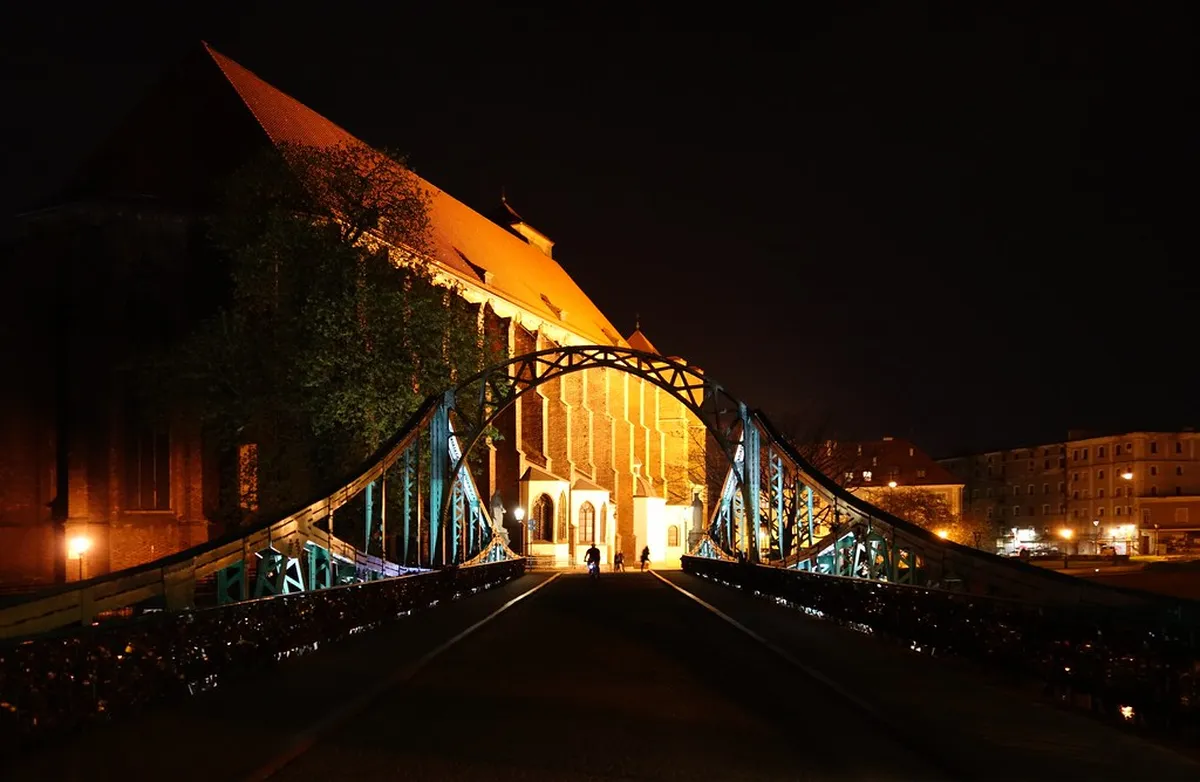
The dominant landmark is Wrocław Cathedral (Katedra św. Jana Chrzciciela), a soaring Gothic structure with twin towers. Take the lift (around 10 PLN) to the top of the south tower for a panoramic view over the island, the bridges, and the wider city as the sun drops — timing your arrival for around 45 minutes before sunset gives you golden light on the cathedral stonework. Inside, the Chapel of St. Elizabeth at the eastern end contains remarkable baroque frescoes often overlooked by visitors hurrying between towers.
The lamplighter (latarnik) begins lighting the gas lamps on Ostrów Tumski at dusk — roughly 20:30 in summer, 16:30 in winter. Gather near the Church of the Holy Cross (Kościół św. Krzyża) around that time to watch the ceremony. It takes about 30 minutes and is free to observe.
After the lamplighter ceremony, walk back across the Most Tumski footbridge and follow the river path south to the restaurant district around Świdnicka for dinner. The Wrocław Old Town guide has a full map of the key bridges and pathways connecting the island to the main city. End your evening with a local craft beer at one of the riverside bars — Wrocław has a thriving brewing scene rooted in its Silesian heritage, and most establishments serve regional lagers and ales alongside Polish classics.
Day 2 Morning: Centennial Hall and the Multimedia Fountain
Begin your second day by heading west of the city centre to the Centennial Hall (Hala Stulecia), a UNESCO World Heritage Site that is one of the most important examples of early 20th-century modernist architecture in the world. Designed by Max Berg and completed in 1913, its reinforced concrete dome — 65 metres in diameter — was the largest in the world at the time of construction and remains awe-inspiring from the inside.
Allow at least an hour inside the hall. The permanent exhibition on the building's history and engineering is genuinely fascinating, and the acoustics under the dome make any ambient sound feel cathedral-like. Outside, the Four Domes Pavilion (Pawilon Czterech Kopuł) houses a branch of the National Museum with a strong collection of Polish contemporary art — entry costs around 15 PLN and is worth 45 minutes of your morning.
The grounds around the Centennial Hall form Szczytnicki Park, one of the largest and most beautiful parks in Poland. The iconic steel Needle (Iglica) stands in the plaza facing the hall — a 96-metre spire erected for an international exhibition in 1948 and now the most recognisable element of the park skyline. In warm months, the Multimedia Fountain in the nearby fountain park puts on free daytime water-and-light shows; check the schedule at the Centennial Hall information desk on arrival.
Day 2 Mid-Morning: Panorama Racławicka
A short walk from the Centennial Hall, the Panorama Racławicka is one of the most remarkable art experiences in Central Europe and a must on any serious Wrocław itinerary. The painting — a colossal 360-degree cyclorama measuring 15 metres high and 114 metres in circumference — depicts the 1794 Battle of Racławice in which Tadeusz Kościuszko's Polish forces defeated the Russian Imperial Army. It is displayed in a purpose-built rotunda and has been wowing visitors since it was installed in Wrocław after World War II.
Timed entry tickets are sold in 30-minute slots and cost around 40–50 PLN for adults in 2026 — book online at least a day ahead in summer as slots sell out by mid-morning. The experience itself lasts about 45 minutes: you enter the darkened rotunda, walk along a raised platform, and the massive painting surrounds you on all sides while an audio guide (included) narrates the battle sequence. The three-dimensional foreground features real soil, props, and sculpted elements that blend seamlessly into the painted horizon.
Panorama Racławicka tickets must be pre-booked online in peak season — walk-up slots often sell out by 10 AM on summer weekends. Reserve at least 48 hours ahead on the official website. Combined tickets with the National Museum next door offer a small saving.
Day 2 Afternoon: Japanese Garden, Oder Islands, and Bridges
Back in Szczytnicki Park, seek out the Japanese Garden (Ogród Japoński), one of only a handful of authentic Japanese-style gardens in Poland. Laid out in 1909 for the Eastern Exhibition and later restored, it covers around 1 hectare of stone lanterns, koi ponds, wooden bridges, and carefully pruned maples. Entry costs a few PLN and it is rarely crowded even in peak summer — plan 30–45 minutes to walk the full circuit in peace.
In the afternoon, make your way back toward the city centre via the network of Oder islands. Wrocław sits on twelve islands connected by over 300 bridges, and a leisurely walk across Wyspa Słodowa (Malt Island) and Wyspa Piaskowa (Sand Island) gives you a feel for how the river defines the city's geography. Sand Island is home to the Church of Our Lady of the Sand (Kościół NMP na Piasku), a Gothic hall church with an impressive ribbed vault and — a small miracle — no tourist queues.
Cross to the left bank at Most Piaskowy and you are back within easy walking distance of the Old Town and the Rynek. If you are considering venturing beyond the city on future trips, our day trips from Wrocław guide covers the Sudeten Mountains, Książ Castle, and the underground tunnels of Project Riese — all under two hours from the city by train or car.
The Monument to the Anonymous Passersby and Świdnicka Street
Before leaving the city centre on Day 2, allow 20 minutes on Świdnicka Street for one of Wrocław's most quietly affecting public artworks. The Monument to the Anonymous Passersby (Pomnik Anonimowego Przechodnia), created by sculptor Jerzy Kalina in 1977 and permanently installed here, shows bronze figures disappearing into the pavement on one side of the street and re-emerging on the other. It was created as a reference to martial law and the way Poland's communist regime made people literally "disappear" — today it functions as both a historical marker and one of the most photographed spots in the city, but it carries real weight once you know what it represents.
The monument is free to see and sits at street level — you can walk right up to and around the emerging figures. Most visitors spot it mid-stride and stop for photos; take a moment to read the interpretive plaque on the wall above. The surrounding stretch of Świdnicka is also where you'll find the entrance to the Feniks passage — a covered early 20th-century arcade that connects through to Plac Kościuszki and makes for a pleasant, café-lined short cut when it rains.
Where to Eat and Drink Across Your 2 Days
Wrocław's food scene punches well above its size. For breakfast on Day 1, the cafés around the Rynek serve excellent Polish-style breakfasts — eggs, cold cuts, fresh bread, and strong coffee — at reasonable prices. Avoid the largest terraces directly on the square for sit-down meals; the lanes running east and west off the Rynek (particularly ulica Ruska and ulica Kuźnicza) have smaller, better-value spots that locals actually use.
For dinner on Day 1, the Nadodrze district a 15-minute walk north of the Rynek is Wrocław's answer to Warsaw's Praga — a slightly gritty, rapidly gentrifying neighbourhood with independent restaurants and craft-beer bars that are genuinely good rather than tourist-facing. Restauracja Jadka on ulica Rzeźnicza is a consistent recommendation for elevated Polish cuisine at accessible prices; book ahead for weekend evenings.
On Day 2, after the Panorama and Japanese Garden, return to the centre for a late lunch of pierogi at one of the milk bars near the university district. The full breakdown of neighbourhood-by-neighbourhood dining, with specific dish recommendations and price ranges for 2026, is in our where to eat in Wrocław guide. Save your appetite for the evening — Wrocław's craft-brewery pubs, particularly in the Śródmieście area, pair house-brewed ales with bar snacks that make a satisfying, informal final dinner before an early train home.
Practical Tips: Getting Around and Staying Oriented
Wrocław's Old Town and Ostrów Tumski are compact enough to cover almost entirely on foot — comfortable walking shoes are the single most important packing decision for this itinerary. The Centennial Hall and Panorama Racławicka are about 3.5 km from the Rynek, easily reached by tram (lines 1, 2, 4, and 10 from Świdnicka stop) or a pleasant 45-minute walk through the park.
Single tram and bus tickets cost around 3.60 PLN for a 15-minute journey or 4.80 PLN for a 60-minute ticket in 2026. Validate your ticket immediately on boarding using the yellow machines — inspectors are active and fines are issued without debate. The Jakdojade app shows real-time departures and is more reliable than the printed timetables at stops. Taxis and Uber/Bolt are widely available; a cross-city ride rarely costs more than 15–20 PLN.
Wrocław's accommodation is concentrated in and around the Old Town. If you haven't booked yet, the streets within ten minutes of the Rynek offer the most convenient base — read our guide to where to stay in Wrocław for specific hotel and apartment recommendations across budget brackets. Book at least two weeks ahead for weekend stays in summer, and considerably earlier for the Wrocław Christmas Market period (late November–December), when accommodation in the centre books out fast.
Frequently Asked Questions
Is 2 days enough for Wrocław?
Yes, two days are enough to see Wrocław's main highlights — the Rynek, Old Town, Ostrów Tumski, Centennial Hall, Panorama Racławicka, and the Japanese Garden. The city is compact and walkable, so you won't waste time on long transfers. If you want to add day trips or go deeper on museums and nightlife, a third day is worthwhile; our guide on how many days in Wrocław weighs up the options.
What is the best time to visit Ostrów Tumski?
Late afternoon into dusk is the ideal time to visit Ostrów Tumski. Arriving about 45 minutes before sunset lets you climb the Cathedral tower in golden light, then watch the lamplighter (latarnik) begin the gas-lamp lighting ceremony around dusk. The island is peaceful at this hour and the atmosphere is unlike anywhere else in Poland.
Do I need to book Panorama Racławicka tickets in advance?
Yes, especially in summer. Panorama Racławicka operates timed-entry slots that sell out quickly on weekends and public holidays — booking online 48 hours ahead is strongly recommended. In the off-season (November–March) walk-up tickets are usually available, but online booking still guarantees your preferred slot and avoids queueing at the ticket desk.
What Polish food should I try in Wrocław?
Start with żurek (sour rye soup served in a bread bowl), pierogi (dumplings with fillings ranging from potato-cheese to wild mushroom), and bigos (hunter's stew). Wrocław also has a strong Silesian food tradition — try Silesian dumplings (kluski śląskie) and roast pork knuckle (golonka). For the full breakdown of where to find each dish, our where to eat in Wrocław guide covers everything from milk bars to sit-down restaurants.
Two days in Wrocław move quickly, but they leave a lasting impression — the dwarfs hidden on every corner, the gas-lit silence of Ostrów Tumski at dusk, and the sheer scale of the Panorama Racławicka are experiences that are genuinely hard to find elsewhere in Europe.
Follow this itinerary as a backbone and let yourself drift off-route whenever something catches your eye; Wrocław rewards curiosity more than almost any other Polish city.
Check our full things to do in Wrocław guide before you go to build out any section that interests you most, and have an unforgettable Polish city break in 2026.
You might also like

Continue reading
More guides you'll find useful