
Wrocław Old Town Guide: Rynek, Sights and Tips (2026)
Few city centers in Central Europe can match the sheer theatrical beauty of Wrocław's Old Town. Gathered around one of the largest medieval market squares on the continent, the streets here are a tapestry of Gothic towers, Baroque facades and brightly painted townhouses that seem to belong to a fairy tale. Whether you are spending a long weekend or a single afternoon, the best things to do in Wrocław begin right here, within easy walking distance of the Rynek.
Wrocław's history is written in its architecture. The city has passed through the hands of Polish Piast dukes, Bohemian kings, Habsburg emperors and Prussian rulers before returning to Poland after 1945. Each era left a mark — Gothic churches, Renaissance merchant halls, Baroque fountains — and the result is a layered Old Town that rewards slow, curious exploration. This guide takes you through every corner of it, from the grandest monuments to the tiny bronze dwarfs hiding under doorsteps.
Practical orientation matters here because the Old Town is compact but dense. Almost everything covered in this guide sits within a roughly fifteen-minute walk of the central Rynek. You can do the whole area justice in a single full day, though two days allow you to eat well, linger in the churches and track down the more elusive dwarfs at a relaxed pace.
The Rynek: Heart of Wrocław Old Town
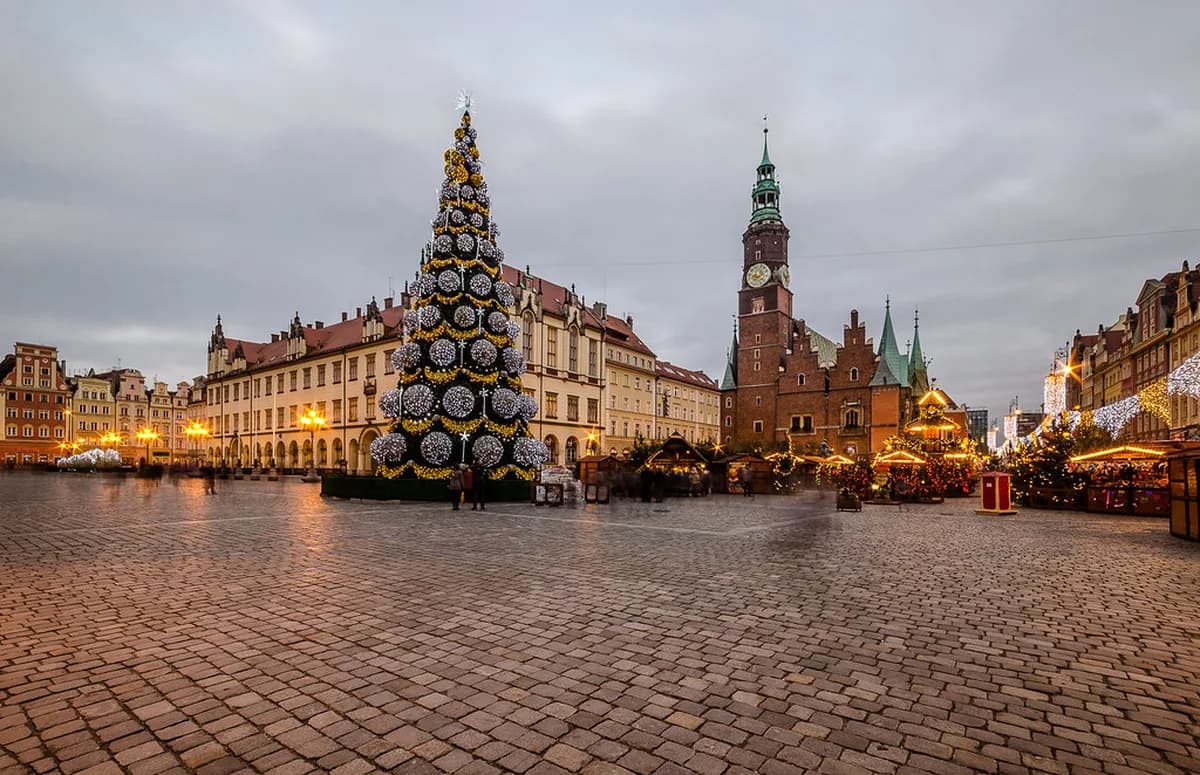
The Rynek — Wrocław's Main Market Square — is the undisputed center of the city and one of the largest medieval market squares in Europe. Measuring roughly 213 by 178 meters, it is vast enough that you need to turn a full circle to take it all in. The square dates to the mid-thirteenth century, when Wrocław was re-founded after the Mongol invasion on a new, planned grid. The resulting plaza became the commercial and civic core of Silesia's most important city.
The perimeter is lined with tall, narrow townhouses whose facades span an extraordinary range of styles. Gothic step-gables sit beside Renaissance loggias and Baroque ornamental plasterwork. Many of the houses were meticulously restored after wartime damage using historical records, giving them a freshness that belies their age. Walking the full perimeter of the square, pausing to look up at each roofline, takes about twenty minutes and reveals an open-air architecture textbook.
In the center of the Rynek stands the Old Town Hall, flanked by smaller freestanding buildings that once housed the fish market and apothecary. Outdoor cafe terraces fan out across the cobblestones from spring through autumn, filling the square with the smell of coffee and the hum of conversation. Early mornings before nine o'clock offer the best light for photography and the fewest crowds.
The Old Town Hall: Gothic Masterpiece of the Rynek
The Wrocław Old Town Hall is the architectural crown jewel of the Rynek. Construction stretched across more than two centuries, from the late thirteenth to the early sixteenth century, which explains why its southern facade blends Gothic tracery with Renaissance detailing in such a satisfying way. The eastern face is considered the finest: three tiers of blind arcading and ornate gables rise to a slender tower topped by a weathervane in the shape of a rooster.
Inside the building, the Museum of Bourgeois Art (Muzeum Mieszczańskie) occupies the historic rooms. The highlight is the Great Hall on the upper floor, a soaring space with a vaulted ceiling decorated with painted crests and stone carvings. Admission is modest and the collection — period furniture, paintings, decorative arts — gives real texture to the lives of the Silesian merchants who once governed this square.
The Old Town Hall astronomical clock on the south facade is a later addition, but the building's most dramatic feature is the Gothic cellar beneath it. The Piwnica Świdnicka, one of the oldest restaurants in Europe, has served beer and food in these vaulted cellars since 1273 — a perfect rainy-day lunch stop after the museum.
On the north side of the Old Town Hall, look for the pillory post — a remnant of the square's judicial past, where public punishments were once carried out. Beside it, a small bronze plaque marks where the city's medieval stocks once stood. These small details, easy to walk past, are what make a slow circuit of the building worthwhile.
The Hansel and Gretel Houses: Wrocław's Most Photographed Pair
Tucked into a narrow alley on the north side of the Old Town Hall, the so-called Hansel and Gretel houses are the most photographed spot in the entire Old Town. The name is informal — locals sometimes call them Jaś i Małgosia — and refers to two small Gothic houses linked by a Baroque gate spanning the passageway between them. The contrast between the tiny scale of these buildings and the grandeur of the surrounding Rynek makes the composition irresistible.
The houses date to the thirteenth and fourteenth centuries and were originally part of the Church of St. Elizabeth complex next door. Their current appearance, with pastel-painted walls and a delicate ornamental arch, comes from later restorations. The gate itself bears Latin inscriptions and a carved relief; the exact meaning of the motto is still debated, which adds a pleasing layer of mystery. Walk through the passage itself — the acoustics are unusual and the view looking back toward the square is lovely.
The street beyond the Hansel and Gretel houses leads to the base of St. Elizabeth's Church, where you will find one of the Old Town's lesser-spotted dwarfs crouching near the entrance. The whole corner rewards a slow fifteen-minute wander rather than a quick snapshot and move-on.
The Great Churches of the Old Town
Wrocław's Old Town holds an exceptional concentration of Gothic brick churches, and each one has a distinct character. St. Elizabeth's Church (Kościół św. Elżbiety), facing the northwest corner of the Rynek, is the most prominent. Its tower was intended to be the tallest in Silesia, but a series of fires and reconstruction efforts over the centuries left it incomplete by the original design. Climb it on a clear day for the finest panoramic view of the Rynek rooflines.
A short walk south, the Church of St. Dorothy, St. Stanislaus and St. Wenceslas offers a quieter Gothic interior with a well-preserved cloister alongside. This church belonged to the Franciscan Order and the scale feels more intimate than St. Elizabeth's. The cloister garden, open to visitors in the warmer months, is one of the more peaceful hidden spots in the Old Town.
On the southern edge of the central area, the Church of St. Mary Magdalene features two towers linked at the top by a Romanesque portal that was relocated here from a demolished monastery. The portal, dating to around 1280, is considered one of the finest pieces of Romanesque carving in Silesia and is easy to miss if you only look at the main facade. Walking around to the side where the portal is embedded reveals it fully.
All three major Old Town churches are free to enter, though a donation is welcomed. St. Elizabeth's tower charges a small fee for the climb and has limited capacity — arrive before midday on weekends to avoid queues. Photography inside churches is generally permitted without flash.
Salt Square (Plac Solny): Flowers, History and Merchant Life
Directly adjacent to the western side of the Rynek, Salt Square (Plac Solny) is a smaller, quieter plaza that locals tend to love more than visitors initially expect. It takes its name from the salt trade that dominated commerce here for centuries. Today the square is home to Wrocław's year-round flower market — vendors arrange buckets of fresh blooms across the cobblestones every day, giving the space a constant splash of colour regardless of the season.
The buildings around Plac Solny have a slightly more modest scale than the main Rynek facades, which makes the square feel almost intimate. At the centre stands a Neo-Gothic stock exchange building from the nineteenth century, now used as an events venue. The ground-floor cafes and wine bars along the eastern edge are popular with locals for an early evening drink, making this a better spot for people-watching than the more tourist-heavy Rynek terraces.
During the weeks leading up to Christmas, Plac Solny hosts a section of Wrocław's celebrated Christmas market — an extension of the main Rynek stalls. If you are visiting in late November or December, the combination of the flower stalls and the market lights makes the square feel particularly magical. The Wrocław Christmas market is one of the finest in Poland and Salt Square is an underrated part of it.
The Wrocław Dwarfs: An Old Town Treasure Hunt
One of the most distinctive and delightful features of the Old Town is the scattering of small bronze dwarf figurines across its pavements, doorsteps and window ledges. There are now well over four hundred dwarfs across the city, but the highest concentration sits within the Old Town, making a dwarf hunt an entertaining way to slow down and notice details you would otherwise stride past.
The dwarfs began as a political symbol in the 1980s, associated with the Orange Alternative movement that used humor to protest communist rule. After 1989, the city commissioned the first permanent bronze dwarf as a tribute to that spirit of gentle subversion. The collection has grown organically since, with each figure placed by local businesses, institutions or artists who commission them as a form of playful urban branding. Each dwarf has a name and a profession — the baker, the student, the tightrope walker — and finding them requires looking down as much as up.
For a thorough exploration of the figures, the dedicated Wrocław dwarfs guide maps the key clusters and explains the stories behind the most notable figures. Within the Old Town itself, look near the base of the Old Town Hall, along ul. Świdnicka, beside the Hansel and Gretel passage, and at the corners of Plac Solny — these are the most rewarding starting points.
The official Wrocław tourist app — published by the team behind visitwroclaw.eu — includes a dwarf map with GPS locations. A free paper dwarf map is available from the tourist information centre inside the Old Town Hall. Families with children find the hunt keeps the walk engaging for hours without any museum queuing.
Stare Jatki: The Medieval Butchers' Row
One block north of the Rynek, tucked between ul. Jatki and the Church of St. Elizabeth, lies one of the most atmospheric streets in the Old Town. Stare Jatki — the Old Butchers' Row — is a narrow Gothic lane that has existed in near-continuous commercial use since the thirteenth century. The original guild of butchers operated here for over five hundred years, and the low-arched medieval stalls still line both sides of the alley, their stone thresholds worn smooth by centuries of foot traffic.
What makes the street memorable today is a series of small bronze animal sculptures scattered across the cobblestones and hung from the eaves — a cockerel, a pig, a fish, a rabbit — placed as a tribute to the trades that once animated the lane. Children instinctively crouch to touch them, and the street doubles as an informal open-air gallery. The stalls are now occupied by art studios, jewellers and small craft shops, which means you can walk the full length in ten minutes or browse for considerably longer.
Stare Jatki is quieter than the main Rynek circuit and easy to miss without a deliberate detour. It is best visited mid-morning before the craft shops get busy. The lane connects at its northern end to a small square where a number of food kiosks sell zapiekanki — open-faced toasted baguettes that are the definitive Polish street-food snack and a good quick lunch if you are keeping the day light.
Cathedral Island and the Panorama of Racławice
Ostrów Tumski — Cathedral Island — lies a ten-minute walk north of the Rynek across the Oder bridges and is the oldest settled part of Wrocław. The island predates the medieval market town by centuries: the first fortified settlement here goes back to the ninth century, and the cathedral on its eastern tip has stood in some form since the tenth. Walking from the noise of the Rynek into the hushed, lamp-lit lanes of Ostrów Tumski feels like crossing into a different era entirely. It is the one extension of the Old Town that every visitor should make, even on a tight schedule.
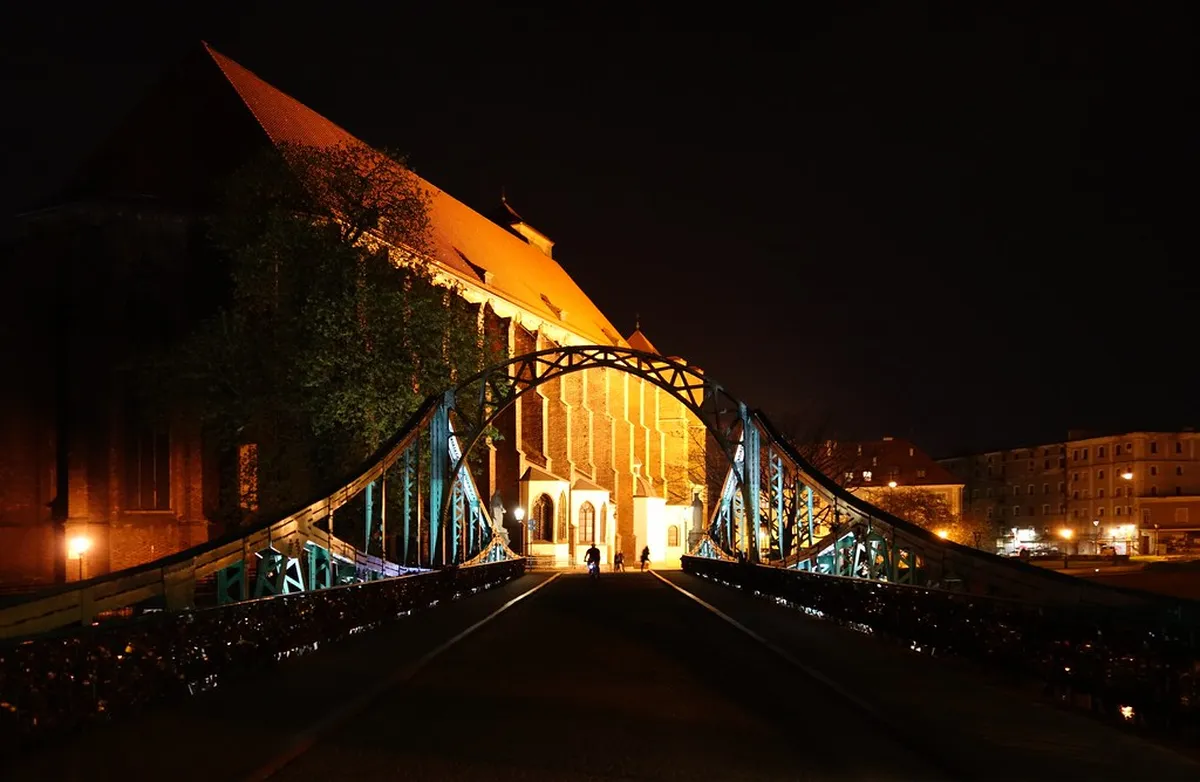
The centrepiece is the Gothic Cathedral of St. John the Baptist, whose twin spires define the Wrocław skyline when seen from the west. The cathedral's interior holds a remarkable collection of medieval chapels added over five centuries, including the Corpus Christi Chapel with its ornate Baroque altar. Outside, the Cathedral Bridge (Most Tumski) is lined with padlocks and offers the best single view back toward the city's spires at dusk. The lamplighter who lights the gas streetlamps on the bridge by hand each evening has become a minor Wrocław institution — the ceremony happens at sunset and takes about ten minutes.
A short walk from Cathedral Island, the Panorama of Racławice (Panorama Racławicka) on ul. Purkyniego is one of the most singular experiences the city offers. The painting is a vast 360-degree cyclorama — 15 metres high and 114 metres in circumference — depicting the 1794 Battle of Racławice in which Tadeusz Kościuszko's forces defeated the Russian army. Visitors stand on a central platform surrounded by the canvas, with sculpted foreground elements creating a startling illusion of depth. Entry requires a timed ticket (around 40 PLN in 2026); booking in advance is strongly advised on weekends and in summer because capacity is strictly controlled.
The Panorama of Racławice and the National Museum share a combined ticket that saves a few złoty. The museums are closed on Mondays. Cathedral Island itself is always accessible and freely walkable; only the cathedral interior charges a small entry fee for the tower.
A Walking Route Through the Old Town
The most logical way to cover the Old Town is a loose spiral outward from the Rynek center. Start at the Old Town Hall and spend twenty minutes examining its facades before crossing to the Hansel and Gretel passage. From there, enter St. Elizabeth's Church and climb the tower if conditions are good. This takes the first ninety minutes of the morning at a comfortable pace.
From St. Elizabeth's, head west to Plac Solny for a coffee at one of the square's pavement cafes. Then walk south along ul. Świdnicka toward St. Dorothy's Church, checking the pavement for dwarfs as you go. The cloister at St. Dorothy's is a good midmorning pause point. Continue east along ul. Świdnicka to reach the Church of St. Mary Magdalene and the Romanesque portal on its flank.
| Landmark | Approx. time needed | Entry fee |
|---|---|---|
| Rynek exterior circuit | 20 min | Free |
| Old Town Hall museum | 45–60 min | Low |
| Hansel and Gretel houses | 10 min | Free |
| St. Elizabeth's tower | 30 min | Low |
| Plac Solny flower market | 15 min | Free |
| St. Dorothy's cloister | 20 min | Free |
| St. Mary Magdalene portal | 15 min | Free |
After St. Mary Magdalene, loop back north to the Rynek via ul. Oławska, pausing to look down each side street. This brings you back to the square for lunch, having covered the main circuit in around three to three-and-a-half hours. Afternoon time is best kept for dwarf hunting, Cathedral Island (a ten-minute walk across the bridges) and a leisurely dinner.
Where to Eat and Drink in and Around the Old Town
The Rynek terraces are convenient and atmospheric, but they are the most expensive option in the city. For a better ratio of quality to price, step one or two streets back from the square. The streets behind the northern and eastern facades of the Rynek — particularly ul. Odrzańska and ul. Kuźnicza — have a denser concentration of independent cafes, milk bars and casual restaurants that locals actually use. The full breakdown of the best neighborhoods and restaurant picks is in our guide to where to eat in Wrocław.
For a sit-down lunch with genuine Silesian flavors, look for restaurants serving żurek (sour rye soup), gołąbki (stuffed cabbage rolls) and kluski śląskie (the distinctive ring-shaped potato dumplings that are a Silesian specialty rather than a Polish-wide dish). These appear on menus at traditional restaurants in the Old Town, usually at prices that are very reasonable by Western European standards.
Craft beer has become central to Wrocław's food and drink culture, and the Old Town area has a strong showing of independent brewpubs. Several are located in restored Gothic and Baroque cellars beneath the Rynek townhouses, which provides atmosphere to match the beer. For evening drinks, the streets around Plac Solny and north toward the river fill up from around six o'clock and stay lively well into the night. The Old Town is also close to the main Wrocław nightlife strip on and around ul. Świdnicka, an easy five-minute walk from the Rynek.
Practical Orientation and Tips for 2026
Wrocław's Old Town is fully pedestrianized in its core, which makes navigation easy on foot. The nearest tram stops are on the ring roads that surround the historic center — ul. Świdnicka to the south and ul. Piłsudskiego to the north deposit you within a two-minute walk of the Rynek. If you are planning beyond the Old Town, the getting around Wrocław page covers trams, buses and cycling in full detail.
Most Old Town sights are accessible year-round, but the experience changes significantly by season. Spring (April–May) and early autumn (September–October) offer mild weather, manageable crowds and the best light for photography. Summer is busier but the outdoor terraces are at their best. Winter, particularly around the Christmas market period in late November and December, transforms the Rynek into one of Poland's most spectacular seasonal scenes. If you are weighing when to come, the best time to visit Wrocław page has a month-by-month breakdown.
The official tourist information point is located inside the Old Town Hall on the Rynek. Staff there offer free city maps, dwarf maps and current event listings. English is spoken throughout, and Poland's national tourism portal poland.travel is a useful companion resource if Wrocław is one stop on a longer Polish itinerary. For visitors deciding how long to allocate to the city, the how many days in Wrocław guide recommends a minimum of two full days to cover the Old Town and Cathedral Island without rushing.
Frequently Asked Questions
How long does it take to walk around Wrocław Old Town?
A focused circuit of the main Rynek and the streets immediately around it takes about ninety minutes at a brisk pace. Adding the interior visits to the Old Town Hall museum, St. Elizabeth's tower and the churches stretches the morning to around three to four hours. A full Old Town day including dwarf hunting and a sit-down lunch comfortably fills six to seven hours.
What are the Hansel and Gretel houses in Wrocław?
The Hansel and Gretel houses are two small Gothic buildings linked by a Baroque ornamental gate on the north side of the Old Town Hall. They were historically part of the Church of St. Elizabeth complex. The nickname comes from their fairy-tale scale compared to the grand surrounding townhouses. The passage between them is freely accessible at all times.
Where do I start looking for the Wrocław dwarfs in the Old Town?
The best starting points are the base of the Old Town Hall, the Hansel and Gretel passage, and the corners of Plac Solny. The official tourist information centre inside the Old Town Hall gives out free dwarf maps. The city's tourist app also includes GPS locations for all registered dwarfs across the center.
Is the Wrocław Old Town suitable for a day trip?
Yes, the Old Town is compact enough to cover in a single day if you keep the focus on the Rynek, Plac Solny and the main churches. Day trippers arriving by train have direct access via tram from the central station in around five minutes. For a fuller picture of what is possible in a short stay, the Wrocław two-day itinerary page maps out a realistic day-trip schedule.
Wrocław's Old Town rewards every type of traveler — the history enthusiast who wants to decode the layers of Gothic, Renaissance and Baroque architecture, the casual visitor who simply wants to sit on the Rynek terrace with a beer in the afternoon sun, and the family who discovers that a bronze dwarf hunt turns a city walk into an adventure. The scale is human, the sights are concentrated, and the atmosphere is genuinely welcoming.
Start with the Rynek and the Old Town Hall, follow your curiosity into the side streets and churches, and let the dwarfs slow you down. If you are still planning the wider trip, the full guide to things to do in Wrocław covers the city well beyond the Old Town boundaries. Safe and curious travels through one of Poland's finest city centers.
You might also like


Continue reading
More guides you'll find useful