
Poland 10-Day Itinerary: The Ultimate First-Timer's Route & Map
Last updated July 2026, this poland 10 day itinerary strings together Warsaw, Gdańsk, and Kraków into a single high-efficiency "Golden Triangle" route built for first-time visitors who want history, culture, and city energy without wasted transit days. Along the way you'll weigh real decisions - Malbork Castle or more time in Gdańsk, Auschwitz-Birkenau or Wieliczka Salt Mine, Wrocław's architecture or the Tatra Mountains around Zakopane - so every day earns its place on the route. Expect fast PKP Intercity trains between hubs, a short Toruń stopover, and practical notes on cost, timing, and connectivity for a 2026 trip.
Poland 10-Day Itinerary at a Glance
This poland 10 day itinerary follows a "Golden Triangle" route: two days in Warsaw, two days in Gdańsk and the Baltic coast, a short stopover in Toruń, three days based in Kraków, and a final two-day choice between Wrocław and Zakopane. The sequence works because it moves in one direction rather than backtracking - Warsaw and Kraków both have major international airports, and PKP Intercity's high-speed EIP (Express Intercity Premium) "Pendolino" trains link the northern and southern legs directly, so time goes toward sightseeing rather than repeat transfers.
| Days | Base | Highlights | Getting there |
|---|---|---|---|
| Days 1-2 | Warsaw | Old Town, Royal Castle (around 30 PLN entry), POLIN Museum | Warsaw Chopin Airport or Warszawa Centralna station |
| Days 3-4 | Gdańsk | Długi Targ, WWII Museum, European Solidarity Centre, optional Malbork Castle | About 2.5-hour PKP Intercity train from Warsaw |
| Day 5 | Toruń | Gothic Old Town, Copernicus House, Leaning Tower | En route stop, roughly 260 km from Warsaw |
| Days 6-8 | Kraków | Wawel Castle, Rynek Główny, Auschwitz-Birkenau, Wieliczka Salt Mine | Onward train connection south |
| Days 9-10 | Wrocław or Zakopane | Market Square architecture and gnomes, or Tatra Mountains hiking | Choose by culture vs. nature preference |
Your Day-by-Day Poland Itinerary
Use this sequence as the backbone of the trip, then adjust individual days based on the decision points called out below.
The itinerary intentionally builds in three choice points—Malbork versus deeper Gdańsk, Auschwitz-Birkenau versus Kazimierz, Wrocław versus Zakopane—each presented as a genuine either-or, so travelers can tailor the trip by interests, stamina, and emotional weight.

- Day 1 - Arrive in Warsaw: Settle in near the Old Town, walk Castle Square, and tour the Royal Castle, where standard entry runs around 30 PLN (traditionally free on Wednesdays; the castle is typically closed Mondays, so confirm current 2026 hours before you go).
- Day 2 - Warsaw's deeper history: Spend the morning at the POLIN Museum of the History of Polish Jews and the nearby Monument to the Ghetto Heroes, then unwind in Łazienki Park, home to free, 0 PLN outdoor Chopin concerts on Sunday afternoons between May and September.
- Day 3 - Warsaw to Gdańsk: Take the PKP Intercity train from Warszawa Centralna to Gdańsk (about 2.5 hours), then explore Długi Targ, the Long Market, and the Gdańsk WWII Museum.
- Day 4 - Gdańsk decision day: Weigh a half-day trip to Malbork Castle, the largest brick castle in the world, against a slower second day inside Gdańsk visiting the European Solidarity Centre and the waterfront.
- Day 5 - Toruń stopover: Break the journey south in Toruń, about 260 km from Warsaw, for four to six hours among Gothic brick churches, the Old Town Market Square, and the Copernicus House; a full overnight isn't necessary on a 10-day pace.
- Day 6 - Arrive in Kraków: Settle into the historic core, tour Wawel Castle, and spend the evening around Rynek Główny, the Main Market Square.
- Day 7 - Auschwitz-Birkenau or Kazimierz: Visit the Auschwitz-Birkenau Memorial and Museum if the timing and emotional weight suit the trip (book well ahead), or spend the day in the Kazimierz Jewish Quarter for a lighter pace instead.
- Day 8 - Wieliczka Salt Mine: Descend into the underground chambers and chapels of the Wieliczka Salt Mine, and note that the standard route involves stairs and sustained walking, so check accessibility details before booking.
- Day 9 - Choose Wrocław or Zakopane: Head to Wrocław for market-square architecture, the city's gnome statues, and the Panorama of the Battle of Racławice, or to Zakopane for the Tatra Mountains if hiking outranks city culture on this trip.
- Day 10 - Final day and departure: Finish sightseeing in Wrocław or Zakopane, then route back toward Kraków or Warsaw for the flight home.
Logistics: Getting Around Poland and Staying Connected
PKP Intercity trains, not rental cars, do most of the work on this route. EIP (Express Intercity Premium) "Pendolino" services connect Warsaw, Gdańsk, and Kraków at speed and require a seat reservation, while regional trains cover shorter hops like the Toruń stopover. A car only earns its cost on rural stretches such as the road toward Zakopane; inside the Golden Triangle, driving mostly adds parking stress without saving time. Book PKP tickets around 30 days ahead when possible to catch discounted fares, and note that Warszawa Centralna and Warszawa Zachodnia are two different Warsaw stations - confirm which one a ticket departs from, since mixing them up is one of the most common planning mistakes on this route. Staying connected matters just as much as staying on schedule: sorting out local eSIM options before departure keeps train times, maps, and museum bookings accessible without hunting for station Wi-Fi. On the language side, English proficiency in Poland is generally strong in Warsaw, Gdańsk, and Kraków's tourist-facing businesses, though a handful of Polish phrases still help in smaller stops like Toruń.
- Auschwitz-Birkenau: reserve entry roughly three months ahead, especially for summer dates.
- PKP Intercity trains: book about 30 days out for the best discounted fares.
- Wieliczka Salt Mine and Malbork Castle: a few weeks ahead is usually enough outside peak summer.
Warsaw: Old Town, the Royal Castle, and POLIN Museum
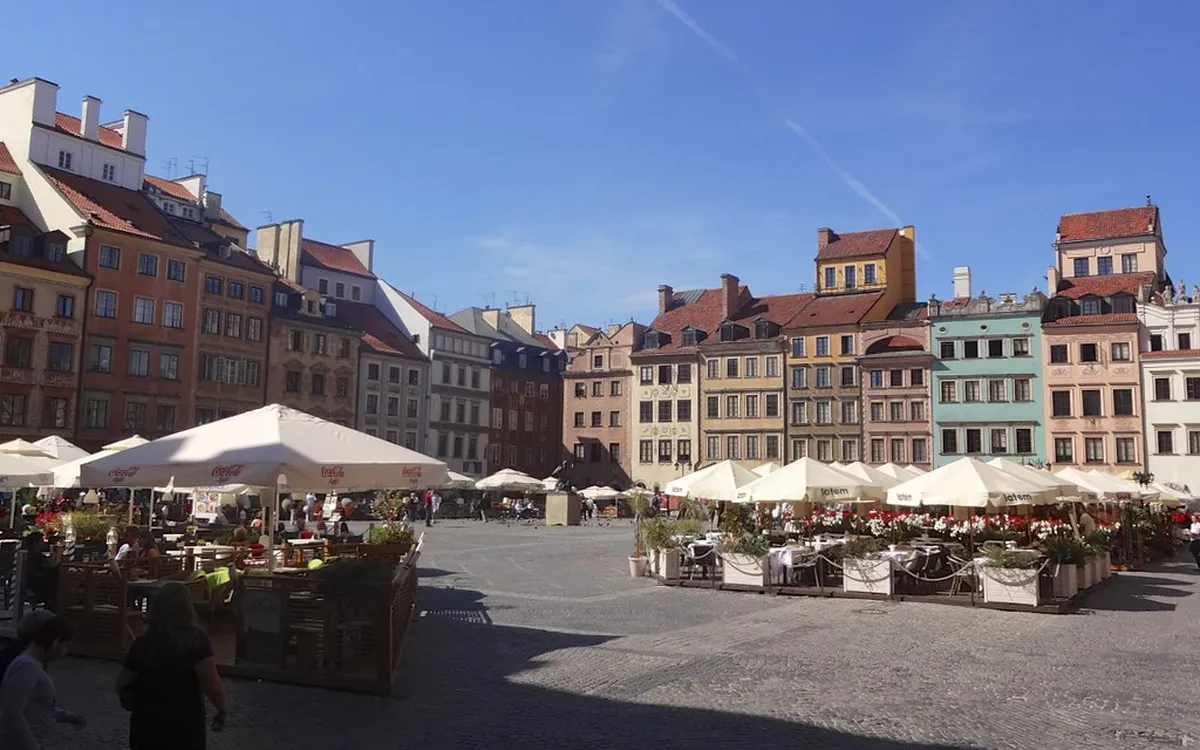
Warsaw anchors the first two days of this itinerary, and most travelers arrive either by air through Warsaw Chopin Airport or by rail into Warszawa Centralna. Base the first afternoon around the Old Town Market Place and Castle Square, where the Royal Castle - the residence that replaced Kraków's Wawel Castle as the seat of Polish kings - charges around 30 PLN for standard entry, is historically free on Wednesdays, and is typically closed on Mondays, so double-check current 2026 opening hours before planning around it. Save the rebuilt townhouses and the Royal Way, the roughly two-mile stretch past the Presidential Palace and the Church of the Holy Cross, for an unhurried walk toward dinner. Day two turns toward twentieth-century history: the POLIN Museum of the History of Polish Jews traces Jewish life in Poland from the Middle Ages through the Holocaust and the postwar years, and the Monument to the Ghetto Heroes stands just across from it, built from material salvaged from the Warsaw Ghetto. Close the day in Łazienki Park, where the Chopin Monument and free, 0 PLN open-air piano concerts on Sunday afternoons between May and September give this history-heavy stretch a lighter finish.
Gdańsk and the Baltic Coast: The Malbork Castle Decision
The PKP Intercity train from Warszawa Centralna to Gdańsk takes about 2.5 hours, trading the capital's density for Baltic waterfront and Hanseatic architecture. Długi Targ, the Long Market, is the natural first stop, flanked by merchant-era facades, and the Gdańsk WWII Museum and European Solidarity Centre both anchor the city's twentieth-century story. Day four is a genuine decision point rather than a default add-on: Malbork Castle, the largest brick castle in the world, is a compelling half-day trip, but it does eat into time otherwise spent inside Gdańsk itself. Travelers prioritizing depth over breadth can skip Malbork and instead slow down around the Solidarity Centre and the waterfront; travelers who want the single most dramatic structure on the route should make the trip.
Toruń: The Gingerbread Stopover Between Coast and South
Toruń sits roughly 260 km from Warsaw and works best as a four-to-six-hour stopover between the Baltic coast and the south, not an overnight, if the itinerary is to hold a 10-day pace. It's the birthplace of Nicolaus Copernicus, a UNESCO-listed Gothic old town, and a base for a walk through the Old Town Market Square, the Leaning Tower, and the Gothic-style Copernicus House, where the astronomer was born in 1473. Its brick churches and preserved city fortifications reward a focused half-day far more than a rushed full one.
Kraków: Wawel Castle, Auschwitz-Birkenau, and Wieliczka Salt Mine
Kraków gets three full days in this itinerary, the most of any stop, starting with Wawel Castle and Rynek Główny, the Main Market Square, which anchors Kazimierz-adjacent evenings in the Jewish Quarter. Auschwitz-Birkenau is the itinerary's heaviest day and deserves deliberate planning rather than a same-week booking attempt: reserve entry around three months ahead, particularly for summer travel, and treat the visit as optional if the emotional weight or a tight booking window doesn't fit the trip - a day in Kazimierz is a reasonable substitute for travelers who choose to skip it. The Wieliczka Salt Mine, an underground network of chambers, chapels, and sculptures carved from salt, is the other major Kraków-area day trip. It's touristy by nature - the crowds are part of the experience - so travelers weighing "too touristy" against "worth it" should factor in that the standard route involves stairs and sustained underground walking, which matters for anyone with mobility considerations.
Day 9-10: Choosing Between Wrocław and Zakopane
The final two days split into two genuinely different trips. Wrocław rewards travelers who want more city culture: market-square architecture, the city's scattered gnome statues, and the Panorama of the Battle of Racławice, a monumental nineteenth-century painting displayed in the round. Zakopane, gateway to the Tatra Mountains, is worth the longer transit only for travelers who'd rather hike than sightsee - it involves more travel time than Wrocław and rewards a genuine interest in mountain scenery over museums and old towns. Neither choice is wrong; the decision comes down to whether the last stretch of the trip should feel urban or alpine. If you want to see how each option changes the rest of the route, our Poland itinerary planner rebuilds the ten days around your own interests, pace and departure airport.
Essential Poland Travel Practicalities
Timing this trip well starts with weather: spring and early autumn balance mild conditions against summer's peak crowds at Auschwitz-Birkenau and Wawel Castle, and the month-by-month weather guide is worth checking before locking in 2026 dates, especially for the Zakopane leg, where mountain weather shifts faster than city forecasts. Poland's currency is the złoty (PLN), and cards are widely accepted in Warsaw, Gdańsk, and Kraków, though smaller stops like Toruń and traditional milk bars still favor cash for quick transactions - review tipping etiquette in Poland before the trip so restaurant and tour tips feel natural rather than improvised. Traditional milk bars, bary mleczne, are one of the best-value stops on this route and run on their own unwritten rules. For broader guidance on safety, water, and etiquette, the essential Poland travel tips hub rounds out the planning picture for this route.
Smaller stops like Toruń reward a brief visit (four to six hours) rather than overnight; Polish phrases help there, and traditional milk bars, despite their unwritten counter-ordering and self-serve rules, rank among the best-value meals on the route.
- Scan the menu board, usually posted only in Polish, and ask staff for a quick translation if needed.
- Order and pay at the counter first, before sitting down.
- Take the numbered receipt or tray to a self-serve table once food is ready.
- Bus the tray back to the counter when finished, since table service isn't part of the format.
Safety, Tap Water, and City Etiquette
Poland is generally straightforward for first-time visitors, especially on this Warsaw, Gdańsk, Toruń, Kraków, and Wrocław route, but a few habits make the trip smoother. Tap water is safe to drink in major cities, so a refillable bottle works well for train days and long museum visits. At stations such as Warszawa Centralna, Gdańsk Główny, and Kraków Główny, keep bags zipped and close in crowded concourses, ticket halls, and tram stops.
- Use marked pedestrian crossings, let trams pass before stepping into the street, keep voices low inside churches and memorial sites, and validate paper transit tickets where local systems require it before riding.
At Auschwitz-Birkenau and POLIN, treat photography rules and quiet areas seriously; these are memorial and historical spaces, not only tourist attractions. In milk bars and casual restaurants, clearing your tray or returning dishes when asked is normal rather than rude.
Frequently Asked Questions
Is 10 days enough time for Poland?
Ten days is enough to cover the Golden Triangle route in this guide - Warsaw, Gdańsk, Toruń, and Kraków - at a pace that allows two to three days per major city rather than rushed overnight stops. Extending to Wrocław or Zakopane at the end uses the full 10 days without requiring a return trip to any earlier stop.
Should the last two days go to Wrocław or Zakopane?
Choose Wrocław for more city architecture, gnome statues, and museum time, and choose Zakopane for the Tatra Mountains if hiking matters more than sightseeing on this trip. Zakopane also involves longer transit, so it suits travelers with more flexibility on the final days.
Do you need a rental car for this itinerary?
No - PKP Intercity trains, including the high-speed EIP Pendolino services, connect Warsaw, Gdańsk, and Kraków efficiently, and a car mostly adds parking hassle inside those cities. A car becomes useful only for rural stretches such as the approach to Zakopane.
How far ahead should Auschwitz-Birkenau tickets be booked?
Aim to reserve Auschwitz-Birkenau entry around three months ahead, especially for summer travel dates, since slots are limited and fill early. If the booking window has closed or the visit doesn't fit the trip emotionally, a day in Kazimierz is a reasonable alternative.
Is Wieliczka Salt Mine worth visiting alongside Auschwitz?
Wieliczka Salt Mine and Auschwitz-Birkenau serve very different purposes - Wieliczka is a touristy but genuinely striking underground network of carved chambers, while Auschwitz is a memorial site - so pairing them across two separate Kraków days, rather than the same day, keeps the pacing more comfortable. Confirm accessibility needs for Wieliczka in advance, since the standard tour includes stairs and sustained walking underground.
Use this guide
Make the next planning decision
These tools use the same Poland-specific context, but turn it into an answer for your trip.
You might also like


Continue reading
More guides you'll find useful