
Ogrodzieniec Castle and the Eagle's Nest Trail: A 2026 Visitor Guide
Last updated July 2026, Ogrodzieniec Castle is the largest and most photographed ruin on Poland's Eagle's Nest Trail, rising on a limestone outcrop above the village of Podzamcze in the Polish Jurassic Highland. Built in the 14th century and later reshaped into a Renaissance residence by the Boner family, the fortress anchors a roughly 160-km chain of medieval strongholds commissioned under King Casimir the Great. This guide covers driving and transit routes from Kraków and Katowice, the ruin's standout chambers, and how the site fits into a wider Jurassic Highland day trip, including its recent role as a Witcher filming location.
Ogrodzieniec Castle on the Eagle's Nest Trail: Quick Facts
Ogrodzieniec Castle sits above Podzamcze, a village in the Silesian Voivodeship inside the Jura Krakowsko-Częstochowska, Poland's Jurassic Highland. Limestone cliffs called monadnocks made this ridge a natural defensive perch centuries before builders raised the current fortress. The facts below cover location, era, and travel times, so you can plan a visit around a Kraków or Katowice base. The ruin's dramatic profile above the highland also makes it one of the most-photographed stops in the region.
- Location: Podzamcze village, Silesian Voivodeship, in the Polish Jurassic Highland
- Founded: 14th century as a royal fortress
- Transformed: 16th century into a Renaissance residence by the Boner family
- From Kraków: about 1 hour by car
- From Katowice: about 50 minutes by car
- Trail role: largest ruin on the roughly 160-km Eagle's Nest Trail (Szlak Orlich Gniazd)
What Is the Eagle's Nest Trail (Szlak Orlich Gniazd)?
King Casimir the Great commissioned this defensive line in the 14th century to guard the route between Kraków and Częstochowa. Engineers set each fortress on a limestone monadnock, exploiting the sheer rock faces of the Jurassic Highland for elevation and natural walls. That vertical siting gave the network its nickname, since the strongholds seem to perch above the surrounding farmland like nests. Today the route is known in Polish as the Szlak Orlich Gniazd, and it draws hikers, cyclists, and castle collectors chasing the full chain rather than a single stop. Ogrodzieniec's scale rivals Książ Castle in Lower Silesia, though Książ sits outside the Eagle's Nest chain and reflects a different, later building era. Where Niedzica Castle above Czorsztyn Lake leaned on mountain terrain and water for defense, Ogrodzieniec's builders relied on bare limestone cliffs instead. Both castles reward a stop, but only Ogrodzieniec carries the Eagle's Nest name and its limestone-nest defensive logic.
History: From Royal Fortress to Romantic Ruin
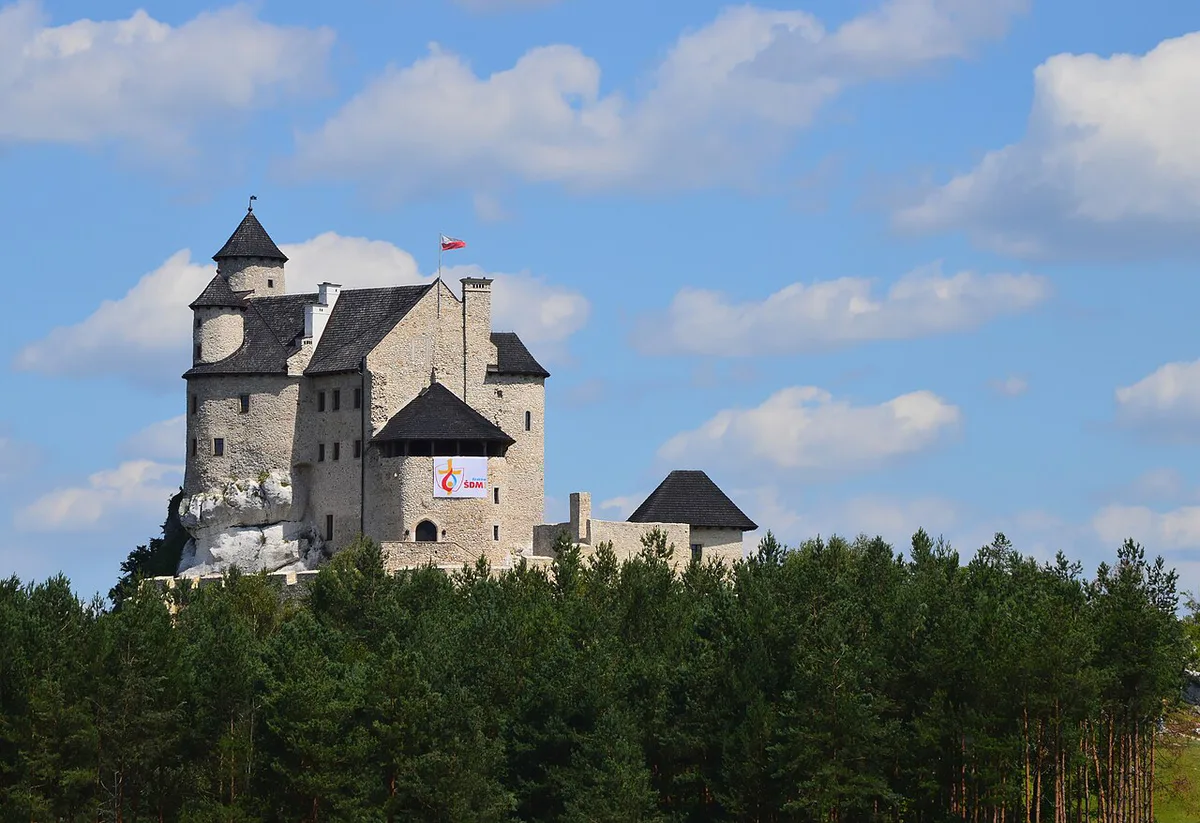
Construction began in the 14th century under royal authority, replacing an earlier wooden stronghold on the same limestone ridge. In the 16th century, the Boner family, wealthy bankers and traders with ties to the royal court, rebuilt the fortress into an arcaded Renaissance residence. Their renovation added decorative details uncommon among strictly military strongholds elsewhere on the trail. That prosperity ended during the Swedish Deluge of 1655, when invading forces damaged the castle and cut off its income from surrounding estates. The site was never fully rebuilt afterward and stood abandoned for generations. Restorers later chose to stabilize rather than reconstruct the walls, preserving Ogrodzieniec as a permanent ruin instead of a rebuilt palace. That decision is why the castle today reads as raw and weathered rather than polished, unlike some restored Eagle's Nest neighbors. Visitors today can still trace the outline of the Renaissance courtyard alongside older, plainer defensive walls from the original fortress.
- 14th century: royal fortress founded on the limestone ridge
- 16th century: Boner family Renaissance rebuild adds an arcaded courtyard
- 1655: the Swedish Deluge damages the castle and estate income collapses
- 20th century onward: stabilization work preserves the site as a permanent ruin
Planning Your Visit: Getting to Ogrodzieniec Castle
Most visitors reach the castle from Kraków or Katowice, both within about an hour by car, making it a practical day trip from either base. Independent travelers without a car can combine train and bus, though journey times run longer and are worth checking for a same-day return. Photographers get the best light on the limestone walls in the early morning, before weekend tour groups and school groups arrive. Weekday visits generally mean shorter lines at the ticket booth and quieter courtyards for photos. Combine the stop with nearby Jurassic Highland viewpoints if driving, since several sit within a short detour of the main road. Check the official Zamek Ogrodzieniec website ahead of your visit, since seasonal hours shift and knights' tournament events occasionally close sections of the grounds.
- By car from Kraków: about 1 hour
- By car from Katowice: about 50 minutes
- By train: regional service to Zawiercie, then a local bus or private minivan to Podzamcze
- Best light: early morning, for golden-hour photos on the limestone walls
- Best timing: weekdays avoid the heaviest weekend crowds
- Tickets: confirm current hours and prices on the official site before you go
Exploring the Ruins: Must-See Features
The ruin rewards slow exploration, with several chambers and towers worth building time around. Climb toward the Curma Tower for the widest views over the Jurassic Highland's rolling limestone country. Below ground, the Torture Chamber, known locally as the Katownia, and the old Armoury hold exhibits tied to the castle's defensive history. The arcaded courtyard added during the Boner renovation is still visible, a rare decorative touch among otherwise military architecture. Local folklore adds the legend of the Black Dog of Ogrodzieniec, said to guard treasure hidden somewhere in the ruins. A short walk away, Birów Mountain (Góra Birów) holds a reconstructed Slavic-era wooden settlement worth combining with the castle visit, particularly if time allows for both stops in one afternoon.
- Curma Tower: highest viewpoint over the Jurassic Highland
- Katownia (Torture Chamber): exhibits on medieval punishment and defense
- Armoury: displays tied to the castle's military history
- Black Dog of Ogrodzieniec: local legend of a treasure-guarding spirit
- Birów Mountain (Góra Birów): reconstructed Slavic wooden settlement nearby
The Witcher and Cinema Connection at Ogrodzieniec
Ogrodzieniec's jagged silhouette has drawn filmmakers for decades, long before streaming made it internationally recognizable. Andrzej Wajda shot scenes for The Revenge (Zemsta) among the ruins in the early 2000s, using the crumbling walls for period atmosphere. More recently, Netflix's The Witcher used the castle's stone walls and towers for the Battle of Sodden Hill sequence. The ruin's weathered limestone and jagged roofline suit the show's dark fantasy look without extra set dressing. For travelers chasing Witcher filming locations across Poland, Ogrodzieniec remains the most recognizable stop on the list. Even so, the site's centuries of documented history stand on their own, independent of any on-screen appearance.
Active Travel: Hiking and Biking the Eagle's Nest Trail
Ogrodzieniec works as a waypoint, not just a standalone stop, for travelers walking or cycling the wider trail network. The Eagle's Nest Trail runs roughly 160 km between the Kraków and Częstochowa areas, linking a string of ruined and restored strongholds. Expect limestone outcrops, exposed rocky sections, and stretches of loose sandy path, so pack sturdy footwear rather than city shoes. Terrain shifts often enough that a route planned for cycling should mix road stretches with off-road sections. Trail signage along the route marks distances between strongholds, useful for pacing a multi-day itinerary. Multi-day hikers often break the route into two or three stages, using towns like Zawiercie as overnight bases. Travelers building a longer look at Poland's defensive architecture across eras can extend the theme with this Poland's WWII history guide, which traces fortification styles from medieval eagle's nests to 20th-century defenses. Sites such as Westerplatte in Gdańsk carry that defensive story into 1939, on the opposite end of the country.
The Eagle's Nest Trail's strongholds were sited on limestone monadnocks for medieval defense. That strategic positioning created the rocky, uneven terrain modern hikers encounter today, explaining why sturdy footwear is essential across the 160-km trail or any multi-day stage.
Ogrodzieniec vs Other Polish Castles: Which One Fits Your Trip
Ogrodzieniec's appeal is its rawness: a permanent ruin left largely as the Swedish Deluge and centuries of weather left it. That differs sharply from the manicured, part-furnished interiors of Kórnik Castle near Poznań, a 19th-century remodel set among formal grounds and an arboretum. Restored properties suit travelers who want guided rooms and curated collections rather than open ruins. If a single day in the region allows only one stop, choose Ogrodzieniec for ruin photography, the Eagle's Nest Trail context, and Witcher-related sites. Choose a restored property instead if furnished interiors and guided tours matter more than atmosphere and open-air exploration.
The preservation choice to keep Ogrodzieniec as a permanent ruin created the weathered aesthetic that attracts history travelers and filmmakers like Netflix for Witcher scenes. This raw authenticity distinguishes it from restored castles, making it ideal for atmospheric exploration over guided tours.
| Castle | Style | Setting | Best For |
|---|---|---|---|
| Ogrodzieniec | Permanent limestone ruin | Jurassic Highland outcrop, Podzamcze | Ruin photography, Witcher fans, day trips from Kraków |
| Książ Castle | Restored, part-furnished | Wałbrzych hills, Lower Silesia | Guided interiors, WWII tunnel history |
| Niedzica Castle | Restored hilltop fortress | Czorsztyn Lake shoreline | Lake views, mountain scenery |
| Kórnik Castle | Furnished 19th-century remodel | Near Poznań, Greater Poland | Furnished interiors, arboretum grounds |
Is Ogrodzieniec Castle Worth the Trip?
Ogrodzieniec earns its place as the Eagle's Nest Trail's centerpiece through scale, history, and an unpolished ruin atmosphere few restored castles match. It rewards a half-day stop beyond Kraków's Old Town, reachable by a short drive or as a stage on the wider trail. History travelers get the Boner-era architecture and the Swedish Deluge story; pop-culture fans get a recognizable Witcher backdrop; hikers get a waypoint on a 160-km network. Pair the visit with nearby stretches of the Jurassic Highland, and budget extra time if the trail's other strongholds interest you too. Whatever draws the visit, Ogrodzieniec is the stop that ties the trail's history, geology, and pop-culture appeal together.
Nearby Eagle's Nest Trail Stops to Pair With Ogrodzieniec
Ogrodzieniec is easiest to understand when paired with one or two neighboring Eagle's Nest sites. Drivers coming from Kraków can add Pieskowa Skała Castle in Ojców National Park, then continue toward Rabsztyn near Olkusz before reaching Podzamcze. That route shows how the trail shifts from wooded valleys to exposed limestone ridges.
Travelers starting from Katowice or Zawiercie usually have a cleaner day by focusing on Ogrodzieniec, then heading north toward Mirów and Bobolice. Those two castles sit close together and give a compact comparison with Ogrodzieniec's larger ruin.
- Pieskowa Skała: restored castle above the Prądnik Valley, near the Hercules Club limestone stack.
- Rabsztyn: smaller ruin near Olkusz, useful on a Kraków-to-Podzamcze driving route.
- Mirów and Bobolice: paired Jurassic Highland castles north of Ogrodzieniec, best by car.
Without a car, keep the plan simple. Visit Ogrodzieniec from Zawiercie and save the wider trail for a separate hiking or cycling stage.
For trip-planning details, see Poland - Wikivoyage and Poland - Wikipedia.
Frequently Asked Questions
How much time should you plan for Ogrodzieniec Castle?
Budget 2 to 3 hours to cover the towers, underground chambers, and viewpoints without rushing. Add extra time if you also plan to walk up to Birów Mountain nearby, since the two sites pair well in one afternoon.
Is Ogrodzieniec Castle dog-friendly?
Pet policies at Polish castle-ruin sites vary by season and by area of the grounds. Confirm current rules on the official Zamek Ogrodzieniec website before bringing a dog, especially if you plan to enter interior chambers and towers.
Can you visit Ogrodzieniec Castle at night?
Standard visiting hours are daytime, but the site runs seasonal Ghost Nights events after dark. Check the official event calendar for current dates and ticket details, since these evening openings are not scheduled year-round.
Is Ogrodzieniec Castle accessible for visitors with limited mobility?
Much of the site sits on uneven limestone terrain, with steep, narrow stairs inside the towers and chambers. Full wheelchair access is difficult across most of the ruin; contact the castle in advance to ask about accessible routes.
How do you get to Ogrodzieniec Castle without a car?
Take a regional train to Zawiercie, then a local bus or private minivan on to Podzamcze. Confirm current timetables locally before you travel, since regional bus schedules can change by season and by operator.
What's the closest town to Ogrodzieniec Castle for an overnight stay?
Zawiercie is the nearest town with train service and traveler accommodations. Kraków also works as an overnight base, given the roughly one-hour drive back to the city.
You might also like



Continue reading
More guides you'll find useful