Branicki Palace Białystok: A Visitor's Guide to Poland's Versailles
Last updated July 2026, this guide to Branicki Palace Białystok covers the two official tour routes, current museum hours, and the free garden areas many visitors skip. The 18th-century Baroque residence anchors central Białystok and doubles as a working campus of the Medical University of Białystok, so a same-day plan has to account for both roles. Expect concrete ticket prices, booking rules, and garden details below, not general scene-setting.
Branicki Palace Białystok: What to Know Before You Go
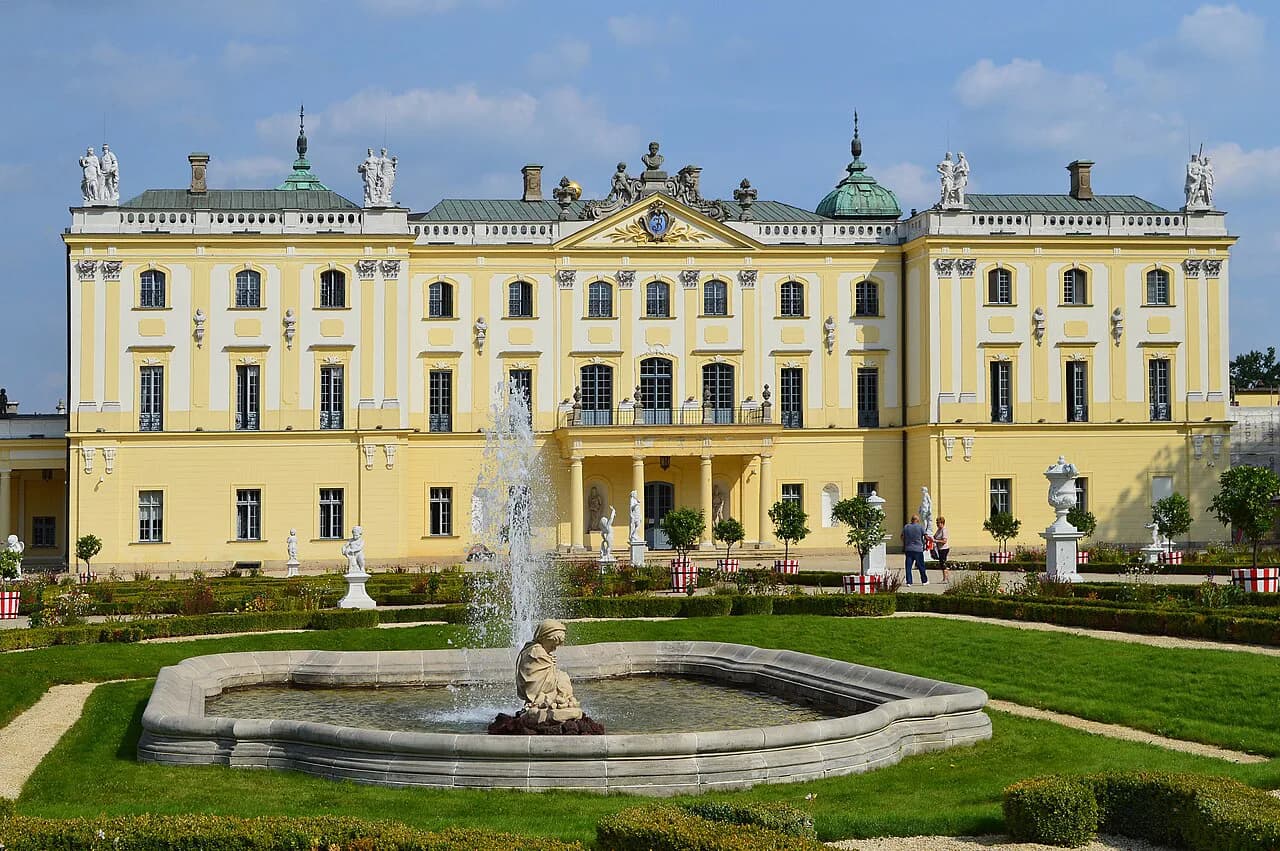
Branicki Palace sits at Jana Kilinskiego 1 in central Białystok, and it doubles as a functioning campus of the Medical University of Białystok (UMB). Locals and 18th-century visitors alike called the complex the Versailles of Poland, a nickname tied to Count Jan Klemens Branicki's ambition to rival Warsaw's Wilanów Palace. Because a university now occupies the building, access to certain rooms depends on the academic calendar rather than a fixed museum schedule. Its right wing houses the Museum of the History of Medicine and Pharmacy, the anchor for most interior visits. Outside, the Baroque gardens and courtyards require no ticket at all.
Route I vs Route II: Choosing Your Tour
Two ticketed routes cover the palace interior. Picking the right one depends on available time and interest in medical history. Route I runs about 90 minutes and includes the multimedia exhibit in the 17th-century cellars, the Museum of the History of Medicine and Pharmacy, and the representative interiors when the university schedule allows access. Its shorter counterpart, Route II, covers the same cellar exhibit and medical museum in about 60 minutes, but skips the representative interiors. A guide is included in both ticket prices, and individual visitors book through the museum office rather than an on-site walk-up counter. Pick Route I when the representative interiors are open and there's a full 90 minutes to spend. Pick Route II for a faster visit focused on the medical history collection alone.
Route I takes about 90 minutes but may be shortened if the university blocks access to representative interiors on your visit day.
| Detail | Route I | Route II |
|---|---|---|
| Duration | About 90 minutes | About 60 minutes |
| Includes | Cellar multimedia exhibit, medicine and pharmacy museum, WWI-era palace history, garden history, and representative interiors when available | Cellar multimedia exhibit, medicine and pharmacy museum, WWI-era palace history, and garden history |
| Normal ticket | 35 PLN | 30 PLN |
| Reduced ticket | 25 PLN | 20 PLN |
The Palace Grounds: What's Free to Explore
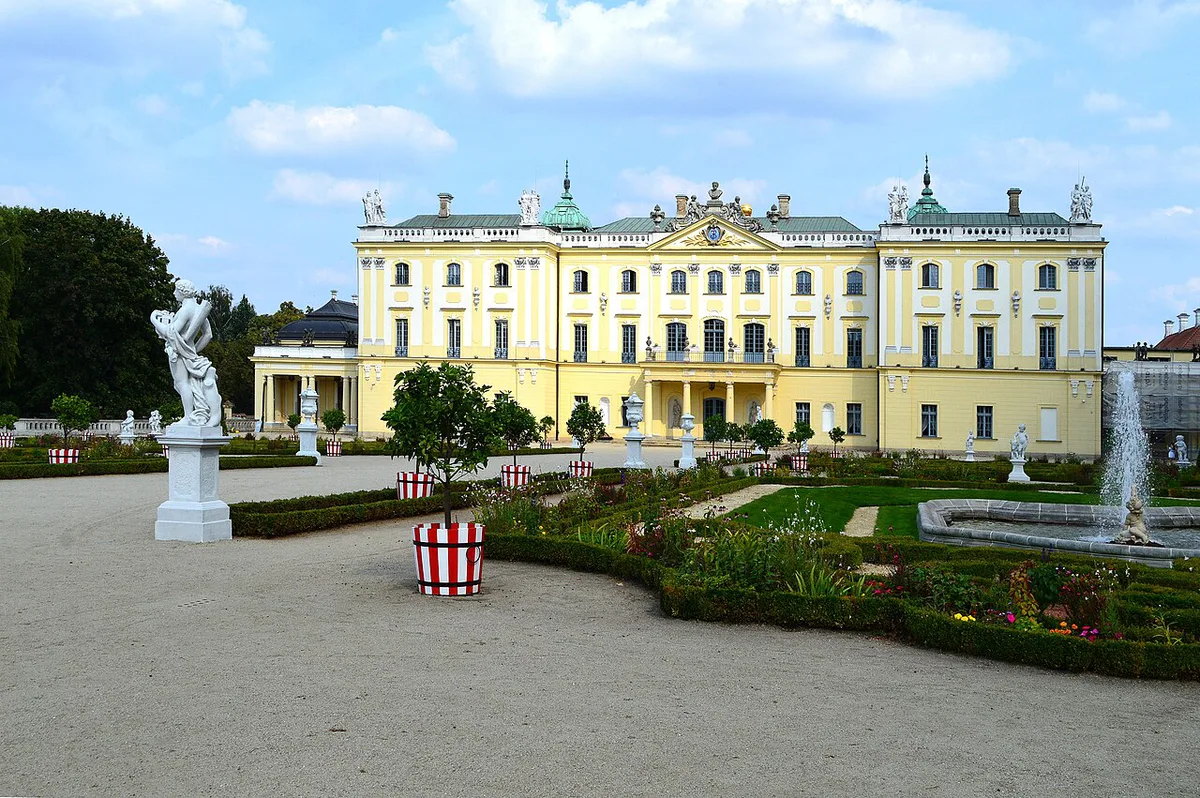
Entry to the palace grounds costs nothing, and the outdoor complex is arguably the strongest reason to stop even when skipping the museum. Arriving through the Great Gate, nicknamed Gryf after the Branicki family's coat of arms, sets an immediate tone. The gate resembles a triumphal arch, and its Gryf crest returned to that position in September 2006, two centuries after it had disappeared. Past the gate, the horseshoe-shaped Courtyard of Honor is flanked by two 1757 sculptures from Jan Chryzostom Redler. One shows Hercules fighting a dragon, and the other shows him fighting a hydra. Beyond the courtyard, the gardens split into two distinct styles. Gardens and courtyards stay open to the public until dusk in most cases, with no ticket required for any of this outdoor space.
- Upper garden: a French-style layout with geometric flower beds and the Pavilion under the Eagle (Pawilon pod Orlem).
- Lower garden: an English-style layout with a small pond, benches, and walking paths.
- Whole complex: roughly 10 hectares between Legionowa and Akademicka streets.
History and Architecture of the Branicki Palace
A wooden manor belonging to the Raczkowicz family stood on this site first. In the 16th century it became a brick, two-story castle for Piotr Wiesiołowski the Younger. Architect Hiob Bretfus built that Gothic-Renaissance structure with a moat and earthen ramparts. Stefan Mikołaj Branicki inherited the estate and commissioned its shift into a Baroque mansion, carried out between 1691 and 1697 by architect Tylman Gamerski. Jan Klemens Branicki, Great Crown Hetman, began the residence's largest expansion around 1726, aiming for something that could rival Wilanów Palace in Warsaw. His wife, Izabella Poniatowska, continued the project alongside him, and work carried on almost to his death in 1771. Architect Johann Sigmund Deybel led construction from 1728, adding the main facade, tympanum, and domed towers, and merging side pavilions into wings around a horseshoe courtyard. Jan Henryk Klemm built the gate that closed off that courtyard in 1758. Jakub Fontana then supervised the palace from 1750 to 1771, designing the vestibule, rococo interiors, and a staircase decorated with 1754 statues by Jan Chryzostom Redler. Branicki also laid out central Białystok during this period, including the triangular market square that still shapes downtown today. Retreating German forces destroyed about 70 percent of the palace in 1944. Postwar reconstruction ran from 1946 to 1960 under architect Stanislaw Bukowski, restoring the appearance the palace held at its mid-18th-century peak. Since 1950, the rebuilt palace has served as the seat of what is now the Medical University of Białystok.
Essential Tips for Visiting Branicki Palace
A few practical details separate a smooth visit from a wasted trip to a locked door. Book ahead by phone at 85 748 54 05, since individual tours depart at fixed times with a capped number of visitors per group. Organized groups need to confirm a date in advance too. A late-arriving group must notify the museum guide directly, or the reservation gets cancelled. Local legend adds a lighter note to the visit. The Hercules statue on the courtyard fence is said to drop its stone the moment a panna cnotliwa, a virtuous maiden, leaves the medical university. It's a joke long recycled by Białystok's own students. Two spots get recommended most often for photos. The symmetrical facade view from the Courtyard of Honor works well, and so do the geometric parterres in the upper French garden.
The roughly 10 hectares open until dusk regardless of whether the university blocks interior tours, meaning the free grounds offer a reliable visit option.
Beyond the Palace: Rynek Kościuszki and Tykocin
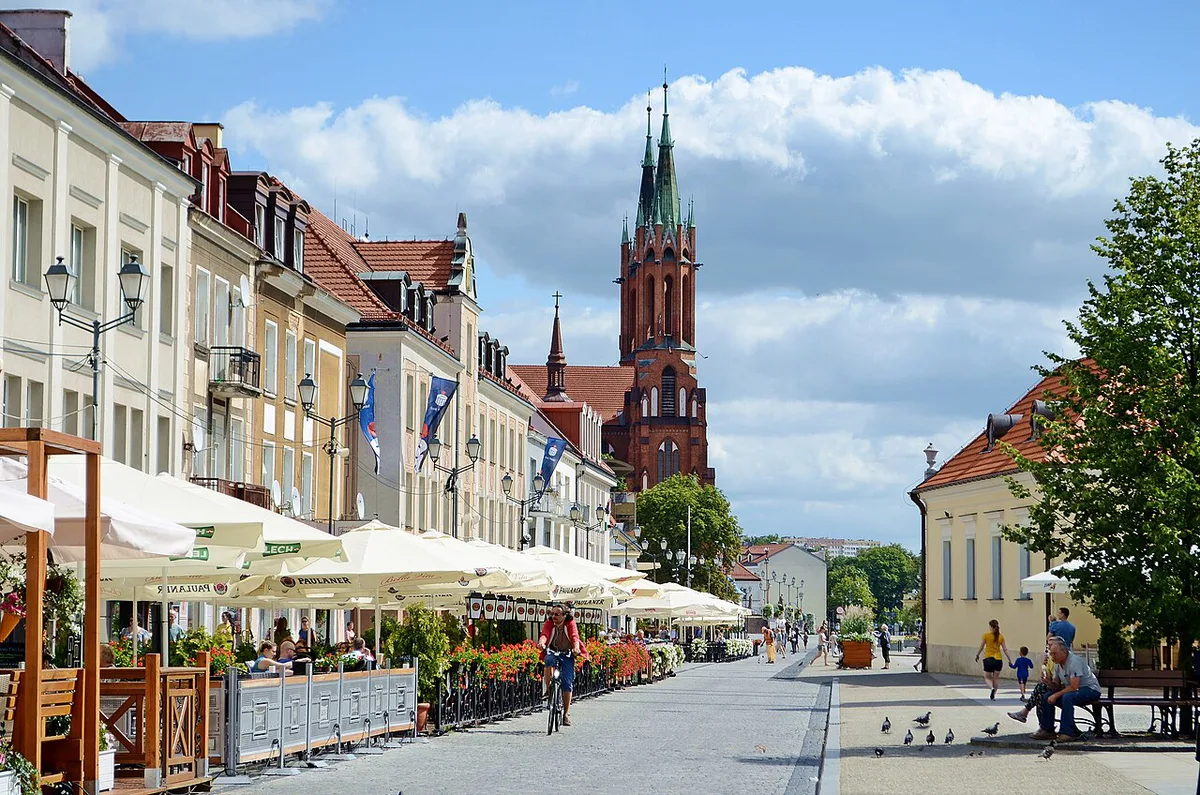
Branicki's influence on Białystok extends well past the palace gate. The triangular Rynek Kościuszki, the city's main square, follows the street plan he commissioned in the 18th century alongside the palace itself. A broader list of the city's sights, including that square, appears in our guide to the best things to do in Białystok. The Branicki family kept a second major residence in Tykocin, a short trip from the city. That estate and its own history are the subject of our Tykocin day trip guide.
Frequently Asked Questions
What are Branicki Palace's current opening hours?
Hours for the Museum of the History of Medicine and Pharmacy and the representative interiors run separately from the free outdoor grounds. As of 2026, the official site lists Tuesday to Friday from 10:00 to 17:00, and Saturday to Sunday from 09:00 to 17:00. Monday closures apply to the museum year-round.
How much do Branicki Palace tickets cost?
Route I, the longer 90-minute option with representative interiors, costs 35 PLN for a normal ticket and 25 PLN reduced. Route II, the 60-minute cellars-and-museum option, costs 30 PLN normal and 20 PLN reduced. A guide is included in both prices, and rates are subject to change, so confirm directly with the museum before visiting.
Do you need to book a tour of Branicki Palace in advance?
Yes. Individual visitors should reserve by phone at 85 748 54 05 because tours depart at set times with capped group sizes. Organized groups must also confirm a date ahead of arrival, and a late group has to notify the museum guide directly or risk losing the reservation.
Can you visit Branicki Palace for free?
Palace grounds, including the Courtyard of Honor and the upper and lower gardens, stay open without a ticket. Only the Museum of the History of Medicine and Pharmacy and the representative interiors on Routes I and II require paid admission.
Is Branicki Palace still used as a university?
Yes, it has served as the seat of the Medical University of Białystok since 1950. That means access to the representative interiors depends on the university's teaching schedule and events calendar, so it can vary day to day.
You might also like


Continue reading
More guides you'll find useful