
The Complete Białystok One Day Itinerary for 2026
Last updated August 2026, this Białystok one-day itinerary sequences the city's must-see sights into a single walkable route. You'll start at Rynek Kościuszki and Branicki Palace, cross into the Bojary wooden-house district, then close at the Sybir Memorial Museum. Add a same-day decision on a bison safari, Tykocin, or the Biebrza River if you want the Podlaskie countryside too.
At a Glance: Planning a One-Day Trip to Białystok
Białystok has no international airport, so most visitors connect through Warsaw by train or intercity bus, a ride of about 2 to 2.5 hours. The city anchors the Podlaskie region, an area sometimes called the Green Lungs of Poland for its forests and wetlands. Within the city itself, Polish, Jewish, Tatar, and Esperanto history overlap in a compact center, which is what makes a single focused day here worthwhile. Budget roughly nine hours on the ground: three time blocks below cover morning, afternoon, and evening, with approximate time needed for each.
| Time Block | Highlights | Time Needed |
|---|---|---|
| Morning | Rynek Kościuszki, Town Hall art museum, Cathedral of the Assumption, Branicki Palace gardens | About 3.5 hours |
| Afternoon | Bojary wooden-house route, Sybir Memorial Museum, Ludwig Zamenhof Centre | About 3.5 hours |
| Evening | Lipowa Street, Orthodox Cathedral of St. Nicholas, murals, dinner | About 2 hours |
- The historic center between Rynek Kościuszki and Lipowa Street covers on foot in 2 to 3 hours without stops.
- The Sybir Memorial Museum sits about a 30-minute walk from the Rynek; pairing it with the Bojary route saves backtracking.
- The Ludwig Zamenhof Centre is free on Sundays; several Białystok museums keep their own separate discount days, so confirm before you go.
- For the fuller list of sights beyond a single day, see our Białystok things-to-do guide.
Morning: Rynek Kościuszki, the Town Hall, and the Cathedral's Loophole
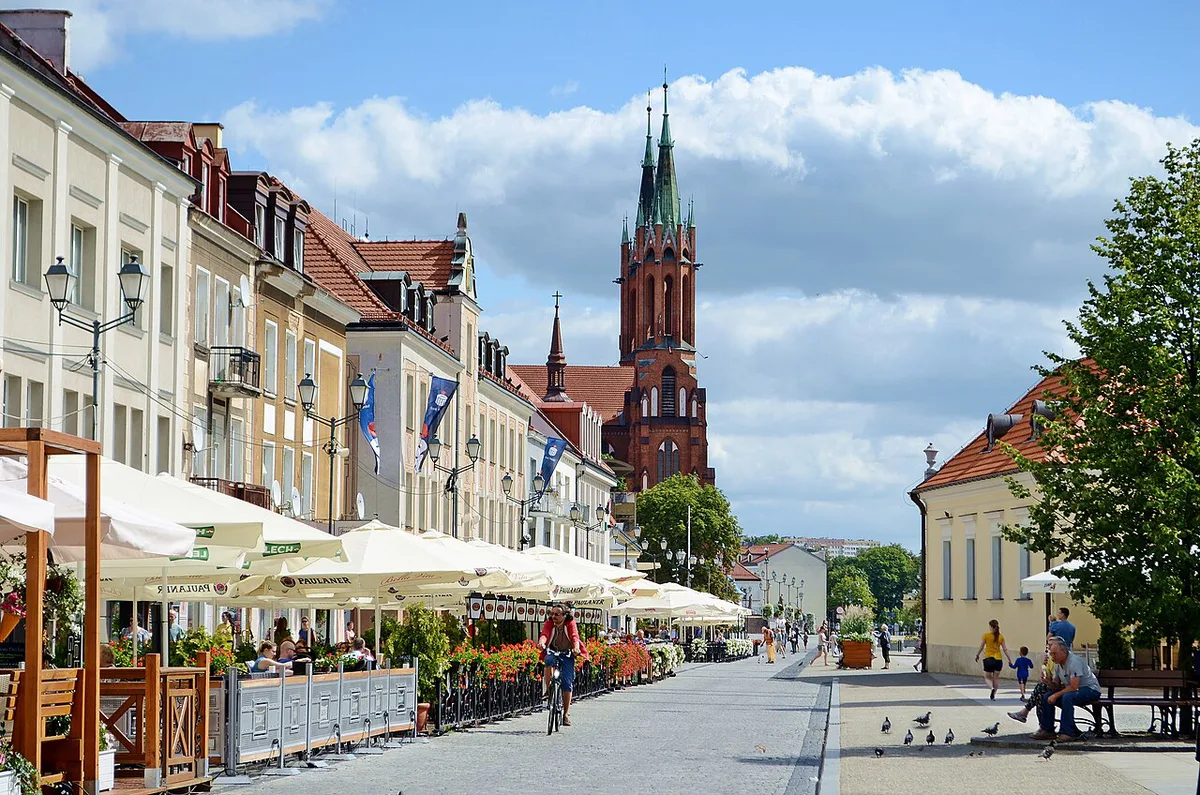
Start the day at Rynek Kościuszki, Białystok's triangular market square lined with cafés and restaurants. Grab breakfast here before the museums open. The Old Town Hall anchors the square and now houses a regional art museum. Paintings from 19th- and early-20th-century regional artists fill the collection. Entry runs around 14 zł, and the whole museum takes under an hour to see. Cathedral of the Assumption stands a few hundred meters east of the Rynek. The neo-Gothic building hides an unusual detail on its western facade. A smaller 17th-century parish church still stands attached there. Czarist-era rules once blocked new Catholic church construction in the city. So the cathedral's builders framed the new building as an 'enlargement' of that older church instead. Travelers with extra morning time can add the Historical Museum on Warszawska Street, east of the Rynek. It recreates the rooms of a turn-of-the-century town house, complete with period furniture and photographs. A large model of historic Białystok anchors the museum, paired with a light-and-sound display on the city's development. Entry costs about 14 zł, the same as the Town Hall art museum.
Branicki Palace: Is the 'Versailles of Poland' Tour Worth Your Time?
South of the cathedral stands Branicki Palace, often nicknamed the 'Versailles of Poland' for its Baroque scale. Jan Klemens Branicki commissioned the palace in the 18th century, reportedly modeling it on the French original. Its Rococo main gate and the palace exterior are the real draw for a one-day visit. A gilded griffin statue tops the gate, east of the palace itself. Landscaped French gardens behind the palace are free to enter and worth about 45 minutes. Fountains and statues of Greek deities line the garden paths. Walk through the gate and turn left to find the smaller Branicki Guest Palace from the same era, with cafés along adjacent Jana Kilińskiego street. Interior access is a different story: the palace now houses offices for the Medical University of Białystok. A paid guided tour covers the medieval cellars, a small pharmacy museum, and the former ballroom, now used as an assembly hall. For a one-day visit, prioritize the gardens and gate over the interior tour, unless the palace's medical history exhibits are a specific interest. Read the full Branicki Palace guide for current tour times and ticket details.
Afternoon: The Bojary Wooden-House Route to Sybir Memorial Museum
From the center, head north through the Bojary district toward the Sybir Memorial Museum. Pre-war wooden houses still line Ulica Wiktorii and Ulica Złota, survivors of a century of urban redevelopment. The Białystok tourist office marked out this Bojary route officially, though only a handful of original wooden homes remain among the newer building stock today. Following the route toward the Sybir museum keeps the afternoon efficient instead of doubling back into the center. Allow at least 1.5 hours once inside the museum. Immersive displays recreate deportation-era barracks and schoolrooms, tracing the exile of Polish citizens to Siberia and Kazakhstan. The basement holds a memorial to the 1940 Katyn Massacre, a section worth building extra time for. Entry costs about 25 zł, higher than the city's other museums, though the depth of the exhibits explains the difference.
Both the morning and afternoon blocks require 3.5 hours each, making them equally time-intensive segments that together consume seven of the nine-hour day.
Ludwig Zamenhof Centre and Białystok's Jewish Heritage Trail
Białystok is the birthplace of Ludwig Zamenhof, creator of the Esperanto language. A dedicated centre covers his life and work near the Biała River, a block north-east once you cross the water. Exhibits set his work inside the multicultural 19th-century city that shaped him, where Polish, Jewish, and Tatar communities lived side by side. Entry is free on Sundays; other days, a ticket costs about 8 zł. Before the Holocaust, Białystok's Jewish community made up a large share of the city's population. Remnants of that history remain findable today. A monument marks the site of the former Great Synagogue. Three surviving former synagogue buildings still stand, though without markers they read as ordinary structures. Following the city's own Jewish Heritage Trail signage links these sites together, including locations tied to the 1943 ghetto uprising. That layered history, Polish, Jewish, Tatar, and the Esperanto movement Zamenhof launched from it, sets Białystok apart from a generic regional-capital stop.
Evening: Lipowa Street, Murals, and Where to Eat
Head back toward the center for Lipowa Street, Białystok's main shopping street running off the Rynek. A short way down Lipowa from the Rynek stands the Orthodox Cathedral of St. Nicholas. It's the city's first Orthodox church, and the only one that survived Białystok's shift into independent Poland. Its iconostasis is worth a look if the doors are open. Farther along Lipowa, near the street's far end, sits the Church of St. Rocha, a modernist white structure that contrasts with the city's older churches. Side streets off Lipowa hide some of Białystok's street art. Look for a mural of a girl watering a plant and another nicknamed 'Grandma Eugenia'. For dinner, favor Podlaskie regional dishes over generic Polish menus. Kartacze are potato dumplings filled with minced meat, a dish shared with Lithuania's cepelinai. Potato babka is a grated potato pie baked with bacon, popular across the Belarusian border too. Pierogi remain the safe default if regional dishes aren't available where you land. Find more picks, including restaurants near the Rynek serving both dishes, in our where to eat in Białystok guide.
Your Białystok One Day Itinerary, Hour by Hour
Combine every stop above into one sequence, and a Białystok one-day itinerary looks roughly like this. Treat these times as a framework rather than a fixed schedule. Museum opening hours shift seasonally, so confirm current hours before you lock in the afternoon block.
This hour-by-hour itinerary spans about nine hours total; Białowieża's 10-hour round-trip commitment falls outside the single-day schedule.
- 8:30 AM: Breakfast at Rynek Kościuszki, the triangular market square ringed with cafés.
- 9:15 AM: Town Hall art museum, around 14 zł, roughly 45 minutes.
- 10:15 AM: Cathedral of the Assumption and its attached 17th-century parish church.
- 11:00 AM: Branicki Palace gardens and the Rococo gate's gilded griffin, free, about 45 minutes.
- 12:00 PM: Walk the Bojary route along Ulica Wiktorii and Ulica Złota.
- 1:00 PM: Sybir Memorial Museum, including the basement Katyn memorial; 25 zł, allow 1.5 hours.
- 3:00 PM: Ludwig Zamenhof Centre, free on Sundays or about 8 zł other days.
- 4:00 PM: Lipowa Street, past the Orthodox Cathedral of St. Nicholas and the Church of St. Rocha.
- 6:00 PM: Dinner near the Rynek: kartacze, pierogi, or potato babka.
City Day or Bison Safari? Beyond-Białystok Day Trips
One day covers the city center comfortably, but Podlaskie's nature and heritage sites outside Białystok need their own time budget. Seeing wild European bison means a trip into Białowieża National Park, a roughly 10-hour round-trip commitment from the city. That's not compatible with the city itinerary above unless you're building a two-day visit. A same-day compromise exists in Tykocin, a 4-hour outing to a medieval castle town with a well-preserved 16th-century synagogue. Full planning lives in our Tykocin day trip guide. Kayaking or birdwatching on the Biebrza River runs about 6 hours, better suited to a second day than a same-day add-on. Travelers focused on the region's Tatar heritage can also consider Kruszyniany, home to a wooden Tatar mosque and a small Muslim community with roots in the 14th century. It sits further out than Tykocin, and works best with your own transport. The table below compares operator-published starting prices for the main options.
| Day Trip | Duration | From | Best For |
|---|---|---|---|
| Białowieża National Park (bison) | 10 hours | 240 zł | Wild European bison, old-growth forest |
| Tykocin | 4 hours | 240 zł | Medieval castle town, Jewish heritage |
| Biebrza River kayaking | 6 hours | 210 zł | Paddling and birdwatching |
| Jewish Sites Tour (in-city) | 2 hours | 90 zł | Guided synagogue and ghetto history |
| Augustów and Suwałki Landscape Park | 12 hours | 340 zł | Lakes and countryside further north |
Planning Essentials: Where to Stay, Getting Around, and Budget
Accommodation in Białystok spans three practical tiers, summarized below. Compare more options, including exact current rates, in our where to stay in Białystok guide. Getting between sights rarely needs public transit: the historic core is walkable, and the Bojary route doubles as the connector to the Sybir museum. See our getting around Białystok guide for bus routes and transfer options from the train station. Entrance fees for the day's three ticketed sights add up to roughly 47 zł total. That combines the Town Hall art museum, the Sybir Memorial Museum, and the Zamenhof Centre on a non-Sunday. Warsaw remains the main gateway for onward travel. Fares shift by carrier and booking window, so confirm current train and bus prices directly rather than relying on a fixed figure. Travelers routing onward can check 25 Best Things To Do In Warsaw: A Complete 2026 Guide as the region's main transit hub. Those extending the trip east often add 12 Best Things to Do in Lublin (2026 Guide) to the circuit. Others continue north toward 12 Best Things to Do in Olsztyn, Poland (2026 Guide) instead.
| Tier | Property | Notes |
|---|---|---|
| Budget | Hostel Białystok Centrum | Walking distance to Rynek Kościuszki |
| Mid-range | Bella Vista Centrum Apartament | Apartment-style stay near the center |
| Luxury | Hotel Branicki | Named for the palace it sits near |
Frequently Asked Questions
How much time do you need for a one-day itinerary in Białystok?
A full day covers the historic center comfortably. Plan about 3.5 hours in the morning for the Rynek, Town Hall, cathedral, and Branicki Palace. Reserve another 3.5 hours in the afternoon for Bojary and the Sybir Memorial Museum. Add roughly 2 hours in the evening for Lipowa Street and dinner. Nine hours total leaves some buffer for slower museum visits.
Is the Branicki Palace interior worth touring?
For a one-day visit, the exterior and free gardens matter more than the paid interior tour. The palace now functions as offices for the Medical University of Białystok, and only the former ballroom and medieval cellars retain much historic character. Save the guided tour for a second visit unless the palace's medical-history exhibits interest you specifically.
How do you get to Białystok from Warsaw?
Białystok has no international airport, so most visitors arrive by train or intercity bus from Warsaw. The ride takes about 2 to 2.5 hours each way. Book the outbound leg early enough to reach the Rynek by mid-morning.
Is the Sybir Memorial Museum worth the extra entrance fee?
At about 25 zł, the Sybir Memorial Museum costs more than Białystok's other museums. The immersive displays on Siberian deportations, plus the basement Katyn memorial, make it the day's most substantial stop. Plan at least 1.5 hours inside rather than rushing through.
Can you fit a Tykocin or bison day trip into the same day as the city itinerary?
Not comfortably. Tykocin runs about 4 hours round-trip, which crowds out the afternoon museum block, and a bison excursion into Białowieża National Park runs closer to 10 hours. Treat either as a second day rather than an add-on to the city itinerary above.
You might also like


Continue reading
More guides you'll find useful