
Bieszczady Mountains: Exploring Poland's Wild Frontier
Last updated July 2026, the Bieszczady Mountains remain Poland's least crowded major range, a corner of the Carpathians where high meadows replace jagged peaks and European bison outnumber tour buses. Based in Rzeszów, you can reach this southeastern frontier in about two and a half hours by car, which makes it a realistic day trip or an easy overnight add-on. This guide covers the drive from Rzeszów, the best beginner-friendly trails on the połoniny, and what to know about Bieszczady National Park before you go.
What Are the Bieszczady Mountains?
The Bieszczady Mountains sit in the extreme southeast corner of Poland, where the country's border meets Slovakia and Ukraine. They form the western edge of a larger range that continues into both neighboring countries, and geographers classify them as part of the Eastern Beskids within the Carpathian system. In Poland, the range falls inside Subcarpathian Voivodeship, the region anchored by Rzeszów. Local folklore ties the name Bieszczady to Bies and Czad, demon figures blamed for strange happenings in these hills. Its roots run deeper still: a Latin-language document from 1269 already referred to the range as Beschad Alpes Poloniae. Slovaks call the same region Beščady, and Ukrainians call it Beshchady, though everyday usage on each side of the border often narrows the word to the local slice of the range. Wooden Orthodox churches recognized as UNESCO World Heritage sites also survive across the wider region, remnants of the Boyko highlander communities who lived here before mid-20th-century border and resettlement changes redrew the population. That layered history, plus genuinely low visitor numbers compared with the Tatras, gives the range its reputation as Poland's wild frontier.

Geography and Peaks: From Tarnica to Pikui
Tarnica is the highest peak inside Poland's own borders, topping out at 1,346 meters (4,416 feet). Pikui, the range's true summit, rises higher still at 1,405 meters (4,610 feet), but it stands across the border in Ukraine and is not part of a typical Poland-based itinerary. Geographers split the wider range into three sections, each bounded by a mountain pass; the table below lays out the boundaries and high points. Ridgelines here run gentler than the granite spires of the Tatras. Instead of scrambling over rock, you walk across rolling grass summits called połoniny, a landscape unique to this corner of the Carpathians. Even without crossing into Ukraine or Slovakia, the Polish side alone holds enough marked trail to fill several full days of hiking.
| Sub-range | Boundary | Highest Peak | Elevation |
|---|---|---|---|
| Western Bieszczady | Łupków Pass to Użocka Pass | Tarnica | 1,346 m (4,416 ft) |
| Central Bieszczady | Użocka Pass to Tukholskyi Pass | Pikui | 1,405 m (4,610 ft) |
| Eastern Bieszczady | Tukholskyi Pass to Vyshkovskyi Pass | Czarna Repa | 1,228 m (4,029 ft) |
Is a Bieszczady Day Trip from Rzeszów Feasible?
Rzeszów makes a workable base for exploring the Bieszczady Mountains. Rzeszów's top attractions can fill the days before or after your trip into the hills. Expect roughly 160 kilometers and about two and a half hours each way, mostly via the S19 expressway and DK19. Sanok makes a natural halfway stop for coffee, fuel, or an early lunch before the road narrows into the mountains. The final stretch toward the park boundary runs through forest switchbacks, so build in extra time near Ustrzyki Górne. A full day trip adds up to close to five hours of total driving, so leave Rzeszów by 6:00 AM to protect enough daylight for a real hike. Driving is faster and more flexible than the bus connections linking Rzeszów to Sanok, Ustrzyki Dolne, and Wetlina, which run on a fixed timetable and add real transfer time. Travelers building a wider Southern Poland loop can use the route guide on to Kraków to place Bieszczady within the region's broader geography.
Top Day-Hike Trails for First-Time Visitors
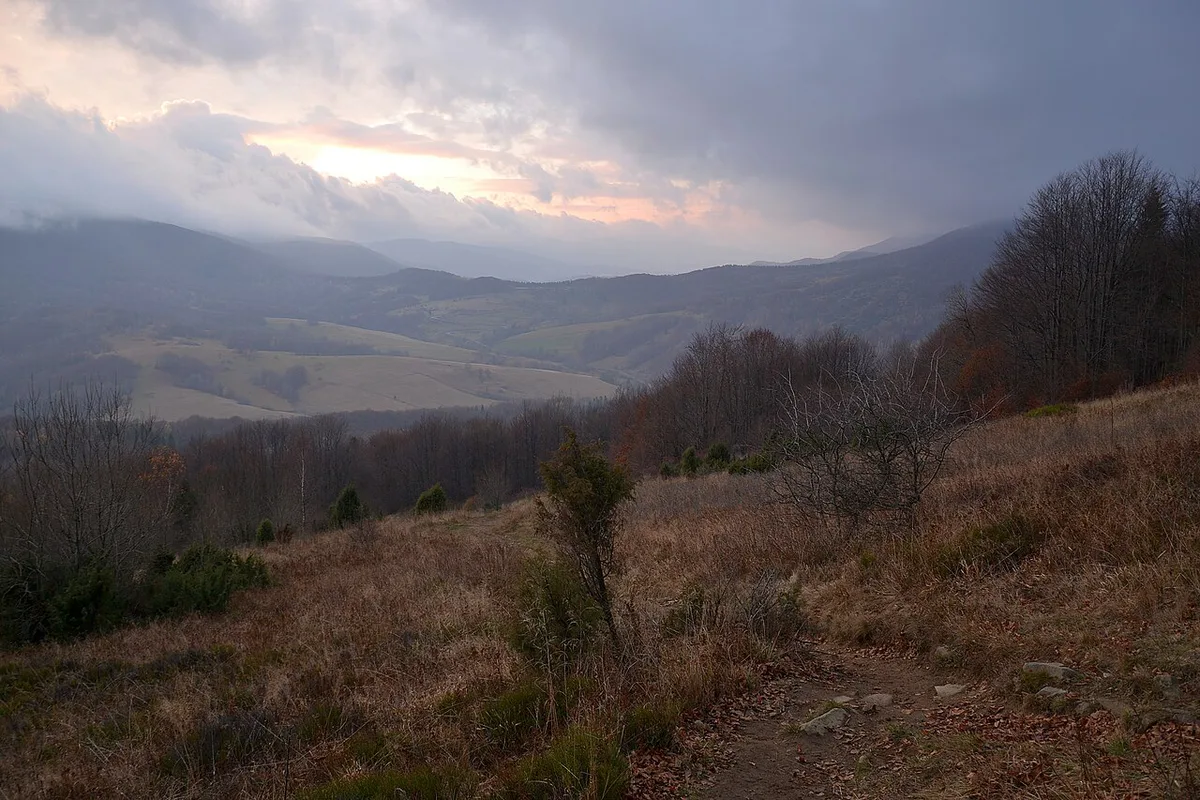
The połoniny are what set Bieszczady apart from Poland's other ranges. These high, treeless meadows open into wide views instead of forcing you through forest for the whole climb. Połonina Wetlińska and Połonina Caryńska are the two classic first-timer routes, both reachable from trailheads near Wetlina and Ustrzyki Górne. Starting early also improves your odds of clear ridge views, since afternoon cloud frequently rolls in over the meadows. Trail conditions on the połoniny shift fast, so pack a rain shell and real hiking boots, not sneakers, even on a clear morning.
Climbing Tarnica at 1,346 m (4,416 ft) requires a 6:00 AM departure from Rzeszów because five hours of driving consumes most daylight on a day trip.
- Połonina Wetlińska: starts near Wetlina; the longer ridge walk of the two, with a gentler overall grade suited to a first połonina hike.
- Połonina Caryńska: starts near Ustrzyki Górne; a shorter approach with steeper early switchbacks, closer to the Ukrainian border.
- Tarnica: Poland's highest peak inside its own borders at 1,346 m (4,416 ft); best for hikers with extra time and energy for a longer day.
Beyond Hiking: Solina Lake and the Forest Railway
Not every Bieszczady trip has to center on hiking. Solina Lake, held back by the Solina Dam, is the region's largest reservoir and a hub for swimming, boat rental, and lakeside walking through the summer. The Bieszczadzka Kolejka Leśna, the Bieszczady Forest Railway, runs narrow-gauge heritage trains on a seasonal schedule, typically active from spring through autumn. The line functions as a slow-paced alternative to a hiking day, running through forest that predates much of the region's modern road network. Confirm the current year's operating months before building a day around it, since the calendar shifts from year to year. Choosing between a lake day and a mountain day changes the whole shape of the trip, so weigh the two options below before you commit to a route.
| Option | Best For | Effort Level |
|---|---|---|
| Solina Lake | Swimming, boat rental, lakeside walking | Low |
| Ustrzyki Górne trailheads | Połonina hikes toward Połonina Caryńska and Tarnica | High |
Practical Logistics: Costs, Park Tickets, and Seasonal Hours
Bieszczadzki Park Narodowy, the Bieszczady National Park (BdPN), charges a per-person entry fee at trailhead ticket points and online, with the rate revised annually. Budget for it as a minor add-on to the trip. In practice, it costs far less than a single tank of gas for the round-trip drive from Rzeszów. Check the BdPN website for the current-year fee schedule and trail closures before you leave, since both are updated each season. Peak trail season runs roughly May through October, when the połoniny are clear of snow and the forest railway is most likely to be running. Winter access narrows sharply, and some trailheads close or become unsafe without proper gear. Mobile signal is patchy across the high meadows, so download offline trail maps before you leave Rzeszów. Plan a Bieszczady visit within that standard warm-season window unless you have real winter mountaineering experience.
Where to Eat and Stay: Local Karczma Picks
Traditional karczma-style inns are the standard place to eat around Bieszczady, serving hearty regional dishes tied to Boyko culture and the wider Subcarpathian table. Expect pierogi, żurek, and grilled trout pulled from local streams and lakes, served in wood-beamed dining rooms near the main trailheads. For an overnight stay, small agroturystyka guesthouses in Wetlina, Ustrzyki Górne, and villages around Solina Lake are the norm rather than large hotels. Booking ahead matters in July and August, when domestic tourism peaks around the lake. Reservations rarely need more than a phone call, since dining rooms here run smaller than in Zakopane or Kraków. If you are only passing through for the day, save the sit-down meal for the return leg. Travelers who prefer to eat after the drive back can check Rzeszów's old town dining scene for dinner options in the city.
Mistakes to Avoid in the Bieszczady Mountains
A few recurring mistakes turn a good Bieszczady trip into a rough one. Weather on the połoniny changes within the hour, so a clear summit can turn windy and cold fast. The list below covers what to plan around before you leave Rzeszów.
- Underestimating the drive: the round trip from Rzeszów plus a real hike adds up to a long day, so start by 6:00 AM.
- Wearing sneakers on the połoniny: pack real hiking boots and a rain shell, since ridge weather shifts fast and without warning.
- Ignoring the Ukrainian border: straying off marked trails near the frontier can draw attention from the Straż Graniczna, the Border Guard, and cause real legal trouble.
- Misjudging wildlife: European bison, wolves, and occasionally bears live in the range, but encounters are uncommon if you stay on marked trails and store food properly.
- Skipping trail markers: routes across the połoniny cross open meadow with few landmarks, so follow the painted trail blazes rather than cutting your own line.
Why Bieszczady Wins on Solitude Over the Tatras
The Tatras get the postcards and the crowds; Bieszczady gets the quiet. Trails on the połoniny stay open and empty even in peak season, and the region's distance from Poland's major cities keeps trail traffic far lighter than around Zakopane, Poland's busiest mountain gateway. That distance is exactly the tradeoff worth making from Rzeszów: a longer drive in exchange for genuine solitude on the ridge. For travelers who already know the Tatras, Bieszczady offers a genuinely different mountain experience within the same country. Pairing a Bieszczady day trip with extra time in Rzeszów turns the wildest range in Poland into a realistic addition to a Subcarpathian itinerary rather than a separate trip.
Choosing the Right Bieszczady Trailhead
Bieszczady ridge hikes often finish at a different trailhead, so confirm your return plan before starting. Public transport between remote trailheads can be limited outside summer.
- Wołosate: Use this southern park entrance for the standard marked ascent of Tarnica. The village has park facilities and lies beyond Ustrzyki Górne.
- Brzegi Górne: Start here for Połonina Caryńska or approach the eastern end of Połonina Wetlińska. Arrive early because parking capacity is limited.
- Przełęcz Wyżna: This roadside pass provides the shortest common approach toward Połonina Wetlińska and the Chatka Puchatka II shelter.
Połonina Caryńska is commonly walked between Brzegi Górne and Ustrzyki Górne. Połonina Wetlińska has several possible exits near Wetlina and the mountain passes.
Drivers should either retrace their route or coordinate transport between endpoints. Download the official park map because mobile coverage may disappear along forested approaches.
Further reading: Poland on Wikivoyage · Poland on Wikipedia
Frequently Asked Questions
Is a day trip from Rzeszów to Bieszczady worth the drive?
Yes, if you commit to an early start. The round trip covers roughly 320 kilometers and around five hours of driving, but it buys access to Poland's least-crowded major mountain range. Leaving Rzeszów by 6:00 AM leaves enough daylight for a full hike on the połoniny before the return drive.
What is the easiest mountain to climb in Bieszczady for beginners?
Połonina Wetlińska is generally the more approachable of the two classic połoniny routes, with a longer but gentler ridge walk than Połonina Caryńska's steeper early climb. Both start from trailheads near Wetlina and Ustrzyki Górne and stay above the treeline for most of the route.
How much does it cost to enter Bieszczady National Park?
Bieszczadzki Park Narodowy charges a per-person entry fee at trailhead ticket points and online, with the rate revised annually. Check the current schedule on the BdPN website before you go. In practice, it costs far less than the fuel for the round-trip drive from Rzeszów.
Can you visit the Bieszczady Mountains without a car?
It is possible, but slower. Bus connections link Rzeszów to towns including Sanok, Ustrzyki Dolne, and Wetlina, though they run on a fixed timetable. A car is faster door-to-door and gives you full control over the day's schedule.
What is the difference between Połonina Wetlińska and Połonina Caryńska?
Połonina Wetlińska is the longer ridge walk with a gentler overall grade, while Połonina Caryńska sits closer to the Ukrainian border and has a shorter, steeper approach. Both showcase the treeless mountain meadows that give Bieszczady its distinct look.
When is the best time to visit the Bieszczady Mountains?
Late spring through early autumn, roughly May to October, gives the most reliable trail and weather conditions. The połoniny are clear of snow during that window, and the forest railway is most likely to be running its seasonal schedule.
You might also like



Continue reading
More guides you'll find useful