Toruń Cathedral Visitor Guide
Toruń Cathedral stands as one of the Old Town's largest Gothic landmarks, its brick towers visible from almost every street nearby. Inside, visitors find the Gothic font where tradition says Nicolaus Copernicus was baptized in 1473. A nearly seven-and-a-half-tonne bell called Tuba Dei has hung in its tower since the year 1500. Last updated for 2026, this guide covers current hours, ticket prices, and what happens when you climb the tower.
This Toruń Cathedral visitor guide breaks down which parts are free, which need a ticket, and when the tower closes for winter. Officially named the Cathedral Basilica of Saint John the Baptist and Saint John the Evangelist, most locals just call it Saint John's.
History of the Cathedral Basilica of St. John the Baptist
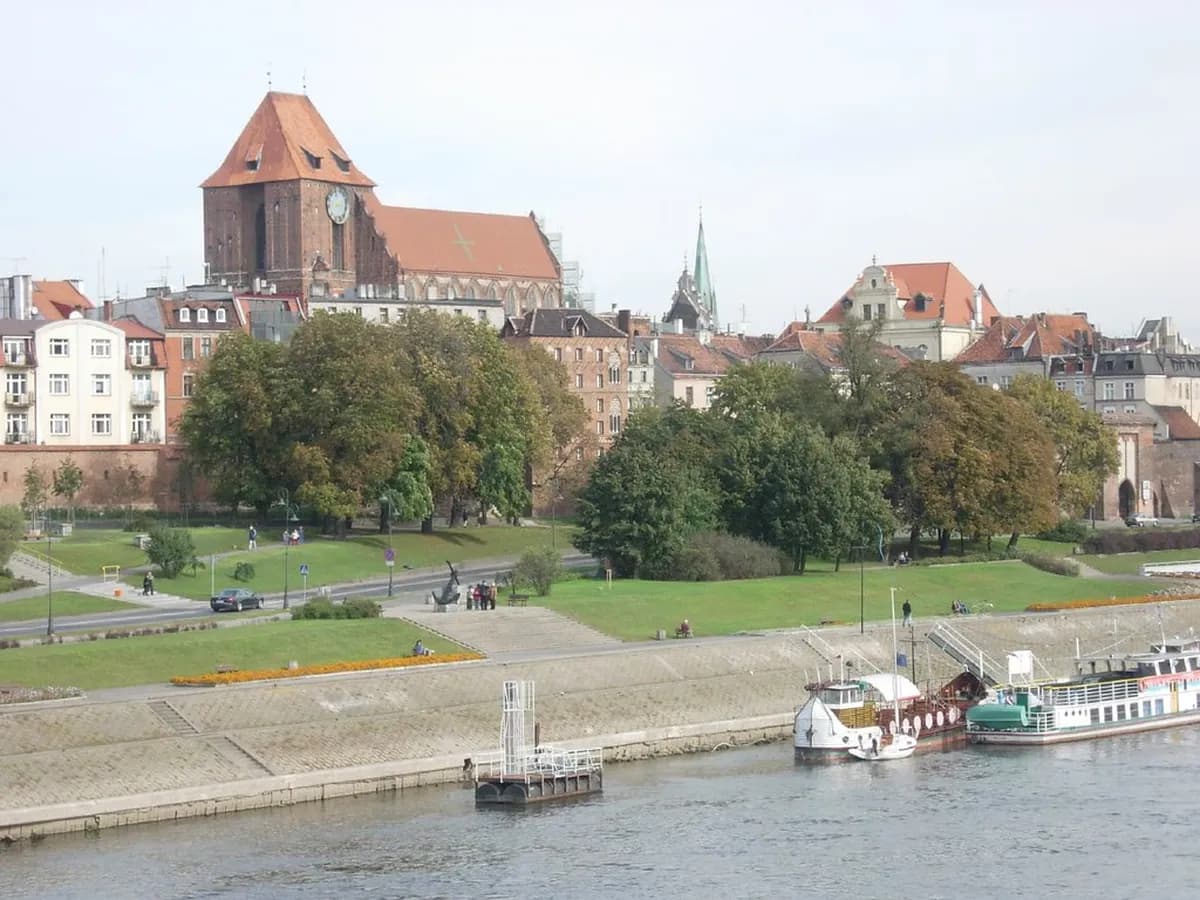
Construction on Toruń Cathedral began in the 13th century, not long after the Teutonic Knights founded the city in 1233. Builders worked in stages for roughly two hundred years, finishing the cathedral's current Gothic form by the late 15th century. The result is a textbook example of Brick Gothic, the northern European style built from red brick instead of stone.
Locals sometimes call the whole Old Town red like Toruń, and the cathedral's brick walls are a big reason why. Its facade sits inside a UNESCO World Heritage Site, part of the medieval town's well-preserved layout.
The same red brick pattern repeats across the Toruń Old Town, tying the cathedral to its wider medieval district. Little damage came to Toruń during the Second World War, so much of this brickwork survives largely unchanged today. That survival is part of why UNESCO added the medieval town to its heritage list in 1997.
Essential Visitor Information: Hours and Tickets
Toruń Cathedral splits into two separate visits with two different rules for cost and hours. Walking through the nave and side chapels costs nothing, though donation boxes near the entrance support ongoing restoration work. Climbing the tower to see Tuba Dei up close, however, requires a separate paid ticket.
For the most current confirmed schedule, check the Visit Toruń Official Portal before your trip. Ticket counters near the tower entrance accept cash and card, though queues can build on busy summer afternoons.
Mass schedules take priority over sightseeing, so plan around the posted service times listed at each entrance. Arriving early in the morning usually means a quieter nave and better light for photos.
The tower climb is not a good fit for visitors with mobility limitations, bad knees, or anyone traveling with a stroller. There is no elevator, and the spiral stone staircase narrows sharply near the top, so prams and large bags will not fit through the passage. Travelers who would rather skip the climb can still see Tuba Dei's scale from ground level and enjoy the free nave visit, which covers the font and the Last Judgement painting without any stairs at all.
- Church Interior Access
- The nave typically opens daily from around 9 in the morning until 4:30 in the afternoon.
- Sundays and public holidays shorten interior sightseeing hours to roughly 2:30 to 4:30 in the afternoon, around Mass times.
- Entry to the interior is free, with donations welcomed at the door.
- Mass times and services can temporarily close parts of the nave to sightseeing.
- Modest dress is appreciated since this remains an active parish church.
- Cathedral Tower Opening Season
- The tower only opens from April through October each year.
- Monday through Saturday hours run from 10 in the morning to 4 in the afternoon.
- Sunday hours are shorter, running only from 2 to 4 in the afternoon.
- The tower stays closed completely from November through March for winter.
- Cathedral Tower Ticket Prices
- A normal adult tower ticket costs around 20 zł per person.
- A reduced ticket for students and seniors costs about 15 zł.
- Prices are set in Polish złoty and can shift from year to year.
- Confirm the latest tower prices before you plan your climb.
The Tuba Dei Bell: Poland's Medieval Giant
Tuba Dei, Latin for God's Trumpet, was cast in the year 1500 for the cathedral's tower. At close to seven and a half tonnes, it ranks among the largest surviving medieval bells anywhere in Europe. Local legend says workers built an 800-metre ramp over nearby rooftops just to haul the bell into place. Seven oxen reportedly pulled the ropes, according to the story still told by local guides today.
Tuba Dei does not ring for every service, which surprises many first-time visitors. The bell sounds mainly on major church holidays and important civic occasions, not on an ordinary weekday. If hearing it ring matters to you, check the parish calendar or ask staff about upcoming feast days.
The bell hangs directly in the path tower climbers take on their way to the viewing platform. Its sheer size becomes obvious up close, dwarfing the wooden beams and stone housing around it.
The Rafters' Clock and External Architecture
One unusual feature on the cathedral's outer wall is the Rafters' Clock, a large dial with just one hand. That single hand only ever marks the hour, since minutes were not useful information from a distance. River rafters working the Vistula could glance up from their boats and read the hour at a glance.
That practical link to the river also explains the clock's name, since rafters, not clergy, were its main audience. Toruń grew wealthy through Hanseatic League trade routes along the Vistula, and river traffic shaped daily life here. A simple one-handed clock fit that river economy far better than a fussy multi-hand design ever could.
Beyond the clock, the cathedral's exterior shows classic Brick Gothic details, including stepped gables and tall pointed windows. Buttresses along the side walls support the tall nave roof, a hallmark of Gothic engineering across northern Europe.
Nicolaus Copernicus and the Cathedral Interior
Inside the nave stands a Gothic baptismal font dating to the 13th century, one of the cathedral's oldest surviving pieces. Tradition holds that astronomer Nicolaus Copernicus, born in Toruń in 1473, was baptized in this very font. A small chapel nearby now honors his connection to the cathedral and the wider city.
To learn more about Copernicus's life and work, the Nicolaus Copernicus House sits a short walk from the cathedral. That museum fills in the family history and scientific career that the cathedral itself only hints at.
Several other interior details reward a slow walk through the nave and side chapels. Among them is a 14th-century Last Judgement painting, a scene many short city guides skip over entirely.
- Gothic Baptismal Font
- The 13th-century stone font predates most of the current cathedral building.
- Tradition ties it directly to Copernicus's baptism in 1473.
- It remains in active use for baptisms held at the cathedral today.
- Visitors often pause here first since it sits near the main entrance.
- Last Judgement Painting
- This 14th-century mural covers a wall inside the cathedral's nave.
- Its faded pigments still show scenes of judgement and salvation.
- Few short city guides mention this painting at all.
- Ask staff to point out its exact location inside the nave.
- Copernicus Memorial Chapel
- A side chapel commemorates the astronomer's baptism and family ties.
- Plaques here explain his connection to the parish and the city.
- It sits close to the Gothic font described above.
- The chapel is a quieter spot for photos than the nave.
Climbing the Tower for Panoramic Views
Climbing the cathedral tower means tackling roughly 200 narrow stone steps in a tight spiral staircase. The climb is moderately difficult, not extreme, though low ceilings and narrow turns catch some visitors off guard. Along the way, you pass close enough to Tuba Dei to appreciate its full scale.
At the top, the viewing platform frames a wide bend of the Vistula River below the Old Town walls. Red rooftops stretch toward the horizon, giving a clear sense of why locals call it red like Toruń.
Toruń has two towers open to climbers, and travelers often ask which one is worth the ticket. The Old Town Hall tower sits right on the market square, stays open year-round, and charges roughly 28 zł for a standard adult ticket. The cathedral tower runs seasonally at a slightly lower 20 zł and rewards climbers with the closer bell and a different river-facing angle.
- Cathedral Tower Climb
- The staircase passes directly beside the massive Tuba Dei bell.
- Roughly 200 steps lead up a tight, winding stone passage.
- A standard ticket runs about 20 zł, open April through October only.
- The view favors the Vistula River and eastern rooftops.
- Old Town Hall Tower Climb
- About 175 steps lead to a viewing terrace roughly 40 metres up.
- A standard ticket runs about 28 zł, open every day of the year.
- It stands right on the main Old Town market square.
- The view favors the cathedral's silhouette and the square below.
For travelers with time for only one climb, the choice usually comes down to season and taste. The cathedral tower costs a little less and puts you beside a 500-year-old bell, while the Old Town Hall tower stays open through the winter and trades the bell for a squarely centered view over the whole Old Town skyline.
Planning Your Visit: Location and Nearby Sights
Toruń Cathedral sits inside the Old Town, an easy walk from either of the city's two train stations. Toruń Główny, the main long-distance station, sits about three kilometers south across the Vistula; cross the Piłsudski Bridge on foot for a walk of about twenty minutes into the Old Town center, or catch a local bus that covers the same route in a few minutes. Toruń Miasto, a smaller stop many first-time visitors overlook, sits within a ten-minute walk of the Old Town and skips the bridge crossing entirely if your train serves it.
For a broader practical rundown of the cathedral and nearby venues, see the In Your Pocket - Toruń Guide. Most other Old Town landmarks sit within a ten-minute walk of the cathedral's main doors.
Budget-minded travelers can stack two free stops on a Wednesday: the cathedral nave costs nothing on any day, and the Old Town Hall's District Museum exhibitions waive their entry fee every Wednesday, leaving only the tower climbs as paid add-ons.
Just a few minutes' walk brings you to the Leaning Tower of Toruń, now home to a small pub. Its noticeable tilt comes from unstable ground near the old defensive walls, not from any construction mistake.
Sweet-toothed travelers usually continue on to the Toruń Gingerbread Museum, a short stroll from the Leaning Tower. Interactive baking sessions run throughout the day, though English-language tours book up fast in peak season.
History fans can head instead to the Teutonic Castle ruins, the remains of the fortress that once ruled the city. Families traveling with kids often add the Toruń Planetarium to the same afternoon, a short walk further south.
Frequently Asked Questions
Is Toruń Cathedral free to visit?
Yes, entry to the church interior is free, though donations are welcomed to help maintain the building. Climbing the cathedral tower to see the Tuba Dei bell requires a separate paid ticket (around 20 PLN normal / 15 PLN reduced).
Was Nicolaus Copernicus baptized here?
Tradition holds that the astronomer Nicolaus Copernicus, born in Toruń in 1473, was baptized in the cathedral's 13th-century Gothic baptismal font, which still stands in the chapel dedicated to him.
What is the Tuba Dei bell?
Tuba Dei ("God's Trumpet") is a massive bronze bell cast in 1500 by local founder Martin Schmidt. Weighing close to 7.5 tonnes with a diameter of about 2.27 metres, it is one of the largest surviving medieval bells in Europe and hangs in the cathedral's tower.
Can you climb the cathedral tower?
Yes. The 52-metre tower is open to visitors April through October (closed in winter) and involves climbing over 200 steps, passing the Tuba Dei bell en route to a viewing platform overlooking the Old Town and the Vistula River.
How old is Toruń Cathedral?
Construction began in the 13th century as a small hall church and was expanded over roughly two centuries, reaching its present Gothic form by the end of the 15th century — making it one of the oldest and largest churches in Toruń's Old Town.
Is Toruń Cathedral part of a UNESCO World Heritage Site?
Yes. As one of the key monuments of Toruń's Old Town, the cathedral is included in the Medieval Town of Toruń UNESCO World Heritage Site (inscribed 1997) and is also designated a Historic Monument of Poland.
Why is it called a minor basilica?
The church was granted the honorary title of minor basilica by the Catholic Church in 1935, recognizing its historical and architectural significance. It later became a cathedral in 1992 when the Diocese of Toruń was established.
Are there restrictions on visiting during Mass?
Yes. As an active parish and cathedral church, sightseeing access is limited during Mass and other liturgical services, so it's best to check the parish Mass schedule before planning your visit.
Toruń Cathedral rewards visitors who slow down enough to notice the details competitors skim past. Between the Gothic font, the Last Judgement painting, and Tuba Dei's sheer size, an hour here goes quickly. Free interior entry makes it an easy add-on to any Old Town walk, tower ticket or not.
Check current tower hours and Mass times before you go, since both can shift with the season. With a little planning, this cathedral visit fits neatly alongside the rest of your Toruń itinerary.
For the latest official information, see the Toruń Cathedral on Wikipedia and Toruń Cathedral official site.
For more Torun planning, explore our 14 Best Things to Do in Torun: A Complete Travel Guide (2026) and 9 Essential Insights for Visiting Torun Old Town.
Browse all Torun attractions in our Torun attractions hub.