
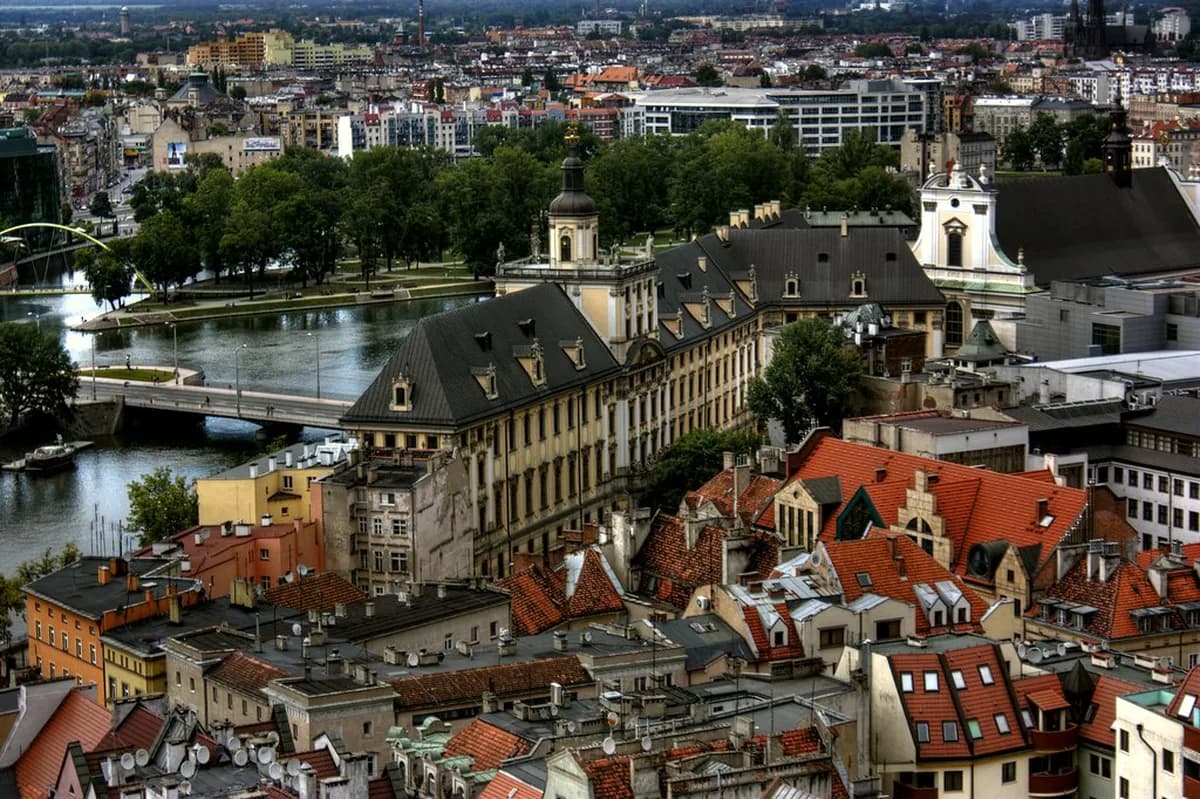
University of Wrocław (Aula Leopoldina & Mathematical Tower) Visitor Guide
The University of Wrocław stands as a beacon of academic excellence and Baroque grandeur in the heart of Poland. This historic institution invites visitors to explore some of the most beautifully preserved interiors in Central Europe. As you walk through its massive doors, you step into a world where science and art have intertwined for centuries. Planning a visit to Wrocław often begins with a trip to this iconic riverside campus.
The main building houses the University Museum, which features the breathtaking Aula Leopoldina and the Mathematical Tower. These sites offer a unique glimpse into the imperial history of the region and the Jesuit influence on education. Whether you are a history buff or a photography enthusiast, these halls provide endless inspiration. Our guide will help you navigate the ticket options and historical nuances of this academic treasure.
Inside the University of Wrocław Museums
Visitors often feel confused by the tiered ticket system when they first arrive at the museum entrance. The museum is a separate tourist entity within the active university building. You must choose how many 'halls' you wish to see before purchasing your entry pass. The options usually include access to two, three, or all four main historical sections.
The entrance is flanked by a pair of ornate blue-and-gold Baroque doors crowned with a double-headed Habsburg eagle — one set at the museum entrance, a second near the Fencer Fountain in the university square, and both are free to admire and photograph without a ticket. Past the doors, the magnificent Imperial Staircase sets the tone for your entire visit, richly decorated with Baroque sculptures and frescoes. For only a little more money, the four-hall ticket unlocks the Oratorium Marianum and Mathematical Tower alongside the Aula Leopoldina, and most guests find that upgrade worth skipping the two-hall minimum.
The museum staff typically provides a small map or pamphlet to guide your self-guided tour. Each section is well-marked, but the layout can be slightly labyrinthine for new arrivals. Plan to spend at least 60 to 90 minutes exploring the various exhibits and architectural details. Starting early in the morning helps you avoid the large student groups that frequent the corridors.
- Ticket Option: 2 Halls
- Cost: 16 PLN normal, 12 PLN reduced
- Access: Aula Leopoldina and Mathematical Tower
- Best for: A quick highlights visit
- Ticket Option: 4 Halls
- Cost: 20-28 PLN normal, 16-22 PLN reduced
- Access: Adds Oratorium Marianum and the exhibition halls
- Best for: The complete experience
- Family Ticket
- Cost: 30-40 PLN (2 adults + 2 children)
- Access: Full four-hall route
- Best for: Families — under-7s and university students/staff always enter free
Aula Leopoldina: High Baroque and Academic Power
The Aula Leopoldina is widely considered the finest Baroque secular interior in all of Poland. Named after Emperor Leopold I, the hall served as a grand stage for university ceremonies and celebrations. The design was executed by Christophorus Tausch, a master of theatrical and illusionistic architecture. Every corner of this room is packed with symbolic meaning and imperial propaganda.
The frescoes on the ceiling, painted by Johann Christoph Handke, depict a clear symbolic hierarchy. Divine wisdom occupies the highest points, while earthly knowledge and imperial power sit below. The podium at the front of the hall was reserved for the highest academic authorities. Detailed sculptures of the four seasons and various virtues line the walls to inspire students.
The woodwork in the hall is equally impressive, featuring intricate carvings and gilded accents. These benches have hosted centuries of scholars and remain in remarkable condition today. Visitors should look closely at the portraits of university founders and benefactors near the windows. Lighting in the hall varies by time of day, creating different moods across the frescoes.
Mathematical Tower: Views and the Meridian Line
The Mathematical Tower stands 42 meters high and was originally designed as an Astronomical Observatory. It offers one of the most comprehensive views of the city and the Oder River. The climb to the top is manageable and takes you through several small museum exhibits. While not as high as the Sky Tower Wrocław, it provides a much more historic perspective.
One of the most overlooked features of the whole visit is the meridian line, and most first-timers walk straight past it. Look for the bronze strip set into the floor near the museum's entrance door — not inside the tower itself — marking the Linia Południkowa, designed in 1791 by Professor Longinus Anton Lorenz Jungnitz using instruments housed in the tower above. Professors once used it alongside the tower's astronomical equipment for precise time-keeping and longitude measurements, and it remains one of the few surviving instruments of its kind in this part of Europe.
The outdoor terrace is decorated with four large sandstone statues personifying the university's founding faculties — theology, law, philosophy, and medicine. These figures have overlooked the Oder through every major conflict fought in Wrocław over the last three centuries, including the 1945 siege, and still provide a perfect backdrop for panoramic photos today. On a clear day you can see the spires of the cathedral, the rooftops of Ostrów Tumski, and the bustling market square beyond. The wind can be strong at this height, so hold onto your hat and your camera strap.
Oratorium Marianum: From Chapel to Concert Hall
The Oratorium Marianum began its life as a Baroque chapel for the Jesuit college. It later transitioned into a concert hall known for its world-class acoustics and elegant design. Many famous musicians have performed here, drawn by the unique sound quality of the space. The room features stunning stucco work and a beautifully restored organ gallery.
Severe damage occurred during the mid-20th century, requiring decades of careful restoration. Today, the hall looks much as it did during its 18th-century peak. It is still used for university functions and public concerts throughout the year. Because the hall is regularly set up with rows of chairs for these performances, photographers hoping for a clear, unobstructed shot should check the performance schedule and time their visit for a non-concert day.
The transition from a religious space to a secular hall reflects the changing history of the university. You can still see religious motifs blended with academic symbols across the ceiling. It is often quieter than the Aula Leopoldina, offering a more peaceful atmosphere for reflection. Take a moment to admire the delicate color palette used in the wall paintings.
University Museum: A Record of Intellectual Life & Baroque
The University of Wrocław — as Breslau, before 1945 — claims ties to nine Nobel laureates through alumni status, faculty posts, or research periods, and the museum displays artifacts and documents celebrating that legacy. These displays emphasize the university's long-standing reputation as a center for global research.
- Max Born — Physics, 1954, born in Breslau and taught here early in his career
- Paul Ehrlich — Medicine, 1908, graduate and early researcher
- Fritz Haber — Chemistry, 1918, professor of chemistry
- Erwin Schrödinger — Physics, 1933, brief but notable teaching connection
Beyond the science, the museum showcases the intricate Baroque woodwork found throughout the main building. The doors to the various lecture halls are masterpieces of craftsmanship and historical design. Each room tells a story of the Jesuit fathers who first established the college in Silesia. The collection also includes rare scientific instruments used by early astronomers and mathematicians.
The museum provides context for how the university evolved under different political regimes. From Prussian rule to the modern Polish state, the institution has remained a cultural anchor. Exhibits often change, so there is usually something new to see on repeat visits. The museum shop offers unique academic souvenirs and detailed history books for purchase.
Wrocław University Damage, Fire, and an 82-Day Siege
The 1945 Siege of Breslau left much of the city in total ruins by the end of the war. However, the main university building and its Baroque interiors miraculously survived the heavy shelling. While some fires broke out, quick actions helped preserve the Aula Leopoldina from total destruction. This survival is a point of pride for the local community and historians alike.
Immediate stabilization happened in the late 1940s under the new Polish administration, but full conservation stretched across decades: minor repairs in the 1970s, research and design work beginning in 2008, and the major restoration phases — ceiling reinforcement, podium, vaults, and stuccowork — running from 2015 through 2022. Walking through the halls today, rebuilt to match archival records fragment by fragment, it is hard to imagine the violence that once surrounded them. The building stands as a testament to the resilience of cultural heritage in the face of war.
The 82-day siege was one of the most brutal chapters in the city's long history. Most of the surrounding neighborhood was leveled, making the university's survival even more striking. Visitors can see historical photos of the damage in specific museum exhibits. These images provide a sobering contrast to the beauty of the restored halls.
Beneath the University Surface: Legends and Stories
The university is home to several local legends that add a layer of charm to the campus. Keep an eye out for the 'Wrocław University gnome' hiding near the main entrance stairs. Finding these small bronze figures is a popular activity when hunting Wrocław dwarfs across the city. The university dwarf is often seen holding a book or a scientific tool.
The Fencer Fountain in the square outside is another landmark with a curious backstory. Legend says the young man depicted lost everything, including his clothes, in a gambling match. He only kept his sword to defend his honor as a student and a gentleman. Today, the fountain is a favorite meeting spot for students and tourists.
Nearby, the 'Powodzianka' statue on the University Bridge commemorates the Great Flood of 1997. It depicts a woman carrying books to safety, symbolizing the city's effort to save its libraries. This modern monument links the university's past with its recent communal struggles. It serves as a reminder of the deep connection between the school and the river.
Older still than the Baroque halls above it, parts of the university complex sit on the foundations of an 11th- to 12th-century Piast ducal stronghold, the medieval seat that preceded the Jesuit college by six centuries. Local folklore ties the site to a "Cursed Maiden," a castellan's daughter said to still haunt the walls after a doomed love affair — more atmospheric than documented, but a tale guides still tell on the Baroque staircase. In 2015 the university also symbolically restored 262 doctoral degrees stripped from Jewish scholars and other academics during the Nazi era, a quieter but no less significant chapter beneath the surface.
Practical Info: Prices, Visiting Hours
The museum is open from 10:00 AM – 6:00 PM during the peak summer season. In the winter months, the doors typically close earlier, often around 4:00 PM or 5:00 PM. It is always wise to check the University of Wrocław Official Website for sudden closures. The museum is usually closed on Wednesdays, so plan your itinerary accordingly.
Ticket prices are tiered based on how many halls you choose to visit. A two-hall pass covering the Aula Leopoldina and Mathematical Tower runs about 16 PLN normal (12 PLN reduced), while the full four-hall ticket — adding the Oratorium Marianum and exhibition halls — costs roughly 20-28 PLN normal (16-22 PLN reduced). A family ticket for two adults and two children costs about 30-40 PLN; children up to seven enter free, and University of Wrocław students and staff always enter free with ID. The ticket office sits near the main entrance, accepts both cash and cards, and advance booking isn't necessary in 2026.
Best time to visit: a weekday late morning outside concert dates is the quietest window, while photographers should arrive about 15 minutes before opening — the narrow Aula Leopoldina fills fast once the first tour and school groups arrive.
The Wrocław City Tourism Portal provides additional details on seasonal events at the university. During graduation ceremonies or academic holidays, some halls may be temporarily restricted. Arriving early helps you beat the mid-day rush of tourist buses. The Mathematical Tower may close during extreme weather for safety reasons.
Essential Tips for Your Visit
For the best photography, try to arrive at the museum 15 minutes before the official opening time. The Aula Leopoldina is narrow, and it fills up quickly once the first tour groups arrive. Using a wide-angle lens will help you capture the full scale of the Baroque frescoes. Flash photography is generally discouraged to protect the delicate historical paints.
Wear comfortable shoes: the full route involves climbing several flights of stairs, and the Imperial Staircase can be slippery in wet weather. Mobility access is only partial — a lift at the church-side entrance reaches the Aula Leopoldina level, but there is no elevator to the Mathematical Tower, which is accessible only via a narrow stone staircase, so visitors who can't manage stairs should plan on the ground-floor halls and skip the tower climb. Selfie sticks and tripods aren't allowed inside any of the halls, though staff are usually glad to take a photo for solo travelers who ask. Carry a small bottle of water, but remember that food is not allowed inside the museum.
Don't skip the University Church of the Holy Name of Jesus located right next door. It features some of the most impressive Baroque art in the city and is free to enter. Combining these two sites gives you a complete picture of the Jesuit architectural legacy. Many visitors find the church just as breathtaking as the university halls.
Other Attractions and Things to Do in Wrocław
The university is just a short walk from the famous Wrocław Market Square. You can easily spend an afternoon exploring the colorful townhouses and local restaurants nearby. This central location makes the university an ideal starting point for a city walking tour. Many visitors head toward the river after their museum visit for a scenic stroll.
Crossing the University Bridge will take you toward the historic islands of the Oder. A walk to Ostrow Tumski allows you to see the oldest part of the city. This area is famous for its cathedral and the traditional gas lamps lit by hand every evening. It provides a quiet contrast to the busy academic atmosphere of the university district.
If you have more time, consider visiting the Centennial Hall on the outskirts of the city. Wrocław offers a diverse range of museums, from modern art to historical panoramas. The city is very walkable, but the tram system is efficient for longer distances. Exploring the various bridges is a great way to see the university from different angles.
Frequently Asked Questions
Can you visit inside the University of Wrocław?
Yes. While the university remains an active academic institution, its historic Baroque core — the Aula Leopoldina ceremonial hall, the Oratorium Marianum, a small exhibition of historic instruments and portraits, and the Mathematical Tower observation terrace — is open to the public as the Museum of the University of Wrocław, entered from Plac Uniwersytecki 1.
What is the Aula Leopoldina?
The Aula Leopoldina is the university's grand ceremonial hall, built 1728-1732 and named after founder Emperor Leopold I. Its illusionistic ceiling frescoes, gilded stuccowork, and ruler portraits make it one of the finest late-Baroque interiors in Central Europe, and it is still used today for graduations and official ceremonies.
Can you climb the Mathematical Tower?
Yes. Included on the same museum ticket, the 42-metre Mathematical Tower was built as an astronomical observatory in 1791, and its open-air terrace gives 360-degree panoramic views over Wrocław's Old Town and the Odra River. There is no elevator to the tower level, so visiting requires climbing a stone staircase.
How much are tickets to the University of Wrocław Museum?
Tickets are sold in packages by how many halls you visit: a two-hall ticket costs around 16 PLN (12 PLN reduced), rising to roughly 20-28 PLN normal / 16-22 PLN reduced for the full four-hall ticket covering the Aula Leopoldina, Oratorium Marianum, exhibition, and Mathematical Tower. A family ticket (2 adults + 2 children) costs about 30-40 PLN, children up to 7 enter free, and University of Wrocław students and staff are always free.
Is the University of Wrocław Museum open on Wednesdays?
No, the museum is closed every Wednesday, plus public holidays, Holy Saturday, and Christmas Eve. It also occasionally closes for academic ceremonies or conservation work, so it's worth checking muzeum.uni.wroc.pl before visiting.
What are the opening hours?
From May to September the museum opens Monday-Tuesday and Thursday-Friday 10:00-17:00 and weekends 10:00-18:00. From October to April, hours shorten to 10:00-16:00 Monday-Tuesday and Thursday-Sunday. The ticket office closes 30 minutes before the museum itself.
How long does a visit take?
Most visitors spend 45-60 minutes covering the Aula Leopoldina, Oratorium Marianum, the small exhibition of historic scientific instruments, and the climb up the Mathematical Tower for the view.
Is the University of Wrocław Museum wheelchair accessible?
Partially. An elevator at the church-side entrance reaches the Aula Leopoldina level, but there is no lift to the Mathematical Tower, which is accessible only via a narrow staircase.
The University of Wrocław offers a profound journey through the intellectual and artistic history of Silesia. From the heights of the Mathematical Tower to the gilded beauty of the Aula Leopoldina, every corner tells a story. The survival of these Baroque treasures through the 1945 siege makes them even more significant to see today. Make sure to include this academic landmark in your next Polish travel itinerary.
Whether you are admiring the meridian line or hunting for the university gnome, the experience is truly unique. The tiered ticket system ensures that every traveler can find an option that fits their budget and schedule. As you leave the Imperial Staircase, you carry with you a piece of Wrocław's enduring academic spirit. The university remains a vibrant part of the city's modern identity and historical soul.
To verify current details, consult the University of Wrocław (Aula Leopoldina & Mathematical Tower) on Wikipedia and University of Wrocław (Aula Leopoldina & Mathematical Tower) official site.
For more Wrocław planning, explore our 15 Best Things to Do in Wrocław (2026 Guide) and The Best Time to Visit Wrocław (Month by Month, 2026) guides.


