

Lublin Old Town Guide: Stare Miasto Walk
Last updated June 2026.
Of all the cities covered on PolandWander, Lublin's Old Town catches visitors most pleasantly off-guard. Unlike Łódź — which is a great city without a medieval core — Lublin's Stare Miasto is the real thing: a compact, hilly, beautifully restored medieval quarter with a proper market square, Gothic gates, a tower climb with panoramic payoff, and a gateway into one of the most moving chapters of Polish-Jewish history you'll encounter anywhere in the country.
The full loop fits comfortably into a morning, with enough time to pause at each stop and do it justice. The route below follows the natural flow: enter through the Kraków Gate, cross the Rynek, climb the Trinitarian Tower, visit the Cathedral, pass through the Grodzka Gate, and finish at the foot of the castle hill. Allow two to three hours at a comfortable pace — or longer if you book the Lublin Underground Route beneath the market square, which I strongly recommend doing while you're in the area. In 2026, this remains one of the most atmospheric morning walks in eastern Poland, and one of the best-value ways to spend time in the country.
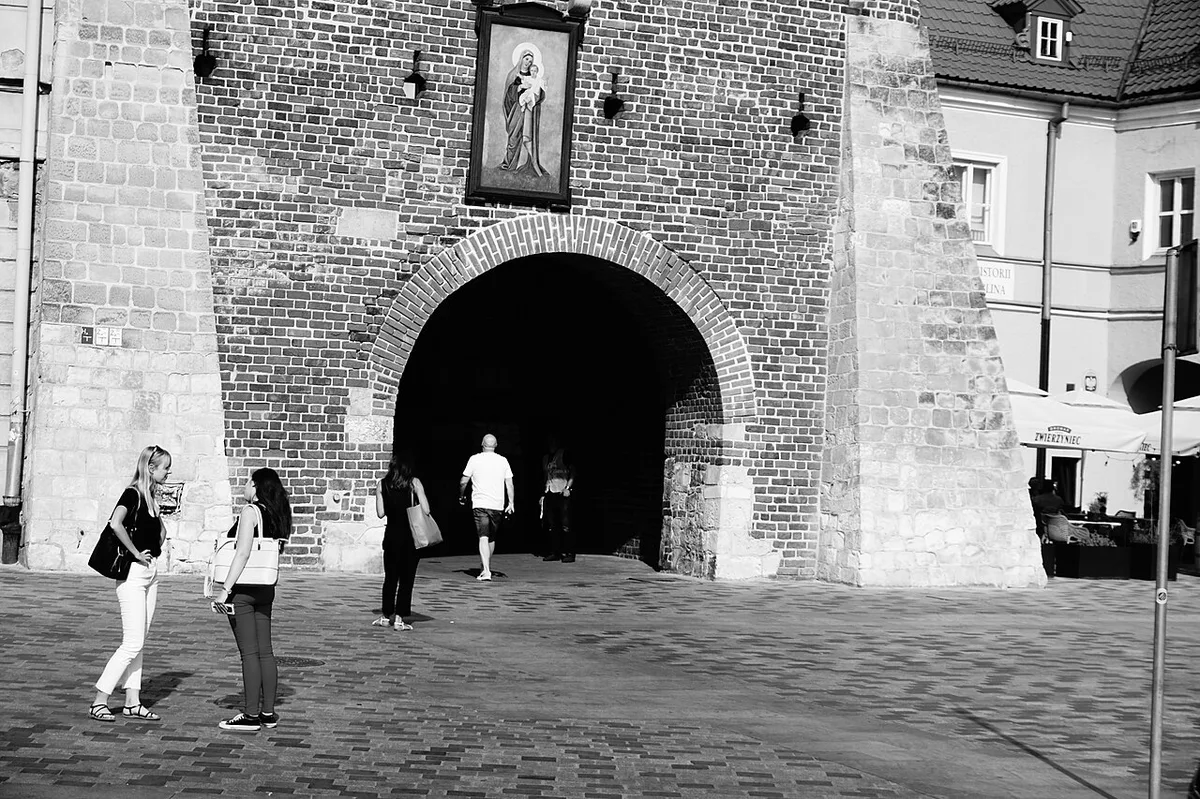
Start Here: Kraków Gate (Brama Krakowska)
The walk begins at the Kraków Gate (Brama Krakowska), the squat, Gothic-brick tower that is Lublin's most recognisable symbol and the main entrance to the Old Town from Krakowskie Przedmieście, the pedestrian promenade that runs through the heart of the city. Built in the 14th century, it's the only surviving gate of the original medieval city walls, and standing in its shadow for a moment before entering the Old Town is a good way to shift gears from the busy promenade outside.
Inside the gate is a small but worthwhile Historical Museum branch — a few rooms tracing Lublin's royal and mercantile past, with maps and artefacts that help you understand how the city grew around this exact entry point. Entry runs around 10–15 PLN (roughly €2.50–3.50) as of 2026; confirm on-site. The real draw, though, is the viewpoint from the top: it's not the most dramatic panorama in the Old Town (the Trinitarian Tower beats it decisively), but it's a decent orientation before you've seen anything else. If you're genuinely short on time, walk through the arch and keep moving — the gate itself is the landmark, and the interior can wait for a return visit.
The Rynek and the Crown Tribunal
Through the gate you enter the Old Town Market Square (Rynek), and Lublin delivers exactly what the name promises: a proper medieval square ringed with painted townhouses in ochre, terracotta and cream, sloping gently with the hill beneath. It's smaller than Kraków's Grand Market, which is part of its charm — a square you can actually linger in without being jostled by tour groups.
The building that dominates the centre is the Crown Tribunal (Trybunał Koronny), the former highest court of the Polish-Lithuanian Commonwealth for the province of Lesser Poland. It's an elegant, arcaded Renaissance-and-Baroque structure, and worth pausing in front of to appreciate the fact that real geopolitical power was once exercised here — the Union of Lublin (1569), which joined Poland and Lithuania into the largest state in Europe, was signed not far away. Today the Tribunal building also houses the entrance to the Lublin Underground Route, the flagship medieval-cellar tour I mentioned in the intro. If you've pre-booked an English-language tour, you'll check in here at the Rynek.
Take time to walk the perimeter of the square and look at the painted tenement facades. They're not identical — each has its own colour and proportions — and a few hide atmospheric courtyards behind their street-level archways. The square is pedestrianised and lined with café terraces in summer. This is the heart of the Old Town, and it rewards slow time far more than a quick snapshot on the way through.
The Underground Route runs guided tours at set times, and English-language departures fill up — especially in summer. Book online or by phone before your visit. The cellars stay at around 8–12 °C year-round, so bring a light layer even on a warm day. Tickets run approximately 20–30 PLN (roughly €5–7); confirm current prices when booking.
Trinitarian Tower Climb and the Cathedral
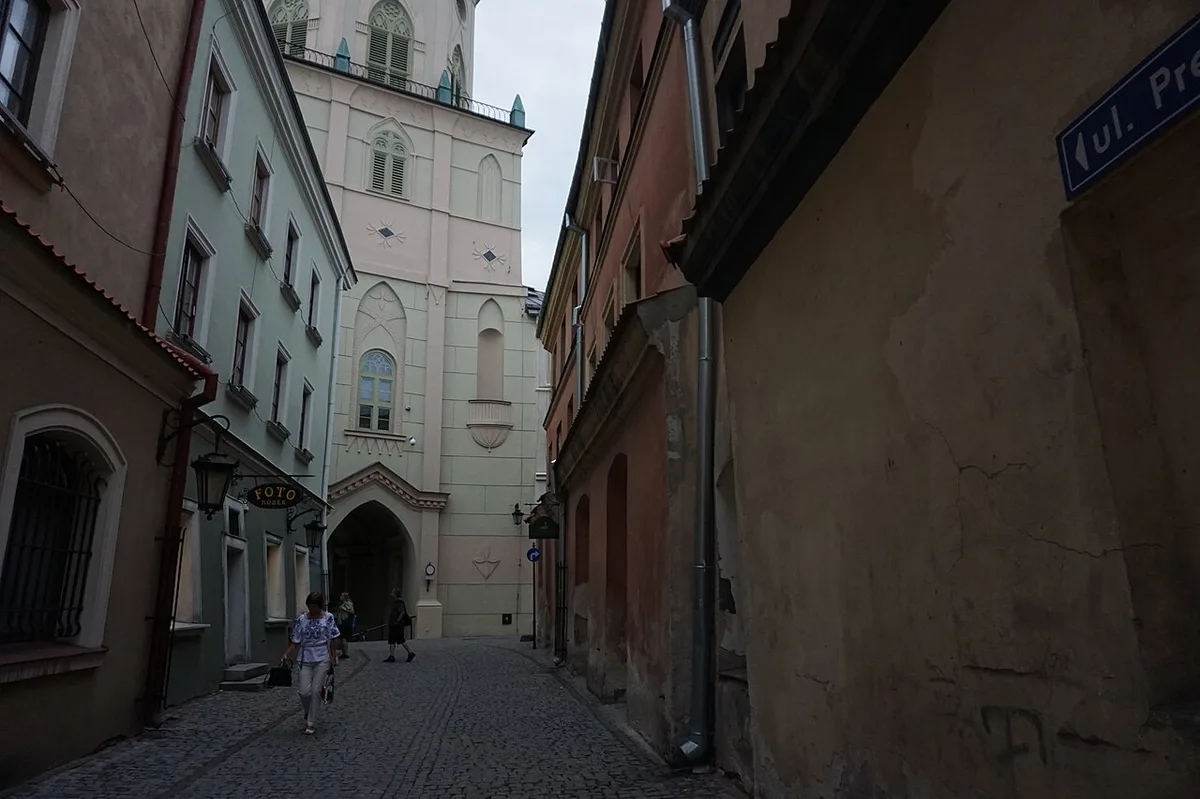
From the Rynek, a short walk brings you to the Trinitarian Tower (Wieża Trynitarska), the tallest structure in the Old Town and the best viewpoint in Lublin's historic core. Climb to the top — it houses the Archdiocesan Museum on the way up, so you're walking through a small collection of sacred art as you ascend — and you get a panorama over the terracotta rooftops of the Old Town, the green hill crowned with the white castle, and the modern city spreading beyond. On a clear day you can see exactly why travellers who make the effort to reach eastern Poland talk about Lublin with real warmth: it has the look of a proper historic city, compact and readable from above in a way that a younger or flatter place can never be.
Budget 20–30 minutes here: long enough to walk the tower's small museum floors and stand at the top without rushing. The building's own history adds an unexpected layer — the tower was built by the Trinitarian Order, a religious order whose charism was ransoming prisoners of war from Ottoman captivity. Entry runs around 10–15 PLN (roughly €2.50–3.50) as of 2026; confirm on-site.
Immediately beside the Trinitarian Tower stands the Lublin Cathedral (Archikatedra św. Jana Chrzciciela i Jana Ewangelisty). Its Baroque exterior is handsome, but the interior holds two specific things worth seeing. The first are the trompe-l'œil ceiling frescoes — look up and you'll see painted architectural illusions that make the vault appear far higher and more elaborately sculpted than it actually is. The second is the Acoustic Sacristy, a small room behind the high altar where the curved walls bounce sound in an uncanny way: whisper at the wall and the person across the room hears you clearly. Entry to the cathedral itself is free; the Acoustic Sacristy may require a small ticket or a timed guide visit. Allow 15–20 minutes here at minimum.
Grodzka Gate — Threshold to Jewish Lublin
Continue downhill from the Cathedral toward the Grodzka Gate (Brama Grodzka), a medieval gateway at the southern end of the Old Town. Historically it stood at the exact boundary between the Christian Old Town and the densely populated Jewish district that spread downhill below it — which is why it's often called the "Gate of Memory" or the "Jewish Gate." That Jewish quarter, once one of the most significant centres of Jewish life and learning in Europe, was destroyed during the German occupation. Today nothing remains of it at street level on the far side of the gate.
The gate itself is now the home of the Grodzka Gate – NN Theatre (Brama Grodzka – Teatr NN), a remarkable cultural institution dedicated to preserving the memory of Jewish Lublin through exhibitions, archives, educational programmes and performances. Even a brief walk through the gate's entrance space, with its pre-war photographs and maps of the vanished quarter, carries real weight. Most visitors end up staying longer than planned — the captions and images make the absence of what was once there feel concrete and personal, not abstract.
Lublin was, for centuries, one of the great centres of Jewish learning in the world. The Yeshiva of the Wise Men of Lublin (Yeshivat Chachmei Lublin), once the largest yeshiva in the world when it opened in 1930, still stands on ul. Lubartowska, a short walk north of the Old Town — a sobering side-trip if you have the afternoon. Its history, and the near-total erasure of the community that built it, is part of what gives Lublin genuine historical depth rather than just picturesque facades.
The Castle Approach
From Grodzka Gate, look uphill and you'll see the white neo-Gothic towers of Lublin Castle (Zamek Lubelski) rising above the Old Town on its hill. The approach — a cobbled lane winding up from the gate — is part of the experience. The castle sits at the natural endpoint of the Old Town walk, a ten-minute climb from the gate.
The oldest part of the castle is the round keep (stołp), a Romanesque tower from the 13th century and one of the oldest surviving stone structures in eastern Poland. The neo-Gothic palace surrounding it was built in the 19th century over the earlier medieval structure, and today houses a branch of the National Museum in Lublin. Entry runs around 25–30 PLN (roughly €6–7) as of 2026; the castle is typically closed one weekday (usually Monday — confirm before you go).
The single most precious thing inside is the Holy Trinity Chapel (Kaplica Trójcy Świętej) — a Gothic chapel commissioned by King Władysław Jagiełło and covered entirely in remarkable Byzantine-Ruthenian frescoes (1418), a fusion of Eastern and Western medieval art that exists nowhere else in Poland in quite this form. A separate (modest) ticket is required, and photography is often restricted — which is appropriate. This is one of the genuine marvels of Central European medieval art, and the restraint in presenting it matches the work. Budget 45–60 minutes for the castle complex and chapel combined. For a complete guide to how this fits with everything else Lublin offers, see our overview of things to do in Lublin.
Practical Notes for the Old Town Walk
The Old Town is fully pedestrianised and hilly — comfortable walking shoes are non-negotiable. The loop from Kraków Gate to the castle and back is roughly 1.5–2 km with some genuine uphill sections. Here's a quick summary of what to expect at each stop in 2026.
| Stop | What it is | Approx. cost (2026) | Time needed |
|---|---|---|---|
| Kraków Gate | 14th-c. Gothic city gate; Historical Museum + viewpoint | ~10–15 PLN (≈€2.50–3.50) for museum; walking through free | 15–30 min |
| Rynek & Crown Tribunal | Medieval market square; Crown Tribunal building; Underground Route entrance | Free (square); Underground Route ~20–30 PLN | 20–40 min (longer with Underground tour) |
| Trinitarian Tower | Tallest tower; best panorama; Archdiocesan Museum | ~10–15 PLN (≈€2.50–3.50) | 20–30 min |
| Cathedral (Archikatedra) | Baroque church; trompe-l'œil ceiling frescoes; Acoustic Sacristy | Free (church); small fee for sacristy | 15–20 min |
| Grodzka Gate / NN Theatre | Medieval gate; exhibition on vanished Jewish Lublin | Free to enter; check for paid exhibitions | 20–30 min |
| Lublin Castle | National Museum branch; 13th-c. round keep; Holy Trinity Chapel frescoes | ~25–30 PLN (≈€6–7); chapel ticket separate | 45–60 min |
If you're building this into a longer stay, our 2-day Lublin itinerary puts the Old Town walk on Day 1 and layers in Majdanek, the Open-Air Village Museum and the Underground Route so nothing overlaps. It's the cleanest way to do Lublin justice without doubling back on yourself.
Lublin Old Town at a Glance
- Start point: Kraków Gate (Brama Krakowska) — the 14th-century Gothic brick gate on Krakowskie Przedmieście, the main entry into Stare Miasto.
- Main square: The Rynek with the Crown Tribunal at its centre — the former highest court of the Polish-Lithuanian Commonwealth, now also the Underground Route entrance.
- Best panorama: Climb the Trinitarian Tower (Wieża Trynitarska) — the tallest point in the Old Town, with rooftop views to the castle.
- Don't miss: Grodzka Gate (Brama Grodzka / NN Theatre) — the threshold to the vanished Jewish quarter, one of the most affecting stops in any Polish city.
- Crown jewel: Holy Trinity Chapel inside Lublin Castle — Byzantine-Ruthenian frescoes from 1418, unique in Poland.
- How long: 2–3 hours for the full loop; 3–4 hours if you book the Underground Route (strongly recommended).
Frequently Asked Questions
What is Lublin Old Town (Stare Miasto) like?
Lublin's Stare Miasto is a small, hilly, beautifully restored medieval quarter — the real thing, with a proper market square (the Rynek), Gothic gates, painted tenement facades, and a castle on a hill above. It's far less crowded than Kraków's Old Town and rewards a slow, on-foot morning. The compact layout means you can cover all the main sights in two to three hours, though the Underground Route beneath the Rynek deserves an extra 45 minutes if you book ahead.
How long does it take to walk Lublin's Old Town?
Allow two to three hours for a comfortable walk from the Kraków Gate to the Castle, taking in the Rynek, the Trinitarian Tower, the Cathedral, and Grodzka Gate along the way. Add 45 minutes to an hour if you book the Lublin Underground Route beneath the market square. The whole area is compact — the route from gate to castle is roughly 1.5 km — but the castle itself adds a worthwhile 45–60 minutes on top of that.
Can you climb the Trinitarian Tower in Lublin?
Yes. The Trinitarian Tower (Wieża Trynitarska) is open to visitors and houses the Archdiocesan Museum on its upper floors. Climbing to the top gives the best panoramic view in the Old Town — rooftops, the castle hill, and the city beyond. Entry costs around 10–15 PLN (roughly €2.50–3.50) as of 2026; confirm current hours and prices on-site or with the Archdiocese of Lublin before your visit. Allow 20–30 minutes for the climb and the small museum.
What is Grodzka Gate in Lublin?
Grodzka Gate (Brama Grodzka) is a medieval gateway at the southern end of the Old Town, historically the threshold between the Christian city and the Jewish quarter that spread below it. The Jewish district was destroyed during the German occupation of World War II. Today the gate houses the Grodzka Gate – NN Theatre (Teatr NN), a cultural institution dedicated to preserving the memory of Lublin's Jewish community through exhibitions and archives. Spending 20–30 minutes here is one of the most affecting stops in any Polish city.
Is Lublin Old Town free to visit?
Walking the streets, the Rynek, and the area around Grodzka Gate is entirely free. Individual attractions charge modest fees: the Kraków Gate Historical Museum and the Trinitarian Tower each run around 10–15 PLN (approximately €2.50–3.50); the Lublin Underground Route is approximately 20–30 PLN (approximately €5–7) for a guided tour; Lublin Castle with its National Museum branch costs around 25–30 PLN (approximately €6–7). The Cathedral is free to enter. Confirm all prices and opening hours on official sites before you visit, as they can change seasonally.
Lublin's Old Town earns its place on any eastern Poland itinerary — and for my money it beats a lot of better-known Polish city centres on the combination of genuine medieval atmosphere, historical depth, and the near-total absence of crowds. The walk from Kraków Gate to the castle takes in more layers of Polish history — royal, multiconfessional, Jewish, and the profound weight of what was lost — than you'll fit into two hours the first time around. Plan to come back to the things you skimmed.
For the single most memorable attraction in the Old Town, the Underground Route guide goes into full detail on the cellar tour that starts right under the Rynek — it's the flagship experience and deserves its own dedicated slot. And if you're working out how to fit all of this into a trip, our 2-day Lublin itinerary shows exactly how to sequence the Old Town walk alongside the castle, Majdanek, and the Open-Air Village Museum. For the full city picture, see things to do in Lublin.
You might also like


Continue reading
More guides you'll find useful


