

Piotrkowska Street, Łódź: The Complete Guide
Last updated June 2026.
If you only have time for one thing in Łódź, make it Piotrkowska Street — the long, theatrical spine that the whole city is built around. At roughly 4.2 km it is one of the longest commercial streets in Europe, and its pedestrianised core is where Łódź's industrial past, street-art present, and café culture all collide in a single walk. Locals call it "Pietryna", and the affection in that nickname tells you everything: this is the street they actually use, not a museum piece behind glass.
I have walked Piotrkowska in summer crowds and in a grey February drizzle, and it works in both. Our editors keep coming back because it is honest about what Łódź is — a 19th-century textile boomtown reinventing itself rather than a polished medieval old town. This guide covers how to orient yourself, the bronze monuments and hidden courtyards worth slowing down for, where to eat, how the rickshaws work, and the few things you can safely skip. For the wider picture, our roundup of the best things to do in Łódź puts Piotrkowska in context alongside Manufaktura and Księży Młyn.
Walking Piotrkowska: Orientation From Plac Wolności to Plac Niepodległości
The simplest way to understand Piotrkowska is as a straight north–south line between two squares. The northern anchor is Plac Wolności (Liberty Square), a roundabout-shaped plaza with the Kościuszko Monument at its centre and the Museum of the City's archaeology and history collections nearby. The southern anchor is Plac Niepodległości (Independence Square), a more workaday transport hub. Between them runs the famous pedestrian stretch — and this is the part virtually every visitor means when they say "Piotrkowska".
That walkable core is around 2 km on its own, which sounds short until you factor in how often you will stop. As of 2026 the pavement is studded with bronze figures, the brass stars of the Walk of Fame of Łódź (honouring the city's film industry), and side passages that pull you off the main drag. I budget two to three hours to do it properly. Start at Plac Wolności and walk south — the early stretch gives you the best first impression.
One honest note: the genuinely interesting density is concentrated in roughly the first kilometre south of Plac Wolności, plus the cluster around OFF Piotrkowska further down — you do not need to march the full 4.2 km. Manufaktura, the giant red-brick mill complex, sits a short walk northwest of Plac Wolności, so most people fold the two together into one day. If you want that mapped out hour by hour, our 2-day Łódź itinerary sequences Piotrkowska, Manufaktura, and Księży Młyn into a route that does not double back.
To help you pace it, here are the key stops from north to south — comfortably a half-day on foot without backtracking.
| Stop | What | Note |
|---|---|---|
| Plac Wolności | Northern square with the Kościuszko Monument and the city museum | Best place to start; Manufaktura is a short walk northwest |
| Pasaż Róży | Mirror-mosaic courtyard by Joanna Rajkowska, near the northern end | Easy to miss from the street — step inside |
| Gutenberg House | One of the street's most ornate facades, with printing-themed sculptures | Look up as you pass the northern half |
| Gallery of Great Citizens bronzes | Tuwim's bench, Rubinstein's piano and Reymont's trunk | All free; rub Tuwim's nose for luck |
| Manufacturers' Table | Bronze of textile barons Poznański, Scheibler and Grohman | A nod to the money that built the street |
| OFF Piotrkowska (no. 138/140) | Former cotton-mill courtyards — craft beer, street food, design | The street's food and nightlife heart |
| Plac Niepodległości | Southern anchor and transport hub | Most visitors turn back before here |
The Gallery of Great Citizens: Łódź's Bronze Storytellers
The detail that makes Piotrkowska more than just a long shopping street is the Gallery of Great Citizens of Łódź (Galeria Wielkich Łodzian) — a scattered set of life-size bronze monuments honouring people who shaped the city. They are not behind ropes; they sit on the pavement, and half the fun is spotting them as you walk. Three are essential.
- Julian Tuwim's bench — the poet Julian Tuwim, born in Łódź, sits on a bench with one hand resting on it. The tradition is to rub his nose for luck, and you can see how polished it has become from decades of hands. It is the single most photographed monument on the street and a good meeting point.
- Artur Rubinstein's piano — a bronze grand piano commemorating the world-famous pianist, another Łódź native. It is a quieter, more elegant monument than Tuwim's and easy to walk past if you are not looking down.
- Władysław Reymont's trunk — the Nobel Prize-winning author, who set his novel Ziemia obiecana (The Promised Land) in Łódź's textile-baron world, is shown seated beside a travelling trunk. It is a fitting tribute in a city whose whole identity is bound up with that book and the Wajda film made from it.
You will also pass the Walk of Fame stars and, at Plac Wolności, the Kościuszko Monument. None cost a thing, and together they turn a simple stroll into a low-key treasure hunt — which is why I rate Piotrkowska so highly for a first afternoon, and why the bronze hunt keeps children moving down the street better than any guided tour would.
OFF Piotrkowska: The Courtyard That Reinvented the Street
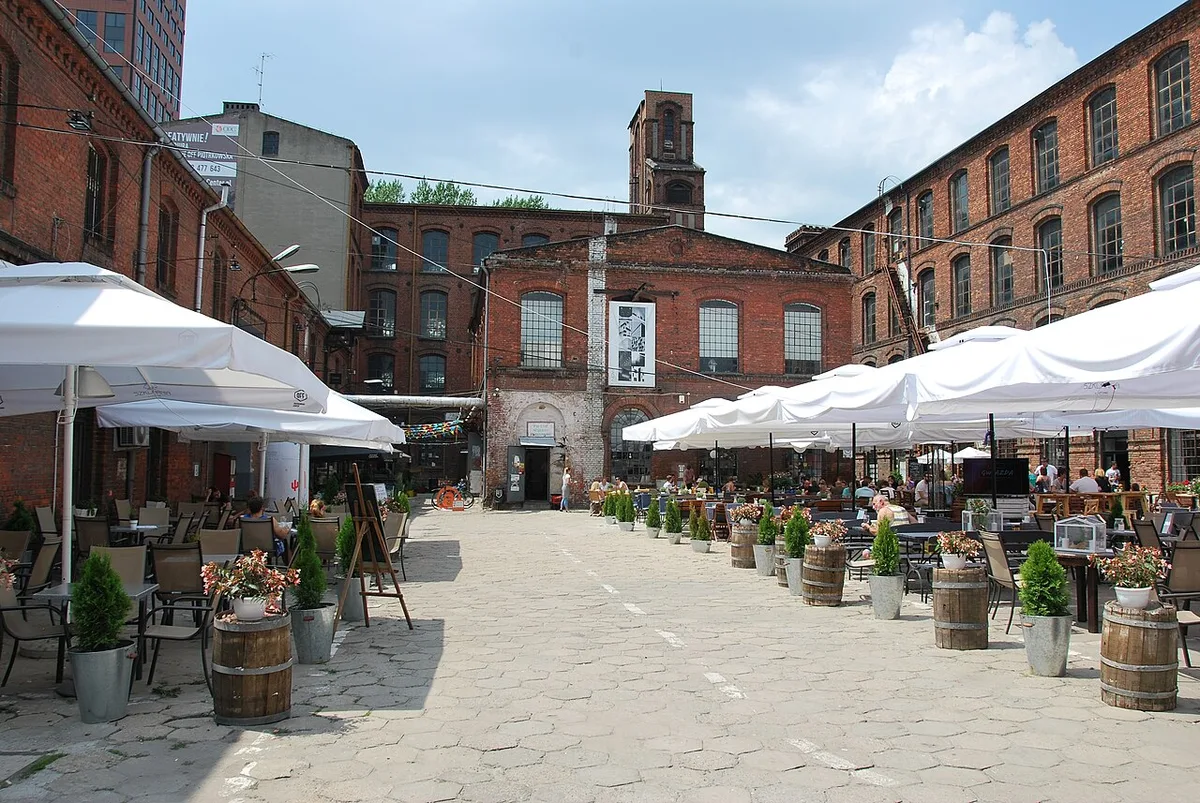
If the bronzes show you Łódź's past, OFF Piotrkowska Center shows you its present. Tucked behind the facades at around ul. Piotrkowska 138/140, it occupies the courtyards of a former cotton mill — raw red brick, exposed pipework, and graffiti, now filled with craft-beer bars, burger and street-food joints, design studios, concept shops, and creative offices. It is the clearest single expression of how Łódź has turned its industrial bones into something young and alive.
I treat OFF Piotrkowska as a destination in its own right rather than a passing stop. Daytime is relaxed — good for a coffee, a long lunch, or browsing independent designers — while evenings tip into one of the liveliest nightlife pockets in the city. The mix changes as tenants come and go, so do not arrive with a fixed list; just walk the courtyards and follow whatever looks busy. Because food is half the reason to come, OFF Piotrkowska anchors a lot of Łódź's casual eating scene — I have written up the standout spots in our full where to eat in Łódź guide.
Palaces, Tenement Facades, and Murals Just Off the Street
Look up. Piotrkowska is essentially an open-air gallery of late-19th and early-20th-century architecture, built when textile money flowed and every factory owner wanted a statement address. The facades run from neo-Renaissance to eclectic to Art Nouveau, and the further you slow down, the more rewarding it gets. The Goldfeder Palace (Pałac Maksymiliana Goldfedera) around Piotrkowska 77 is one of the more ornate examples, and there are restored tenement frontages all along the northern half. Many have peeling neighbours right next door — that uneven mix of grand and gritty is the real texture of the street, and I would not want it sanded smooth.
Two courtyards are worth ducking into. Pasaż Róży (the Rose Passage), near the northern end, is a tenement courtyard covered in shimmering mirror-mosaic by artist Joanna Rajkowska — easy to miss from the street, magical once you are inside. Elsewhere, the side streets around Piotrkowska are part of Łódź's celebrated Urban Forms collection of large-scale murals by Polish and international artists. You do not need a tour to enjoy them; just glance down the cross-streets as you walk and you will spot full-building paintings looming over the rooftops.
Be honest about expectations, though: Łódź has no medieval market square, no castle, no postcard old town — and Piotrkowska is not pretending to be one. Its appeal is the texture of a working industrial-era boulevard, monuments at your feet, art on the gable ends, and a creative scene growing out of old mills. If that is your kind of city, you will love it.
Where to Eat and Drink on Piotrkowska
Piotrkowska is wall-to-wall cafés, bars, and restaurants, and the quality genuinely spans the range from tourist-trap to excellent. The northern, more polished stretch has the classic café terraces — fine for a coffee and people-watching, though the most prominent street-front spots charge a small location premium. For better value and more atmosphere, I steer toward OFF Piotrkowska and the side passages, where independent kitchens and craft-beer bars do casual food well.
Prices in 2026 remain a genuine draw: a good coffee runs roughly 12–18 PLN (around €3–4), a casual main often 30–50 PLN (around €7–12), and Łódź sits comfortably below Kraków and Warsaw. For something regional, look out for zalewajka — the local sour-rye soup — alongside the usual pierogi. Check current prices on the door, since spots open and close faster than any guide can keep up. For specific picks across budgets, see our dedicated Łódź restaurants and food guide, plus the Manufaktura dining hall to the north for choice under one roof on a rainy evening.
Rickshaws, Practicalities, and What to Skip
The most charming way to cover ground on Piotrkowska is by rickshaw (riksza). Cycle rickshaws have ferried people up and down the pedestrian stretch for years, and because cars are banned from the core, they are a genuinely useful — and very Łódź — way to rest your feet over the longer distances. They are not a fixed-fare public service, so agree the price before you set off; expect a modest sum for a ride along the central stretch, and treat it as a novelty hop rather than serious transport.
For everything else, walking is the answer in the centre. Beyond the flat pedestrian core, Łódź's extensive MPK tram network gets you to Manufaktura, Księży Młyn, and the stations. The main rail hub, Łódź Fabryczna, is a short walk from the southern end of Piotrkowska, so the street is easy to reach the moment you arrive by train.
What to skip: do not feel obliged to walk the entire 4.2 km — the southern reaches thin out into ordinary city street, and you get the best of Piotrkowska in the first kilometre plus OFF Piotrkowska. I would also skip the pricier touristy street-front cafés at the very top in favour of the courtyards. And if your time is tight, prioritise Piotrkowska and Manufaktura over the modest Old Town to the north.
Beyond the Bronzes: The Walk of Fame, Manufacturers' Table, and Pavement Plaques
The three Great Citizens bronzes get the photographs, but Piotrkowska hides a whole second layer of monuments that rushed visitors stride straight past. Łódź effectively gave birth to Polish cinema — the legendary National Film School is here — so the street honours it underfoot with the HollyŁódź Walk of Fame, brass stars set into the pavement for the country's directors, actors, and cinematographers. As of 2026 there are well over ninety stars and the row keeps growing; I catch myself reading names off the ground as much as looking up at the facades.
Watch the pavement again near the junction with Nawrot and Tuwima streets, where hundreds of small oblong plaques are laid edge to edge. This is the citizens' monument first installed in 2000 — it engraves thousands of ordinary Łódź residents' names into the street itself, running roughly between numbers 98 and 146. It is one of the most democratic monuments I have ever walked over: no kings or generals, just the people who actually built the city.
For the barons who built the fortunes, look for the Manufacturers' Table (unveiled in 2002), a bronze gathering of the three textile kings — Izrael Poznański, Karol Scheibler, and Henryk Grohman — whose mills bankrolled the whole boulevard. And do look up at the Gutenberg House, widely rated the most beautiful facade on the street, its sculptures celebrating the printed word. None of it is ticketed; it is all just part of the free open-air museum the street has quietly become.
Every monument on Piotrkowska's trail — the bronzes, the Walk of Fame stars, the Manufacturers' Table, the pavement plaques and the murals down the side streets — is free and out in the open. You can fill an entire afternoon on this open-air museum without paying a single złoty.
When to Walk Piotrkowska: Time of Day, Seasons, and the Light Festival
Piotrkowska changes character by the hour. I like it early, when the street is quiet enough to actually photograph the facades and read the pavement plaques without dodging crowds. By late afternoon the café terraces fill, and after dark the centre of gravity shifts south to OFF Piotrkowska, where the courtyards turn into the city's busiest nightlife pocket. If you only get one window, an evening stroll captures the buzz while a morning one captures the architecture.
Season matters less than you might expect, because so much of the appeal is the street itself rather than the weather. Summer is the obvious peak — terraces spill across the pavement and the people-watching is at its best — but I have happily walked Pietryna in a grey February drizzle, ducking between cafés. Spring and early autumn hit the sweet spot of mild days and thinner crowds.
The one date worth planning around is the Light Move Festival (Festiwal Kinetycznej Sztuki Światła), Łódź's projection-mapping light festival, usually held over a weekend in autumn, when Piotrkowska's tenement facades are washed with animated light shows and the whole street fills after dark. Exact dates move year to year, so check the current programme before you build a trip around it.
If you want the Light Move Festival, confirm the precise dates first — it typically lands on an autumn weekend and pulls big evening crowds onto Piotrkowska, so book a central room early. Outside the festival, no booking is needed: the street is free and open around the clock.
Piotrkowska Street at a Glance
- What it is: One of Europe's longest commercial streets (~4.2 km), with a pedestrianised core running from Plac Wolności to Plac Niepodległości — the heart of Łódź.
- Don't miss: The Gallery of Great Citizens bronzes — Tuwim's bench (rub his nose for luck), Rubinstein's piano, and Reymont's trunk.
- For atmosphere: OFF Piotrkowska Center (around no. 138/140), a former cotton mill turned craft-beer, street-food, and design hub.
- How long: Allow 2–3 hours for the walkable core; pair it with Manufaktura, a short walk northwest, for a full day.
- Getting around: Walk the core, or take a cycle rickshaw (riksza) — agree the price first; Łódź Fabryczna station is a short walk from the southern end.
- Useful link: Piotrkowska Street (Wikipedia)
Frequently Asked Questions
How long is Piotrkowska Street in Łódź?
Piotrkowska Street is around 4.2 km long, making it one of the longest commercial streets in Europe. The pedestrianised core that most visitors mean — running from Plac Wolności in the north to Plac Niepodległości in the south — is roughly 2 km, and the genuinely interesting density is concentrated in the first kilometre plus the area around OFF Piotrkowska. You do not need to walk the entire length.
What is the Gallery of Great Citizens on Piotrkowska?
The Gallery of Great Citizens of Łódź is a set of life-size bronze monuments set along the pavement of Piotrkowska, honouring people connected to the city. The three best known are the poet Julian Tuwim's bench (rub his nose for luck), pianist Artur Rubinstein's piano, and Nobel-winning author Władysław Reymont's travelling trunk. They are free to visit and turn a simple walk into a treasure hunt.
What is OFF Piotrkowska?
OFF Piotrkowska Center is a former cotton-mill courtyard complex at around ul. Piotrkowska 138/140, reborn as a hub of craft-beer bars, street food, burger joints, design studios, and concept shops. It is the clearest example of Łódź turning its industrial buildings into something young and creative — relaxed by day and one of the liveliest nightlife pockets in the city after dark.
Is Piotrkowska Street worth visiting?
Yes — Piotrkowska is the single best reason to visit Łódź. It rewards travellers who enjoy industrial-era architecture, street art, bronze monuments, and a lively café and bar scene rather than a polished medieval old town. Łódź has no historic market square or castle, so set expectations accordingly, but if post-industrial reinvention appeals to you, Piotrkowska delivers more character than most Polish streets.
How do you get around Piotrkowska Street?
The pedestrianised core is flat and best walked, since cars are banned. Cycle rickshaws (riksze) ferry people up and down the central stretch — agree the price before you set off, as fares are not fixed. Beyond the centre, Łódź's extensive MPK tram network reaches Manufaktura, Księży Młyn, and the stations, and Łódź Fabryczna rail station is a short walk from the southern end of the street.
Piotrkowska is the thread that ties the whole of Łódź together — its monuments, its mills-turned-bars, its murals, and its café terraces all hang off this one long street. Walk it slowly, look up at the facades and down at the bronzes, duck into a courtyard or two, and you will understand why locals are so fond of "Pietryna". It is not a postcard old town, and it does not try to be; it is a working, evolving boulevard with more genuine character than its reputation suggests.
Give it a relaxed half-day, fold in Manufaktura just to the north, and you will have seen the best of central Łódź. From here, plan your meals with our Łódź food guide, slot the street into a full route with our 2-day Łódź itinerary, or step back for the bigger picture in our guide to the best things to do in Łódź.
You might also like


Continue reading
More guides you'll find useful


