

Gdynia Orłowo Guide: Cliff, Pier & Beach
Last updated June 2026.
Every city needs a neighbourhood that earns the phrase "you have to walk it." In Kraków it's the Old Town; in Lublin it's Stare Miasto. Gdynia, the boldly modern port city built from a fishing village in two decades, doesn't have a medieval core — and it doesn't pretend to. What it has instead is Orłowo — spend a morning there and you'll understand why Gdynia residents talk about it the way people in other Polish cities talk about their historic quarters.
Orłowo sits in the southern part of the city, about 8 km from the centre along the coast. It combines a genuinely dramatic sea-cliff, a charming wooden pier, a quiet beach still dotted with fishing boats, a nature-reserve forest you can walk through to the clifftop, and a network of genteel villa-lined streets that feel like a different city from the purposeful modernist blocks of the waterfront district. In 2026, it remains Gdynia's most satisfying on-foot neighbourhood — the place where the city's character snaps into focus. This guide tells you exactly how to see it, in order, without wasting time on the bits that don't pay off. For the full city picture, start with our overview of things to do in Gdynia.
Why Orłowo — and Why It Matters That Gdynia Has No Old Town
I want to address this directly, because it shapes how you should frame your visit. Gdynia was built almost entirely between the wars — from 1918 to 1939, Poland turned what had been a small fishing village on the Baltic into a functioning deep-water seaport, an act of national will that makes the city an architectural and historical anomaly. The result is a city of 1930s functionalist Modernist buildings, a working port, museum ships, and wide pedestrian promenades — but no cobblestoned medieval core, no Gothic church looming over a Rynek, no castle on a hill.
This is not a flaw. It's exactly what makes Gdynia different from Gdańsk (which has all those things in abundance) and worth visiting as its own destination rather than just as the northernmost stop on the SKM commuter rail. But it does mean that if you come to Gdynia expecting Stare Miasto, you will be disappointed. Come instead for the sea, the ships, the modernist streets, and — on this side trip to the south — for Orłowo, which gives you cliff-top drama, a wooden pier, and a landscape that rewards an easy half-day.
The sensible approach is to do the city-centre sights — Skwer Kościuszki, the Southern Pier, the museum ships — on your first morning, then make your way to Orłowo by early afternoon. If you're planning a two-day stay, our 2-day Gdynia itinerary puts Orłowo on Day 2, which is the right call: the cliff path and the pier are better in the softer afternoon light, and you want the morning energy for the Dar Pomorza and the Emigration Museum.
Stop One: Kamienna Góra Viewpoint (and the Funicular)
If you're coming from the city centre on foot rather than taking the SKM direct to Orłowo, the route south along the coast takes you through Kamienna Góra — a low, wooded hill district between the modernist centre and Orłowo, and Gdynia's most underrated free attraction. The hill carries elegant interwar villas, shaded walking paths, and a viewpoint terrace at the top with what I'd argue is the best panorama in the city: the whole arc of the bay, the port, the Southern Pier, and on a clear day the dark line of the Hel Peninsula curving away to the northeast.
The funicular (kolejka linowa) up from the coastal promenade is a short ride — one of those modest pleasures that locals use daily and visitors tend to overlook. It's worth taking at least one way; the views from the car looking back across the bay are good, and the practical reason to ride up rather than walk is that the hill path down toward Orłowo on the far side is much gentler. At the top, a small white cross marks the summit and there are café options with terrace seating. Budget 20–30 minutes here; it's a logical pause before the cliff walk, and the contrast with the flat modernist city below underlines how varied Gdynia's topography actually is.
The Kamienna Góra funicular runs seasonally and on reduced hours outside of summer — check current times locally before banking on it as your route up. The footpath is a perfectly good alternative and is clearly signposted from the coastal promenade. If you're arriving by SKM at Gdynia Orłowo, skip Kamienna Góra for the outward journey and visit it on your way back north toward the centre; the path connects naturally.
The Orłowo Cliff (Klif Orłowski) and the Kępa Redłowska Nature Reserve
The Orłowo Cliff (Klif Orłowski) is the centrepiece of the whole area and the reason the neighbourhood punches above its weight as a Baltic attraction. It's a proper sea-cliff — roughly 15–20 metres of actively eroding glacial till and sand, dark and layered where the Baltic has cut into it, topped with a dense mixed forest that is part of the Kępa Redłowska nature reserve. The reserve protects a narrow wooded promontory above the cliff edge, and the walking paths through it — some right at the cliff top, others a few metres back in the trees — are among the most atmospheric walks in Gdynia.
Out on the clifftop path, the combination of the forest canopy above and the open sea below feels genuinely dramatic — not in a manicured park way, but in the way that genuinely wild coastal edges feel. The cliff is eroding, and in places sections of the path have been cut back or fenced off as the edge retreats; this is part of what makes it a nature reserve rather than a promenade. Pay attention to signage and stay on the marked paths. The erosion is also what makes it visually striking: fresh cross-sections of glacial sediment, exposed roots, and irregular overhangs.
The reserve can be entered from the Orłowo side (coming up from the beach/pier area) or from the north via paths through the Kamienna Góra area. A full traverse of the reserve's main path runs roughly 2–3 km one way. There is no entrance fee for the reserve itself — it's a public nature area, free to walk. What you're paying with is time and comfortable footwear; the paths are uneven and can be muddy after rain.
The Wooden Pier and the Beach
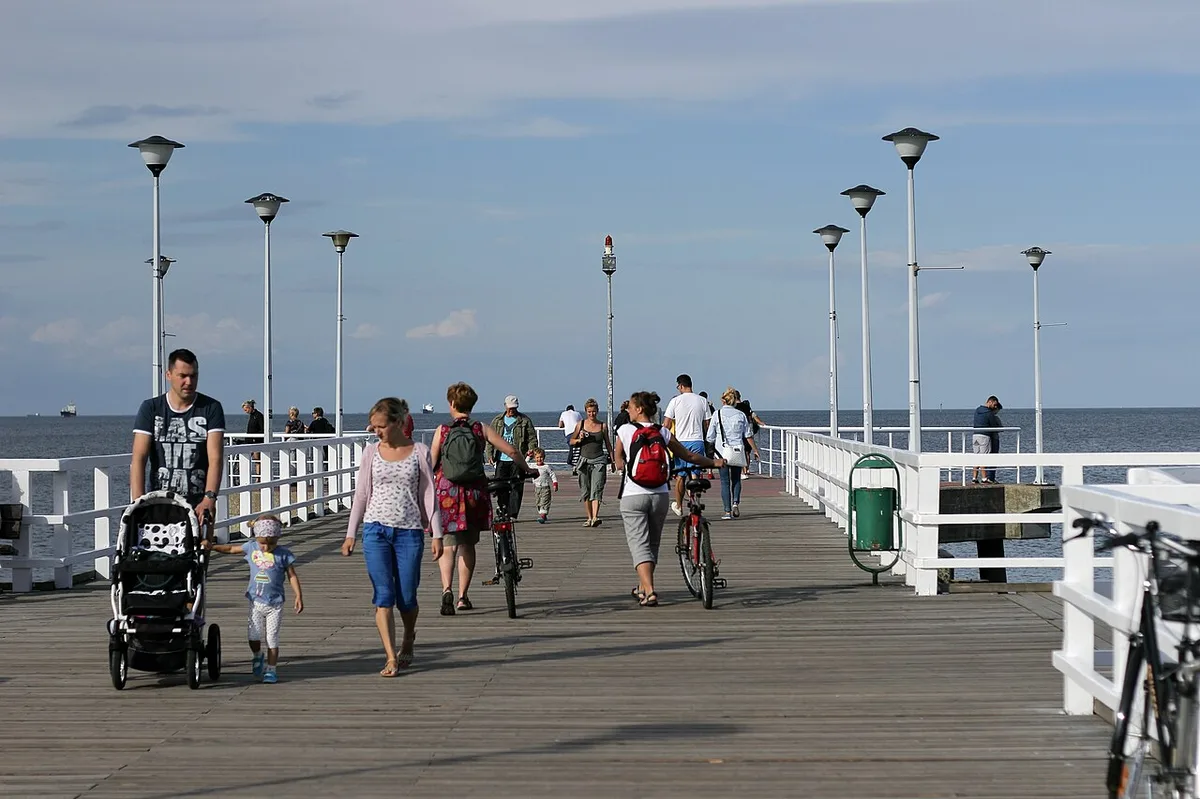
Below the cliff, at sea level, Orłowo splits into two distinct spaces worth separate attention. The first is the Orłowo Pier (Molo w Orłowie), a modest wooden structure jutting into the Baltic — shorter and quieter than the famous long Molo in neighbouring Sopot, but with a character all its own. On summer mornings you'll find anglers along its length; in the afternoon it fills with families and a few couples doing that specifically Baltic thing of sitting on a bench watching the sea. The views back toward the cliff from the end of the pier are excellent — this is the best angle from which to appreciate the scale of Klif Orłowski.
The pier is free to walk, open year-round, and takes about 10 minutes end-to-end at a gentle pace. It is not the main event in Gdynia the way Sopot's Molo is the main event in Sopot — but paired with the cliff, it completes the Orłowo package in a way that makes the whole thing feel satisfying rather than half-finished.
The second space is the beach itself. Orłowo beach is narrower and quieter than Gdynia's City Beach to the north, and the cliff backdrop gives it an atmosphere you don't get from a flat strip of sand. Old wooden fishing boats are usually pulled up above the tide line — Orłowo retains a trace of the fishing-village character that the rest of Gdynia long since shed. The water is Baltic: bracing even in July, genuinely swimmable in August if you've calibrated your expectations. This is not a Mediterranean beach. It is an excellent Baltic beach — clean, relatively uncrowded, and dramatically framed.
Orłowo beach gets noticeably busier on hot weekends in July and August — if you want the fishing-boats-at-dawn atmosphere rather than the busy-strand one, aim for a weekday morning or a visit in late May or early September. Shoulder-season Orłowo is, in my opinion, actually better: the light is lower, the cliff colours are richer, and you'll have the pier almost to yourself.
The Villa Streets — Orłowo's Landward Half
Most visitors to Orłowo come for the cliff and the pier and turn straight back north. I'd suggest spending an extra 30–40 minutes walking inland through the residential streets that make up the villa district behind the beach. This is the part of Orłowo that really earns the word "genteel."
The streets — particularly ul. Orłowska and the lanes off it — are lined with interwar villas: two-storey houses in rendered brick and stucco, many with wooden verandas and established gardens. Some are modest; a few are quietly grand. The architectural style is the same interwar Modernism that defines the Gdynia city centre, but in a smaller, residential scale — functionalist houses designed for the professional classes who built the new Poland in the 1930s. The neighbourhood survived the war and postwar periods in reasonable shape and feels, more than anywhere else in Gdynia, like a preserved social world as much as a preserved architectural one.
Walk it for the atmosphere rather than any specific landmark; the enjoyment is cumulative. When you're ready to eat, there are a handful of cafés and small restaurants along the waterfront — for a broader guide to where to eat around Gdynia, including the best fish-fry bars near the coast, see our Gdynia restaurant guide.
Getting There, Timing, and What to Skip
Orłowo is well served by the SKM (Szybka Kolej Miejska) Tricity commuter rail. The stop is Gdynia Orłowo, about 8 minutes from Gdynia Główna. Trains run frequently during the day — buy a ticket at the platform machine, validate it before boarding. Current transport updates and seasonal notices for the whole city are posted on the official portal, gdynia.pl. The station puts you about a 5-minute walk from the pier. This is the cleanest approach: quick, reliable, and no parking to think about.
On foot from the city centre along the coastal promenade, allow about 40–50 minutes — scenic but longer than most visitors want to add to a day that already includes the Southern Pier. Coming via Kamienna Góra (funicular + clifftop path) adds roughly 30 minutes over the direct coastal walk but is the more interesting route.
Below is a quick summary of what to budget for each part of the Orłowo visit, as of 2026.
| Stop | What it is | Cost (2026) | Time needed |
|---|---|---|---|
| Kamienna Góra funicular | Short cable-car ride up the hill; bay panorama at the top | Around 5–10 PLN (≈€1.20–2.40); confirm on-site | 20–30 min including viewpoint |
| Kępa Redłowska reserve + cliff path | Clifftop forest walk; sea views; Klif Orłowski; uneven terrain | Free | 45–90 min (partial to full traverse) |
| Orłowo Pier (Molo w Orłowie) | Wooden pier; sea views; anglers; best angle on the cliff | Free | 15–20 min |
| Orłowo beach | Quiet Baltic beach; fishing boats; cliff backdrop | Free | 30 min–2 hrs (swimming season Jul–Aug) |
| Villa streets | Interwar residential architecture; Orłowska and surrounding lanes | Free | 30–40 min walk |
| SKM Gdynia Orłowo (return) | Commuter rail back to Gdynia Główna or onward to Sopot/Gdańsk | Around 4–6 PLN (≈€1–1.50); confirm current fares | 8–12 min ride |
What to skip: There is no admission-based attraction in Orłowo worth paying for — the cliff, the reserve, the pier, and the beach are all free and are the point. Don't be lured by any souvenir stands near the pier into spending time or money there. If you've already done a long cliff walk and are tired, you can skip the villa streets without losing anything irreplaceable; the landward half is a bonus, not the main event.
Gdynia Orłowo at a Glance
- What it is: Gdynia's signature coastal quarter — a sea-cliff nature reserve, wooden pier, quiet fishing-boat beach, and interwar villa streets. The city has no medieval old town; Orłowo is what you come for instead.
- Getting there: SKM commuter rail to Gdynia Orłowo (~8 min from Gdynia Główna). Or walk via the coastal promenade (~40 min) or Kamienna Góra (~50–60 min, more scenic).
- Centrepiece: Klif Orłowski — the eroding sea-cliff in the Kępa Redłowska nature reserve. Clifftop forest paths, free to walk, uneven terrain. Best views from the end of the wooden pier looking back at the cliff face.
- The pier: Molo w Orłowie — a quiet wooden pier with Baltic views. Free, open year-round, 10 min end-to-end. Anglers in the morning; families in the afternoon.
- Don't miss: Kamienna Góra viewpoint on the way — best panorama over the bay, short funicular option, free to walk.
- How long: Half-day comfortably — 3–4 hours including Kamienna Góra, the cliff path, the pier, and the villa streets.
Frequently Asked Questions
What is Orłowo and why should I visit it in Gdynia?
Orłowo is a coastal quarter in the southern part of Gdynia, about 8 km from the city centre. Unlike most Polish cities, Gdynia has no medieval old town — it was built from scratch between the wars as a modern seaport. Orłowo is its signature neighbourhood: a combination of the Orłowo Cliff (Klif Orłowski) in the Kępa Redłowska nature reserve, a charming wooden pier (Molo w Orłowie), a quiet beach with fishing boats, clifftop forest walking paths, and genteel interwar villa streets. It gives Gdynia visitors the atmospheric, on-foot neighbourhood experience that other Polish cities get from their historic quarters.
How do I get to Orłowo from Gdynia city centre?
The easiest way is the SKM commuter rail — take any SKM train from Gdynia Główna toward Gdańsk and get off at Gdynia Orłowo, which is about 8 minutes away. Trains run frequently throughout the day. Buy a ticket at the platform machine and validate it before boarding. From the station it's a 5-minute walk to the pier. Alternatively, you can walk along the coastal promenade (about 40–50 minutes from the centre) or take the more scenic route via the Kamienna Góra funicular and clifftop path, which adds around 30 minutes but is the more rewarding approach.
How long does the Orłowo cliff walk take?
The main clifftop path through the Kępa Redłowska nature reserve runs roughly 2–3 km one way. A partial walk to the best cliff-edge viewpoints and back takes about 45 minutes; the full traverse of the reserve takes 60–90 minutes depending on pace. The terrain is uneven and can be muddy after rain — wear comfortable shoes with grip. The reserve is free to enter and open year-round; some sections near the cliff edge may be fenced off due to active erosion, so stay on marked paths.
Is Orłowo beach good for swimming?
Orłowo beach is a clean Baltic beach with a dramatic cliff backdrop and fishing boats pulled above the tideline. The Baltic Sea is cold — water temperatures in June hover around 15–17°C and reach a swimmable 20–22°C in July and August. If you're used to warm Mediterranean water, the Baltic will feel bracing even at peak summer. That said, Orłowo beach is quiet and well-kept, significantly less crowded than the city beach to the north, and the cliff setting makes it one of the most attractive beaches in the Gdynia area. For swimming, July and August are the realistic window.
Is there an entry fee for the Kępa Redłowska nature reserve?
No. The Kępa Redłowska nature reserve, which contains the Orłowo Cliff walking paths, is a public protected area and free to enter. The Orłowo Pier (Molo w Orłowie) and the beach are also free. The only costs in Orłowo are the SKM train fare (around 4–6 PLN each way as of 2026 — confirm current fares at the machine) and, if you take it, the Kamienna Góra funicular (around 5–10 PLN — confirm on-site). Refreshments at the cliff-side cafés and any restaurant meals are on top of that. Confirm all fares and hours locally, as they can change seasonally.
Orłowo is the proof that Gdynia doesn't need a medieval old town. The cliff, the wooden pier, the fishing-boat beach, and the villa streets make a half-day neighbourhood walk that stands on its own terms — genuinely atmospheric in a way that requires no historical scaffolding, just the Baltic light and a good pair of shoes. The walk rewards every season — June greenery, September light, even a grey October morning when the forest is all dripping beeches and the sea the colour of pewter — and each delivers something slightly different. Aim for a weekday in shoulder season if you can; the experience sharpens considerably when the pier isn't crowded.
If you're building a full Gdynia itinerary, our 2-day Gdynia itinerary puts Orłowo on the morning of Day 2, leaving the afternoon for an SKM hop to Sopot — the right rhythm if you want to see both without rushing either. And for everything else the city has to offer across the Southern Pier, the modernist architecture, and the Emigration Museum, see our full guide to things to do in Gdynia for context and sequencing.
You might also like



Continue reading
More guides you'll find useful


