Krakow Ghetto Heroes Square: History, Symbolism, and Visitor Guide
Last updated July 2026, this guide covers Krakow Ghetto Heroes Square, the memorial plaza known in Polish as Plac Bohaterów Getta in the Podgórze district. The square marks the gathering point where German occupying forces assembled Jewish residents of the Kraków Ghetto before deportation to Bełżec, Auschwitz, and Płaszów. Below you will find the history behind its name changes, the symbolism of the 70-chair memorial, the Eagle Pharmacy museum on its corner, and the tram and footbridge routes that link it to Kazimierz and Schindler's Factory.
What Is Krakow Ghetto Heroes Square? A Quick Answer for Podgórze Visitors
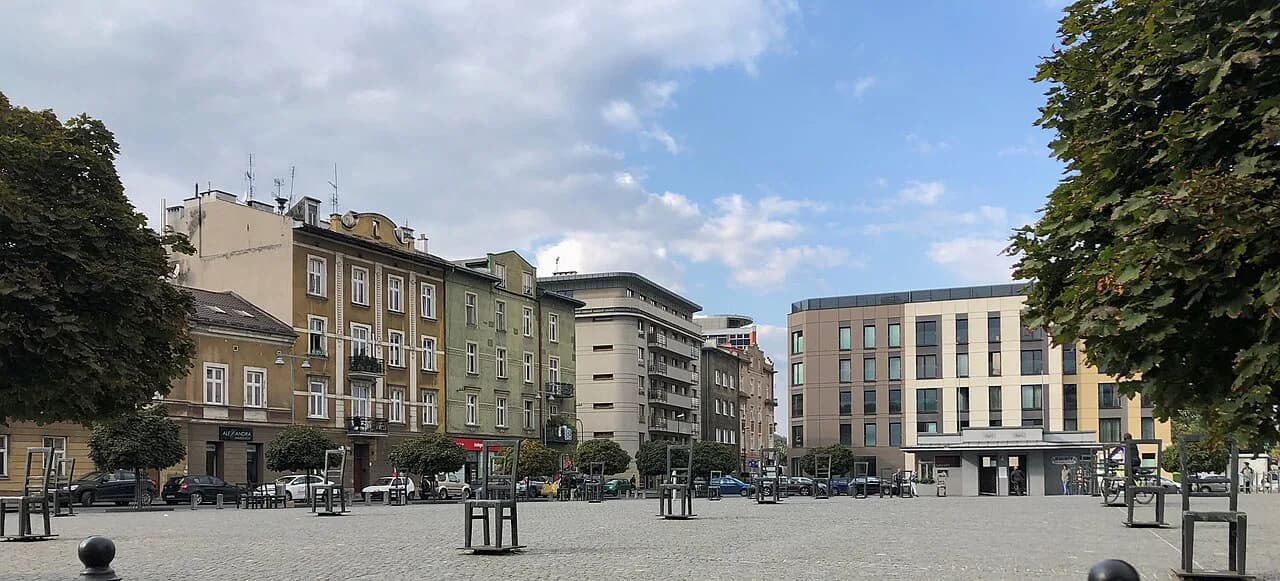
Krakow Ghetto Heroes Square, Plac Bohaterów Getta in Polish, sits in Podgórze, the district across the Vistula River from Kazimierz that the German administration converted into the Kraków Ghetto in 1941. Between 1941 and 1943, the square served as the ghetto's gathering point, where residents assembled with whatever belongings they could carry before transport to concentration and extermination camps. Today the square holds a memorial of 70 chairs and also functions as a working tram interchange. That combination matters for planning: this is an open public square with live traffic, not a closed-off park. For WWII history itineraries in Kraków, it anchors a route that also connects to Schindler's Factory nearby and to the broader Poland WWII history guide for national context.
The German Occupation and Formation of the Kraków Ghetto
German forces occupied Kraków in September 1939, and repressions against the city's Jewish community escalated within weeks.
- Forced labor requirements were imposed on Jewish residents.
- Jewish residents were required to wear armbands marked with the Star of David.
- German authorities confiscated Jewish-owned valuables, businesses, and properties.
- By May 1940, deportations had reduced Kraków's Jewish population from about 70,000 to roughly 15,000 residents.
From Small Market to Zgody Square: How the Name Changed
The square carried three names before its current one, each tied to a different period in Podgórze's history.
- Until around 1880: Mały Rynek, meaning Small Market Square.
- From 1917 to 1948: Zgody Square, meaning Square of Concord.
- From 1948 onward: Bohaterów Getta, meaning Heroes of the Ghetto Square, commemorating the Jewish residents who passed through it.
The Liquidation of the Kraków Ghetto, 1942-1943
The square, still named Zgody Square at the time, saw three major waves of deportation before the ghetto's final liquidation.
The square was renamed from Zgody Square (Square of Concord) to Bohaterów Getta (Heroes of the Ghetto) in 1948, five years after the 1943 liquidation. The delayed renaming means that all three major deportation waves (1942–1943) occurred under the square's previous name.
- Night of 31 May 1942: about 5,000 Jewish residents were deported to Bełżec extermination camp.
- End of October 1942: more than 7,000 residents were deported. The ghetto was then divided into Part A for those able to work and Part B for the elderly and ill.
- 13-14 March 1943: SS-Sturmbannführer Willi Haase oversaw the final deportations. Workers were sent to concentration camps including Auschwitz and Płaszów. Close to 2,000 people were murdered on site during this final action.
Understanding the Empty Chairs Memorial
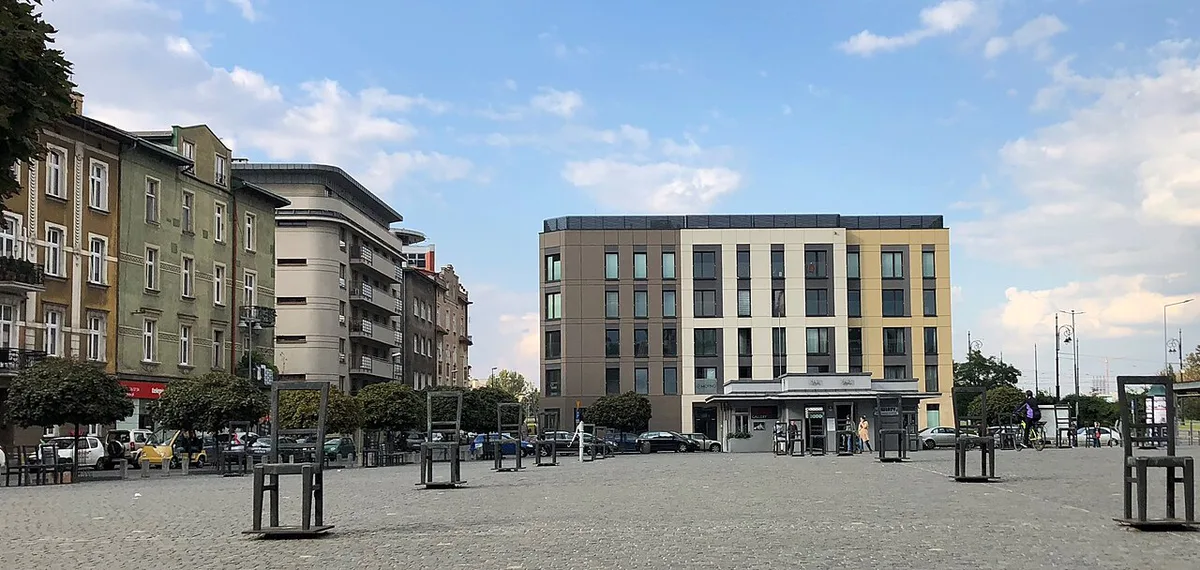
The square's 2005 redevelopment removed the old bus station building and rebuilt it from scratch. Once construction finished, a memorial designed by architects Piotr Lewicki and Kazimierz Łatak was unveiled in the square. The installation totals 70 oversized chairs, commonly cited as a mix of 33 larger chairs and 37 smaller ones, positioned across the open square rather than grouped into rows. The design draws directly on a passage from Tadeusz Pankiewicz's book The Kraków Ghetto Pharmacy, which describes furniture being carried out into the square as houses were cleared after the last ghetto residents had been deported. The empty seats stand in for the people who once filled them, a physical reminder rather than a decorative feature. In 2006 the memorial received a special mention in the European Prize for Urban Public Space competition. In 2011 it won the Gold Award in the Urban Quality Award competition.
The memorial's 70 chairs derive from Tadeusz Pankiewicz's memoir describing residents carrying furniture as the ghetto was cleared. Pankiewicz, the only non-Jewish resident permitted inside the ghetto walls, witnessed these scenes from the Eagle Pharmacy, making the memorial an echo of his testimony.
The Eagle Pharmacy (Apteka Pod Orłem): Tadeusz Pankiewicz's Legacy
At number 18 on the square stood the Eagle Pharmacy, run throughout the ghetto years by Tadeusz Pankiewicz. He was the only non-Jewish resident permitted to live and operate a business inside the ghetto walls. From behind the pharmacy counter he supplied medicine, offered a place of refuge, and helped pass underground news between residents. The building today houses a branch of the Krakow Museum (Muzeum Krakowa), with exhibits on the pharmacy's wartime role. The square itself is free and open at all times, but the pharmacy museum charges admission. Check the official Krakow Museum website for current 2026 opening hours, ticket prices, and any free-entry days before you go.
Planning Your Visit: Trams, Walking Routes, and Timing
The square functions as an active transit hub, so plan around both the memorial and the tram traffic crossing it.
| Aspect | Details |
|---|---|
| Getting there by tram | Tram lines 3, 8, 19, and 24 stop at "Plac Bohaterów Getta." |
| Walking from Kazimierz | Cross the Father Bernatek Footbridge, then continue into Podgórze. |
| Time needed | About 20 minutes for the square alone; 60 to 90 minutes with the Eagle Pharmacy museum. |
| Cost | The square is free and public; the pharmacy museum requires a ticket. |
The Memorial Circuit: Combining the Square with Nearby WWII Sites
Ghetto Heroes Square works best as one stop on a longer route through Podgórze's wartime sites. Schindler's Factory museum is about a five-minute walk from the square, making it a natural next stop after the memorial. Fragments of the original ghetto wall still stand on Lwowska Street and Limanowskiego Street, giving a physical sense of how the ghetto was enclosed. For the deportation story that continues past this square, the Płaszów concentration camp site received many of the workers sent from here in 1943. If you are comparing ghetto histories across Poland, the Warsaw Ghetto uprising sites guide covers a different city's wartime geography. For a change of era entirely, the Rynek Underground Museum covers medieval Kraków rather than WWII history. Travelers extending their trip beyond Kraków can also plan around the Centennial Hall in Wrocław, a separate UNESCO-listed stop.
Visitor Etiquette and Mistakes to Avoid
Ghetto Heroes Square commemorates a site of mourning, not a photo backdrop.
- Avoid posed photos sitting on the memorial chairs; treat the installation as a monument, not a prop.
- Watch for active tram traffic crossing the square at all hours; it is a working transit hub, not a pedestrian-only zone.
- Visit outside peak tram commute hours if you want a quieter, less crowded experience.
Walking from Kazimierz: The Most Useful Route
The clearest walking approach starts in Kazimierz near Plac Wolnica or Corpus Christi Basilica, then follows Mostowa Street to the Father Bernatek Footbridge over the Vistula. After crossing into Podgórze, continue through the riverside streets toward Plac Bohaterów Getta rather than treating the square as an isolated tram stop. This route helps the geography make sense: Kazimierz was the historic Jewish quarter before the German occupation, while Podgórze became the enclosed ghetto area in 1941.
Allow roughly 15 to 25 minutes depending on where you start in Kazimierz. The walk is usually more meaningful than taking a short tram because it shows the physical separation created by the river and places the square within the wider Podgórze route. From the square, you can continue to the Eagle Pharmacy on the corner, the ghetto wall fragments on Lwowska or Limanowskiego streets, and then Schindler’s Factory in Zabłocie.
What to Expect Inside the Eagle Pharmacy Museum
The Eagle Pharmacy museum is worth adding if you want the square to feel less abstract. It is a compact Krakow Museum branch inside the former Apteka Pod Orłem at Plac Bohaterów Getta 18, so the visit focuses on rooms, objects, documents, and testimonies rather than a large chronological exhibition.
Inside, the recreated pharmacy setting helps explain why Tadeusz Pankiewicz’s position mattered: the counter, cabinets, medicines, and back rooms became part of the ghetto’s informal support network. Exhibits cover the pharmacy’s role as a meeting point, a source of medicine and hair dye, a place where news circulated, and a witness point during deportations from the square outside. Allow about an hour if you want to read the displays carefully, and visit it before or after standing among the chairs so the two sites reinforce each other.
For trip-planning details, see Poland - Wikivoyage and Poland - Wikipedia.
Frequently Asked Questions
How many chairs are in the Krakow Ghetto Heroes Square memorial?
The memorial installation totals 70 oversized chairs, commonly cited as a mix of 33 larger chairs and 37 smaller ones, scattered across the square.
Why was the square renamed several times?
It was called Mały Rynek (Small Market Square) until around 1880, then Zgody Square (Square of Concord) from 1917 to 1948, before taking its current name, Bohaterów Getta (Heroes of the Ghetto Square), from 1948 onward.
Is Krakow Ghetto Heroes Square free to visit?
Yes. The square itself is open and free at all times. The Eagle Pharmacy museum on its corner, run by the Krakow Museum, charges admission, so check the official Krakow Museum website for current 2026 prices and hours.
How much time should I plan for a visit?
Budget about 20 minutes for the square and memorial alone. Add 60 to 90 minutes if you also enter the Eagle Pharmacy museum.
How do you get to Ghetto Heroes Square from Kazimierz?
Walk across the Father Bernatek Footbridge from Kazimierz into Podgórze, or take tram line 3, 8, 19, or 24 to the "Plac Bohaterów Getta" stop.
You might also like


Continue reading
More guides you'll find useful