
Exploseum Visitor Guide: 7 Things to Know Before You Go
The Exploseum sits in the forested southern edge of Bydgoszcz, built into the surviving concrete bunkers of a former Nazi Germany explosives factory. Visitors follow a marked, roughly two-kilometer route through eight preserved production buildings and the underground passages that once carried nitroglycerin between them. This exploseum visitor guide covers what you actually need for a 2026 visit: current ticket tiers, the route's physical demands, and how to get there without wasted time. It's one of the more unusual stops among the attractions in Bydgoszcz, and a fair share of planning it well comes down to logistics rather than exhibits.
The History of DAG Fabrik Bromberg and Alfred Nobel
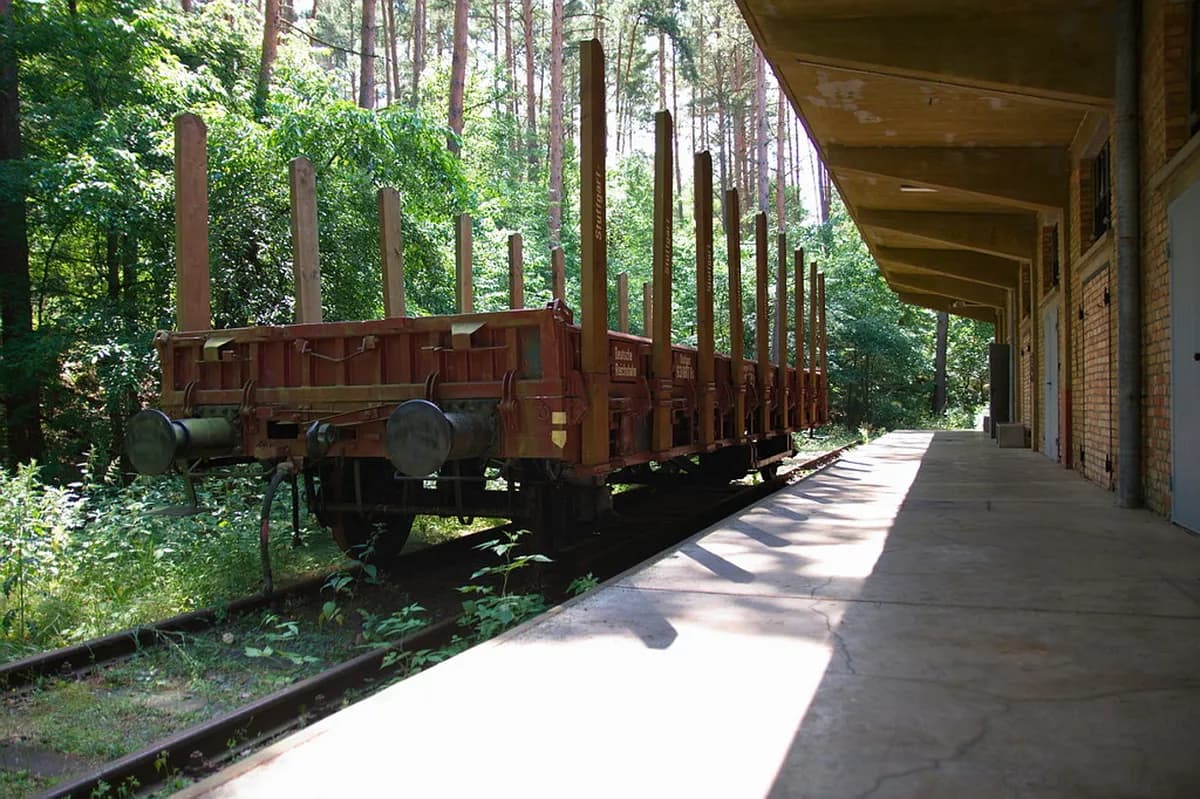
Alfred Nobel's Dynamit-Aktien-Gesellschaft (DAG) grew into Germany's largest explosives manufacturer, and during WWII its Bromberg plant became one of the largest munitions complexes in the Third Reich's war economy. At its peak the site covered roughly 23 square kilometers, with more than 1,000 buildings connected by 400 km of internal roads and 40 km of railway track. Today the museum preserves eight of those original structures, linked by the same tunnel network that once moved raw materials between production stages.
The factory depended on forced labor almost from the start. Around 1,000 Jewish women were transported here from the Stutthoff concentration camp system to work in munitions production, alongside prisoners of war and civilian laborers brought in from across occupied Europe. By late 1944 the site ran 18 forced-labor camps with residential barracks for a workforce that at its height numbered 30,000 to 40,000 people. Exhibits inside the buildings document individual stories through period photographs, testimonies, and camp records, per the European Route of Industrial Heritage (ERIH) - Exploseum, so the numbers don't stay abstract.
Only eight of the original 1,000-plus buildings survive in a state open to the public, and that gap is part of what makes the site land emotionally. To hide the plant from Allied reconnaissance, builders painted structures khaki and planted moss and vegetation on the roofs; a decoy factory model was reportedly built roughly two kilometers away to confuse aerial reconnaissance in 1944. Walking the quiet, wooded grounds today, it's easy to underestimate just how vast this one factory once was.
Exploring the Exploseum: Tunnels and Architecture
The self-guided route begins at the Production Preparation Building and finishes at the Rolling Building and warehouses, passing along the way through the Glycerin Nitration Building, Acid Denitration Building, Acid Flushing Building, Nitroglycerin Stabilization Building, and Gelatinization Building. Buildings were deliberately spaced apart and their doors never faced one another, a safety measure meant to contain any single accidental explosion. The path is one-way, with staff stationed at intervals, so there's no risk of getting lost — but there's also no shortcut back once you're partway through.
Pro tip: several underground passages have a clearance close to 1.9 meters (about 6 ft 3 in). Visitors around that height rarely need to duck, but if you or a travel companion is taller, watch your head in the lower sections near the acid-handling buildings. The corridors aren't shoulder-width tight, but stretches run dim and enclosed for several hundred meters at a time, worth knowing if you're prone to claustrophobia.
Accessibility is easy to overlook here because the history dominates the planning conversation, but it's worth a specific mention. The route mixes gravel forest paths, uneven concrete floors, and short staircases between certain buildings; the museum has added stair lifts in some sections for wheelchair users, though not every stretch of the 2km loop is step-free. Visitors using wheelchairs, or traveling with a stroller, get the most out of a visit by contacting the museum in advance to confirm which buildings are reachable that day — most unrestored industrial ruins in Poland offer no accommodation at all, so Exploseum's partial adaptation is unusual even where it falls short of full access.
- Route at a glance
- Length: about 2 kilometers, one-way
- Tunnel clearance: roughly 1.9 meters in the lowest sections
- Buildings on the route: 8
- Typical walking time: about 2 hours
Essential Visitor Info: Tickets, Prices, and Discounts
Standard admission runs 25 PLN for a normal ticket and 20 PLN reduced (students, seniors), with a family ticket covering up to 2 adults plus 3 children for 80 PLN. Groups of 10 or more pay 18 PLN per person, and children under 7 always enter free. The self-guided permanent exhibition is what these prices cover; the guided Alternative and Extreme routes that reach deeper, less-accessible tunnels cost an additional 25 to 60 PLN depending on route and ticket type.
Opening hours split by season, which catches a lot of first-time visitors off guard. From April through October the museum is open Tuesday to Sunday, 10:00 to 18:00, closed Mondays year-round. March runs shortened hours of 9:00 to 15:00 ahead of the full season, and the site closes entirely from November through February for winter — so anyone building an off-season Poland itinerary around Bydgoszcz needs a backup plan for those months. Last entry to the permanent exhibition is roughly one hour before closing.
Budget around two hours for the standard route, longer if you add a guided Alternative or Extreme route or you're visiting with kids who want to linger at the multimedia displays. Per the Tymrazem Travel Blog - Exploseum Guide, most independent visitors comfortably cover the full 2km loop within that window without feeling rushed.
- Ticket price breakdown
- Normal: 25 PLN
- Reduced: 20 PLN
- Family (2 adults + 3 children): 80 PLN
- Group (10+ people): 18 PLN per person
- Guided Alternative/Extreme routes: +25 to 60 PLN
- Children under 7: free
Location: Navigating the Bydgoszcz Forest
The Exploseum sits on ul. Alfreda Nobla, roughly 9 kilometers southeast of Bydgoszcz's Rynek (Market Square), inside the Bydgoszcz Industrial and Technological Park and its surrounding forest. By car, the route runs via ul. Glinki and ul. Bydgoskich Przemysłowców before the signposted turn onto ul. Alfreda Nobla itself; the last stretch is clearly marked, so the drive is straightforward even the first time. Onsite parking is free and rarely fills up outside of school-group peak times.
Public bus route 68E connects the site to central Bydgoszcz for visitors without a car, though services run less frequently than in the city center, so check current timetables before relying on it for a same-day return trip. If you're staying in the Bydgoszcz Old Town, a taxi or rideshare takes about 15 to 20 minutes each way and is the more reliable option outside of bus 68E's peak hours. Cyclists can also reach the site via forest trails, though surfaces get uneven after rain.
The surrounding Bydgoszcz Forest is popular with locals for walking and cycling, and pairing the museum with a stroll through the woods makes for a full afternoon out. Mobile signal is patchy in parts of the industrial park, so download an offline map before you set out. Watch for the concrete building shapes appearing through the trees as you approach — it's your cue you're close.
Planning Your Visit: Guided vs. Self-Guided Tours
Most visitors choose the self-guided permanent exhibition, moving through the tunnels at their own pace with multimedia displays and information boards along the route. Exhibition texts are primarily in Polish, so non-Polish speakers relying on signage alone will get the gist but miss some nuance; guided tours in English are available for an added per-person fee and are worth booking if the details matter to you.
Beyond the standard route, the museum also runs a guided Alternative Route and a more physically demanding Extreme Route that push further into deeper, less-accessible tunnels. Both have limited daily capacity and can fill up in peak season, so book ahead by phone (+48 52 58 59 741) or email (exploseum@muzeum.bydgoszcz.pl) rather than showing up and hoping for a slot. A guide adds context on the machinery and the daily lives of the forced laborers that the self-guided signage only summarizes.
Whichever route you pick, the tunnels stay cool year-round, so bring a light jacket even in the height of a Polish summer. Staff are stationed along the one-way path to answer questions, and there's no need to worry about navigation once you're inside — the route only goes one direction.
Educational Value and Group Visits
As a member of the European Route of Industrial Heritage, the Exploseum carries real educational weight for visitors of all ages, not just history specialists. School groups visit regularly to cover chemistry, twentieth-century history, and the ethics of wartime industrial production in one stop, and the museum balances technical detail on explosives manufacturing with the human stories of the people forced to produce it.
Group organizers should contact the Leon Wyczółkowski District Museum in advance to arrange workshops or confirm the 18 PLN-per-person rate for groups of 10 or more. Guided sessions go deeper into the specific explosives produced at DAG Fabrik Bromberg and the machinery involved than the self-guided signage covers. The site's dramatic concrete architecture and forest setting also draw photography groups outside of school-trip season.
The museum periodically hosts temporary exhibitions tied to broader industrial-history and regional-development themes; check the official museum site closer to your 2026 visit date for anything running while you're there. Ticket revenue goes toward maintaining the concrete structures, which take real upkeep given decades of exposure in a forest environment.
Is the Exploseum Worth It? (Review & Verdict)
The Exploseum is a completely different register from the scenic waterfront charm of Mill Island in the city center — it's raw, unpolished, and asks more of you emotionally. That's also its strength: walking through actual production buildings, rather than a curated exhibit about them, gives a sense of scale that photographs and text panels alone don't convey. If the forced-labor history covered here resonates, pairing a visit with a broader look at the camp system feeding sites like this one (Stutthof's museum, further north in Pomerania) rounds out the picture for anyone building a serious WWII-history itinerary through the region.
Pair it with something lighter, like the quirky Museum of Soap in Bydgoszcz, to round out a day that doesn't stay heavy the whole time — the city's museum scene is more varied than its size suggests. The Exploseum's combination of low ticket prices, genuine physical immersion, and a real one-way tunnel walk make it stand out even among Poland's better industrial-heritage sites.
Verdict for 2026: worth planning around, not squeezing in. Budget the full two hours, book ahead if you want the Alternative or Extreme route, and check the seasonal hours before you go, since a Monday or winter arrival with no backup plan is the most common way to miss it. For more ideas nearby, browse our other guides to attractions in Poland.
Frequently Asked Questions
What is Exploseum?
Exploseum is a museum in Bydgoszcz, Poland, built on the site of DAG Fabrik Bromberg, a Nazi Germany explosives and munitions factory operated during WWII with forced labor. It has been run as a branch of the Regional Museum 'Leon Wyczółkowski' since opening to the public in 2011.
How much are Exploseum tickets?
Standard admission is 25 PLN (normal) or 20 PLN (reduced), with a family ticket (up to 2 adults + 3 children) at 80 PLN and group rates of 18 PLN per person for groups of 10 or more. The guided Alternative and Extreme routes cost extra, from 25 to 60 PLN depending on route and ticket type. Children under 7 enter free.
What are Exploseum's opening hours?
In the main season (April to October) Exploseum is open Tuesday to Sunday, 10:00 AM to 6:00 PM, closed Mondays. March has shortened hours (9:00 AM-3:00 PM), and the museum closes entirely for the winter off-season. Last entry to the permanent exhibition is generally about one hour before closing.
Do I need to book tickets in advance?
Reservations are recommended, particularly for the guided Alternative and Extreme routes, which have limited capacity and can fill up quickly. Bookings can be made by phone (+48 52 58 59 741) or email (exploseum@muzeum.bydgoszcz.pl).
How long does a visit to Exploseum take?
A standard visit takes around two hours on foot, covering part of the museum's nearly 2-kilometer network of overground and underground tunnels. The guided Extreme Route goes further and requires more time and physical effort.
Is Exploseum wheelchair accessible?
The museum can accommodate wheelchair users with advance notice and provides stair lifts in some areas, though the site's industrial tunnels and uneven surfaces limit accessibility in places. Contacting the museum ahead of a visit is recommended.
What language are the tours in?
Exhibition texts are primarily in Polish, but guided tours are also available in English for an additional per-person fee. Non-Polish speakers should book an English-language guide in advance.
How do I get to Exploseum from Bydgoszcz city center?
Exploseum sits on ul. Alfreda Nobla southeast of the city center, near the Bydgoszcz Industrial and Technological Park. It's reachable by car via ul. Glinki and ul. Bydgoskich Przemysłowców, or by public bus route 68E.
What is the history behind Exploseum's buildings?
The buildings belonged to DAG Fabrik Bromberg, an explosives and ammunition factory built between 1939 and 1944 for Nazi Germany's Dynamit Aktiengesellschaft (DAG) using forced laborers and prisoners of war from across occupied Europe. At its peak the complex covered about 23 square kilometers, one of the largest DAG plants of the war.
The Exploseum is a powerful, physically immersive way to understand the industrial scale of World War II and the human cost behind it. Walking the preserved DAG Fabrik Bromberg buildings and tunnels gives a perspective no book or documentary quite replicates, and current 2026 pricing keeps it accessible whether you take the standard self-guided route or book one of the deeper guided options. Plan around its seasonal hours, book ahead for the Alternative or Extreme routes if you want them, and it remains one of the most significant industrial heritage sites in Poland.
To verify current details, consult the Exploseum on Wikipedia, Exploseum official site and Exploseum official site.
For more Bydgoszcz planning, read our Things to Do in Bydgoszcz: 2026 Guide to the City's Best Sights and Best Time to Visit Bydgoszcz (2026 Season Guide) guides.


