
13 Best Things to Do in Sopot, Poland
Last updated June 2026 — The first time I walked the length of Bohaterów Monte Cassino, Sopot's main pedestrian promenade, the sea appeared at the far end like a reward: a glittering sliver of Baltic blue framed by the wooden boards of the pier stretching out across it. It took me about fifteen minutes to walk from the SKM station to the waterfront, and in that time I passed the warped, fairy-tale curves of the Crooked House, the terrace cafés filling up with the after-lunch crowd, and a succession of villa-lined side streets that spoke clearly of old resort money. Sopot is not subtle about what it is. It is the Polish Riviera — small, self-assured, and built for pleasure since the early 19th century.
Sopot sits between Gdańsk and Gdynia on the SKM commuter rail, the elegant middle city of the Tricity, and it is by some distance the most overtly glamorous of the three. It has no medieval old town and no working port — its "centre" is a pedestrian promenade and a 511-metre wooden pier, and it makes no apologies for that. Whether it deserves a half-day or two full days depends on what you want from it — our honest verdict on whether Sopot is worth visiting makes the full case. If you're building a wider Tricity trip alongside this, the things to do in Gdynia guide covers the bold modernist seaport twelve minutes north on the SKM. Here are the 13 best things to do in Sopot in 2026.
Key Takeaways
- Sopot Pier (Molo Sopockie) at approximately 511 metres is the longest wooden pier in Europe — walking its full length to the open Baltic is Sopot's defining and irreplaceable experience.
- Bohaterów Monte Cassino ("Monciak") is the city's pedestrian spine: a lively promenade running from the SKM station to the pier entrance, home to the surrealist Crooked House (Krzywy Domek), opened in 2004, and Sopot's best cafés, boutiques, and restaurant terraces.
- Sopot has NO medieval old town — its cultural circuit runs from Monciak to the pier, along the Grand Hotel seafront promenade, to the beaches and marina, and uphill to the Forest Opera in the beech forest above town.
- The Grand Hotel Sopot (now Sofitel Grand Sopot), opened in 1927, is the iconic heritage spa hotel that defines the Polish Riviera's resort character — worth visiting even if you're not staying there.
- The Forest Opera (Opera Leśna) is an open-air amphitheatre in the forest above Sopot; it has hosted the Sopot International Song Contest — one of Europe's oldest continuous pop music festivals — since 1961.
- Sopot connects to Gdańsk (~20 min by SKM) and Gdynia (~12 min by SKM) — making it an ideal Tricity base, and day trips to either city or to the Hel Peninsula in summer are straightforward.
Why Sopot Is the Polish Riviera
Sopot's resort identity stretches back to the early 19th century, when Prussian military physician Jean Georg Haffner opened a bathing establishment here and began marketing the Baltic air and mineral waters to wealthy Germans from Danzig. By 1900 the town had a Grand Hotel, a spa quarter, a casino, and a racing track — and its reputation as a fashionable resort followed it through every subsequent change of political ownership. When Sopot became Polish in 1945 it retained that character entirely. Today it is one of the most expensive places to live in Poland: a city of roughly 35,000 permanent residents that swells many times larger each July and August.
For visitors, the appeal is concentrated and legible. One promenade, one famous pier, one extraordinary hotel, one outdoor concert hall, and a Blue Flag Baltic beach that actually delivers. You can understand the whole city in a single day if you walk it properly — and yet it rewards slowing down and staying longer. For the broader context of Poland beyond the Tricity, our places to visit in Poland guide puts Sopot in a useful national frame.
13 Best Things to Do in Sopot
The 13 picks below cover every layer of what Sopot does well: the pedestrian promenade walk, the surrealist architecture, the pier, the beaches, the lighthouse, the marina, the heritage hotel, the festival opera, the spa-town history, the food and drink scene, and the day trips that put Sopot in Tricity context. I've arranged them to follow a natural route from the SKM station to the seafront and then outward. For the full pier experience — distances, viewing platforms, facilities, and what you can see from the sea end — the Sopot Pier guide has everything in detail.
| Attraction | Type | Time needed | Cost (approx., 2026) |
|---|---|---|---|
| Bohaterów Monte Cassino (Monciak) | Pedestrian promenade | 30 min stroll + café stops | Free |
| Crooked House (Krzywy Domek) | Architecture / shopping | 15–30 min | Free to view; shops inside |
| Sopot Pier (Molo Sopockie) | Historic pier — Europe's longest wooden | 1 hr return walk | ~8–12 PLN (≈€2–3; confirm) |
| Baltic beaches | Sandy Blue Flag beach | Half-day (summer) | Free |
| Sopot Lighthouse | 19th-century lighthouse + views | 30–45 min | Small entry fee (confirm) |
| Sopot Marina | Marina promenade | 30 min stroll | Free |
| Grand Hotel Sopot (Sofitel) | Heritage hotel / seafront terrace | Coffee visit or overnight stay | Coffee from ~25 PLN; rooms from ~600 PLN |
| Forest Opera (Opera Leśna) | Open-air concert venue | Event evening (Sopot Festival, July–Aug) | Ticket required for events |
| Spa-town heritage walk | Architecture / history | 1 hr self-guided | Free |
| Restaurants & beach bars | Food & drink | Lunch or dinner | ~50–120 PLN per head |
| Art Nouveau side streets | Architecture walk | 45 min | Free |
| Day trips by SKM or summer ferry | Day trip | Full day | SKM ticket ~5–8 PLN; ferry seasonal |
- Walk Bohaterów Monte Cassino (Monciak) — Sopot's pedestrian heart
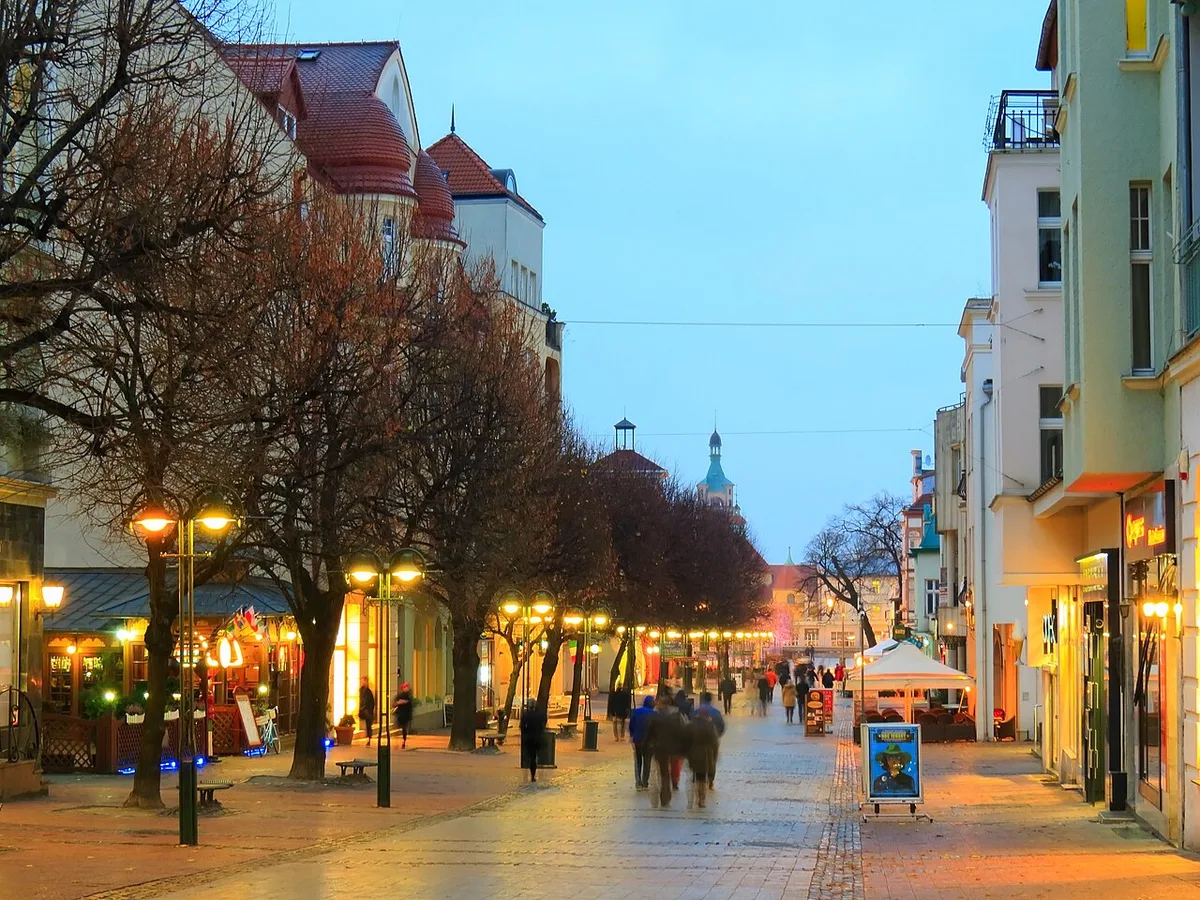
- Every visit to Sopot starts here. Bohaterów Monte Cassino — universally called "Monciak" by locals — is the city's main pedestrian promenade, a wide, cobbled street that runs from the SKM station in a straight line down to the pier entrance and the sea. It takes about fifteen minutes to walk end to end without stopping; with café stops, window shopping, and the unavoidable pause in front of the Crooked House, it absorbs the better part of a leisurely morning.
- Monciak concentrates everything casual about Sopot: amber jewellery shops, ice-cream parlours, craft-beer bars, upmarket restaurant terraces, and the kind of meandering summer crowd that only resort towns generate. It feels festive in a way that is entirely its own — looser and more pleasure-focused than anything in Gdańsk's royal way or Gdynia's purposeful Skwer Kościuszki.
- For the full history of the promenade — the named buildings, the side streets worth ducking into, and the stories behind the villas on either side — our Sopot Monte Cassino promenade guide goes into proper depth.
- See the Crooked House (Krzywy Domek) — Sopot's most photographed building
- The Krzywy Domek ("Crooked House") is one of the most distinctive pieces of architecture in Poland: a shopping centre opened in 2004 on Bohaterów Monte Cassino whose exterior walls and roof undulate in organic, melting curves, the façade clad in iridescent glass that shifts colour in sunlight. Designed by Szotyński and Zaleski, it draws inspiration from the surrealist illustrations of Jan Marcin Szancer and the bent, biological forms of Vienna's Friedensreich Hundertwasser.
- The result is a building that still generates double-takes twenty years later — a genuinely disorienting structure that sits in cheerful contradiction to the neoclassical villas and hotel façades on either side. It is unmissable and thoroughly worth five minutes of careful looking from the opposite pavement before you carry on down to the pier.
- The interior is a conventional modern shopping centre (clothes, cafés, souvenirs), but it is the exterior that matters. It photographs best from slightly further back on the opposite pavement, in morning light when the glass picks up the sun at an angle.
- Walk to the end of Sopot Pier (Molo Sopockie) — the longest wooden pier in Europe
- Sopot Pier is the single most iconic sight in the city and one of the most recognisable images in all of northern Poland. Stretching approximately 511 metres into the Bay of Gdańsk, it is the longest wooden pier in Europe — a 19th-century engineering achievement rebuilt and extended multiple times, still standing on thousands of wooden piles driven into the seabed. Walking its full length and arriving at the railing at the sea end, with open water in three directions and the city receding behind you, is an experience that justifies the entry fee entirely.
- From the far end on a clear day you can see the full arc of the Tricity coast: Gdańsk's skyline to the south, Gdynia's port cranes to the north, and the hazy streak of the Hel Peninsula curling into the bay. The pier has its own character at different times: sunrise brings photographers and joggers; midday in July fills it to the rails; late evening in summer, when the Baltic light lingers and the crowds thin, is the best of all.
- Entry is charged — approximately 8–12 PLN (≈€2–3) as of 2026, but confirm current prices at the gate. The pier is open year-round; winter visits, when the Baltic turns grey and the boards are near-empty, have their own austere appeal. Full details on facilities, seasonal events on the pier, and the best approach on foot are all in our Sopot Pier guide.
- Swim and sunbathe on Sopot's Baltic beaches
- Sopot's sandy beach flanks the pier on both sides and extends north and south along the seafront — wide, well-maintained, and Blue Flag certified. In July and August, when Baltic water temperatures reach 18–22°C, the beach fills quickly; arrive before 10 am to claim a spot without the crowd. The section immediately south of the pier entrance, in front of the Grand Hotel Sofitel promenade, is the most atmospheric — sun-loungers, the hotel's white façade as a backdrop, and the long wooden pier visible from end to end.
- Outside the July–August window, the beach is still worth a walk for the Baltic light alone. The water is genuinely cold outside summer — swimming in June or September is possible but bracing. Beach infrastructure (sun-lounger rentals, food stands, seasonal bars) is solid along the main stretch by the pier and thins out at the northern and southern ends of the seafront.
- Climb the Sopot Lighthouse (Latarnia Morska Sopot)
- The Sopot lighthouse stands near the marina, a short walk from the pier entrance — a handsome 19th-century tower that is open to visitors during the summer season and offers one of the best elevated views of the town: the pier stretching into the bay, the seafront promenade, the beach, and on a clear day the full sweep of the Tricity coast from the Hel Peninsula to Gdynia's cranes. The climb is a tight spiral staircase and the gallery at the top is exposed to the Baltic wind, which only adds to it.
- It's a smaller-scale attraction — 30 to 45 minutes is enough — but the lighthouse adds a vertical perspective to a town otherwise experienced at sea level, and it's the kind of detail that separates a thorough Sopot visit from a quick Monciak-and-pier sprint. Confirm opening hours and entry fees before visiting, as both are seasonal.
- Stroll the Sopot Marina at dusk
- The Sopot marina, tucked between the pier and the lighthouse, is a natural extension of any afternoon on the waterfront. Pleasure yachts and sailing boats fill the berths through summer, and the walkway along the marina edge has a relaxed, end-of-day atmosphere that is better than the busier sections of Monciak at peak hours. The contrast — open water, moored boats, the lighthouse behind you, the pier lit up ahead — is the most quietly pleasant half-hour in Sopot.
- In summer, seasonal passenger boats run from the marina south toward Gdańsk and north along the coast, offering a sea-level view of the Tricity shoreline that you won't get from the SKM. The marina-side bars and restaurants come into their own in the evening, making the marina a natural endpoint for a full Sopot afternoon before dinner.
- Visit (or stay at) the Grand Hotel Sopot — Sofitel Grand Sopot
- The Grand Hotel Sopot — now operating as Sofitel Grand Sopot — is the most historically significant hotel in the Tricity and the building that most completely embodies the Polish Riviera's heritage. Opened in 1927, it sits directly on the seafront promenade between the beach and Monciak, its white neoclassical façade and balconied upper storeys presenting a confident image of resort elegance that time has treated with unusual kindness.
- The hotel has hosted an extraordinary guest list over nearly a century — Marlene Dietrich, Fidel Castro, modern European heads of state — and carries its history visibly in the preserved public areas and the seafront terrace. You don't need to stay here to experience it: the ground-floor bar and terrace are open to non-guests, and the seafront promenade in front of the hotel is one of Sopot's most beautiful evening walks. For accommodation across all budgets — from the Sofitel down to well-priced guesthouses in the side streets — our where to stay in Sopot guide covers the full range.
- See the Forest Opera (Opera Leśna) — home of the Sopot International Song Contest
- The Opera Leśna (Forest Opera) is an open-air amphitheatre set in beech and oak forest on the hills immediately above Sopot, accessed via a pleasant 20-minute walk from the town centre or a short taxi ride. The setting is extraordinary: a covered stage with sightlines into the surrounding trees, an audience capacity of around 5,000, and acoustic intimacy that exposed outdoor venues rarely achieve. On warm summer evenings with the forest dark around the stage, it is a genuinely atmospheric place to hear music.
- The Forest Opera is best known internationally as the venue for the Sopot International Song Contest — the Sopot Festival — one of Europe's oldest continuous pop music events, held annually since 1961 and drawing major international acts alongside Polish stars. The festival takes place in late July or early August each year; tickets sell out well in advance, and the surrounding weeks fill Sopot's hotels at peak prices. Even outside the festival, the venue hosts concerts throughout summer — check the programme at operalesna.pl before your trip.
- Discover Sopot's spa-town heritage — pump rooms, sanatoria, and the 19th-century resort quarter
- Before it became a Polish resort, Sopot was the German spa town of "Zoppot" — a fashionable watering place from the early 1800s built on the curative reputation of Baltic air, mineral-water springs, and purpose-built bathing facilities. The architecture of that era survives in patches: the Pijalnia Wód Mineralnych (the mineral water pump room near the pier), the late-19th-century sanatorium buildings in the streets behind the Grand Hotel, and a scattering of grand villas that speak of the resort's long pre-war history.
- Walking the streets between Monciak and the railway line — particularly Chopina, Kościuszki, and the parallel lanes behind the Grand Hotel — reveals a quieter, older Sopot than the tourist promenade suggests: a town that has been receiving pleasure-seekers for two hundred years and still carries that in its bones. Allow an extra hour for this layer on your second visit to Sopot — or on a slow afternoon after the beach.
- Eat and drink well in Sopot — restaurants, beach bars, and Baltic fish
- Sopot's food and drink scene is strong and varied: upmarket restaurant terraces on Monciak and the seafront, casual beach bars along the boardwalk, Baltic fish restaurants near the pier, and a clutch of excellent cocktail bars that fill up on summer evenings. The cuisine trends toward Polish classics — pierogi, Baltic fish (cod, herring, smoked eel), grilled meats — with a resort-town emphasis on fresh catches and outdoor eating. Prices are noticeably higher than in Gdańsk's old town; budget roughly 50–120 PLN per head for a proper sit-down meal in 2026.
- For specific restaurant recommendations by neighbourhood, price range, and cuisine type — from a lunchtime fish fry near the pier to a reserved dinner on the seafront terrace — our where to eat in Sopot guide covers the full field. One practical note: the best outdoor tables on Monciak and the seafront fill very quickly on July and August evenings — book ahead or arrive before 6 pm.
- Explore Art Nouveau villas and quiet side streets off Monciak
- Sopot's commercial promenade gets most of the visitor attention, but the residential streets that branch off Monciak to either side — particularly heading west toward the railway and east toward the seafront — reveal a different city: a late-19th and early-20th-century resort town of handsome villas, garden-enclosed houses, and occasional grand sanatorium buildings now converted to apartments or boutique hotels. The architectural style is predominantly Art Nouveau and historicist, reflecting the tastes of the Danzig bourgeoisie who built holiday homes here in the 1890s–1920s.
- Walking these streets is free, takes no more than 45 minutes, and provides the physical context for understanding Sopot as a resort town rather than an industrial or administrative city. Look for the streets running parallel to Monciak — Chopina, Emilii Plater, Haffnera — for the densest concentration of preserved villas, many of which still carry the faint grandeur of a century ago despite varying states of upkeep.
- Take a day trip to Gdańsk, Gdynia, or the Hel Peninsula
- Sopot's position at the centre of the Tricity makes it an excellent day-trip base in both directions. Gdańsk is approximately 20 minutes south on the SKM — the medieval Royal Way, the Długi Targ, the European Solidarity Centre, and the Westerplatte memorial are all reachable without a car or a tour. Our things to do in Gdańsk guide covers the full range of what the largest Tricity city offers, including how to plan the old town walk in a single day. Gdynia is approximately 12 minutes north — the Dar Pomorza tall ship, the Emigration Museum in the historic Marine Station, and the Orłowo cliff coast make for a very manageable half-day from Sopot.
- In summer, seasonal passenger boats from the Sopot marina also cross to the Hel Peninsula — the long sandspit curling into the Bay of Gdańsk — for a beach-and-fishing-village day trip that is quite unlike anything on the mainland. Ferries run approximately June through September; book ahead in July and August when they fill quickly. For a full breakdown of all day-trip options from Sopot by rail, boat, and road, our day trips from Sopot guide has everything you need.
Sopot Pier charges a modest entry fee (approximately 8–12 PLN as of 2026 — confirm at the entrance) and is open year-round, though the full summer season (roughly May–September) is when the beach infrastructure, marina boats, seaside bars, and pier-end events run at full capacity. If you're visiting during the Sopot International Song Contest in late July or early August, book accommodation at least two to three months ahead — the festival fills the town completely and rates spike sharply across the whole Tricity.
Things to Do in Sopot at a Glance
- Top sights: Sopot Pier (Molo Sopockie, ~511m — the longest wooden pier in Europe), the Crooked House (Krzywy Domek) on Monciak, the Grand Hotel Sopot (Sofitel), the Sopot Lighthouse, and the Forest Opera (Opera Leśna) in the hills above town.
- Most distinctive character: Sopot has no medieval old town and no port — it is an upscale 19th-century spa-resort town whose cultural circuit runs from the SKM station down Bohaterów Monte Cassino (Monciak) to the pier and the Baltic beach. The resort identity is the product, not a side note.
- Getting there and around: Take the SKM commuter rail to Sopot station — from Gdańsk Główny approximately 20 minutes, from Gdynia Główna approximately 12 minutes. Everything in Sopot is walkable from the SKM: Monciak begins at the station exit and the pier is 15 minutes on foot. The Forest Opera is the one exception — a 20-minute uphill walk or a short taxi ride.
- How long to stay: One afternoon covers Monciak, the Crooked House, and the pier; one full day adds the beach, lighthouse, marina, Grand Hotel terrace, and a proper meal. Two days is more relaxed and allows the Forest Opera, the spa-town back streets, and the Art Nouveau villa quarter. See our how many days in Sopot guide for a full day-by-day breakdown.
- Free highlights: Walking Bohaterów Monte Cassino, viewing the Crooked House exterior, the seafront and marina promenades, the Baltic beaches, and the Art Nouveau side streets.
- Compare individual sights: Use the Sopot attractions hub for entity-by-entity tickets, hours, and visitor tips.
- Book ahead for: The Sopot International Song Contest (late July / early August) and the Open'er Festival in Gdynia (early July) — both fill accommodation across the entire Tricity months in advance.
- Useful links: Sopot (Wikipedia) · Sopot City (official)
How to Get To and Around Sopot
Getting to Sopot is straightforward from anywhere in the Tricity. The SKM (Szybka Kolej Miejska) commuter rail runs frequently from Gdańsk Główny (approximately 20 minutes) and Gdynia Główna (approximately 12 minutes); Sopot station sits at the top of Monciak, within easy walking distance of everything the city offers. Intercity PKP trains also call at Sopot on some routes from Warsaw and Kraków — a useful direct option if you're arriving from outside the Tricity and want to skip Gdańsk for your first night.
Once you're in Sopot, you won't need public transport for the main sights. The pier, the beaches, the Crooked House, the marina, the lighthouse, and the Grand Hotel are all within a 15-minute walk of the SKM station. The Forest Opera is the exception: it sits uphill from the town centre and is reachable on foot via Chopina and Rzemieślnicza (about 20 minutes, with some incline) or by taxi in under five minutes. For full transport options — from Warsaw by train, from Gdańsk airport, and SKM timetable details — our getting to Sopot guide has the complete picture.
Where to Stay in Sopot
For a first visit, the streets between Monciak and the seafront — around Bohaterów Monte Cassino, Haffnera, and the parallel lanes east of the promenade — put you within ten minutes' walk of everything in Sopot and within easy reach of the SKM for Gdańsk and Gdynia day trips. The Sofitel Grand Sopot is the prestige splurge; mid-range hotels and boutique pensions in the surrounding streets offer strong value relative to Gdańsk old-town prices. Sopot is noticeably more expensive than either of its Tricity neighbours, particularly in July and August — a shoulder-season visit in May–June or September delivers the same atmosphere and the same beaches at meaningfully lower room rates.
For neighbourhood-by-neighbourhood picks, budget guidance by category (budget / mid-range / luxury), and the best booking windows for the festival season, our where to stay in Sopot guide covers the full range from the Grand Hotel down to good-value guesthouses in the quieter residential streets.
Best Time to Visit Sopot
Sopot's Baltic climate means warm, breezy summers (typically 20–24°C in July–August) and cold, grey winters. The clearest sweet spot is late May through early September: the pier, beaches, and marina run at full capacity, the Forest Opera and summer events calendar — with the Sopot International Song Contest as its centrepiece — give the town real energy, and the Baltic is warm enough to swim in July and August. Late May and September offer lower prices, manageable crowds, and the kind of long Baltic afternoon light that photographers prefer over the glare of peak-summer midday.
Winter in Sopot has its own quieter appeal — the pier in frost, the Grand Hotel terrace with its off-season stillness, the beach-front walks empty of the summer crowd — but most seasonal attractions reduce or close. For a full month-by-month breakdown covering weather, the Sopot Festival dates, prices, and crowd levels, see our best time to visit Sopot guide.
Explore More Sopot Guides
Keep planning your Sopot trip with these guides.
- Best Time to Visit Sopot
- Best Day Trips from Sopot
- Free Things to Do in Sopot
- How to Get to Sopot from Gdańsk, Gdynia & Beyond
- How Many Days in Sopot?
- Is Sopot Worth Visiting? An Honest 2026 Verdict
- Monte Cassino Promenade Guide 2026
- Sopot Nightlife Guide 2026
- Sopot One Day Itinerary (2026)
- Sopot Pier Guide
- Sopot With Kids
- Where to Eat in Sopot
- Where to Stay in Sopot
Explore things to do in other cities
Frequently Asked Questions
What is Sopot famous for?
Sopot is famous for being the most upscale resort town on the Polish Baltic coast — the "Polish Riviera." It is best known for Sopot Pier (Molo Sopockie), the longest wooden pier in Europe at approximately 511 metres; the Crooked House (Krzywy Domek), a surrealist shopping centre opened in 2004 on Bohaterów Monte Cassino (Monciak); the Grand Hotel Sopot (now Sofitel Grand Sopot), a 1927 seafront heritage spa hotel; and the Forest Opera (Opera Leśna), which has hosted the Sopot International Song Contest — one of Europe's oldest pop music festivals — since 1961. Sopot is the elegant middle city of the Tricity between Gdańsk and Gdynia, connected by the SKM commuter rail.
Is Sopot worth visiting as a day trip from Gdańsk?
Yes — Sopot is an excellent day trip from Gdańsk, roughly 20 minutes on the SKM commuter rail. A half-day covers the walk along Bohaterów Monte Cassino (Monciak), the Crooked House, and the full length of Sopot Pier; a full day adds the Baltic beach, the lighthouse, the marina, the Grand Hotel promenade, and a proper lunch. Sopot is a completely different experience from Gdańsk — no medieval old town, but a resort atmosphere and Baltic beach that Gdańsk itself lacks. The SKM makes it entirely stress-free: trains run every few minutes at peak times and the Sopot station exit opens directly onto the top of Monciak.
How many days do you need in Sopot?
One day covers Sopot's highlights comfortably: Monciak and the Crooked House, Sopot Pier, the beach, the lighthouse and marina, and the Grand Hotel promenade, with time for a sit-down meal. Two days is more relaxed and adds the Forest Opera area, the spa-town back streets and Art Nouveau villa quarter, and optionally an evening concert or sunset on the pier. If you're combining Sopot with Gdańsk and Gdynia in a wider Tricity trip, three days total with Sopot as a base is a very workable structure that lets you day-trip without rushing any of the three cities.
What is the longest wooden pier in Europe?
Sopot Pier (Molo Sopockie) in Sopot, Poland, is the longest wooden pier in Europe at approximately 511 metres. It extends into the Bay of Gdańsk from the foot of Bohaterów Monte Cassino (Monciak) and has stood in various forms since the 19th century, rebuilt and extended multiple times on thousands of wooden piles driven into the seabed. It is open year-round — entry approximately 8–12 PLN as of 2026; confirm at the entrance — and walking its full length to the open Baltic is Sopot's signature experience. The view from the far end on a clear day takes in the full arc of the Tricity coast.
How do I get from Gdańsk to Sopot?
The easiest way is the SKM (Szybka Kolej Miejska) commuter rail — frequent trains run from Gdańsk Główny to Sopot station in approximately 20 minutes. Tickets are bought at platform vending machines and must be validated before boarding; the service runs every few minutes at peak times and connects Gdańsk, Sopot, and Gdynia into a single, stress-free transport unit. Sopot station exits directly onto the top of Bohaterów Monte Cassino (Monciak), so you begin the walk toward the pier immediately on arrival. Intercity PKP trains also stop at Sopot on some routes from Warsaw and Kraków — useful if you're arriving directly from the south without transiting Gdańsk.
Final Thoughts
Sopot is a city that knows exactly what it is, has known for two centuries, and has never felt any need to apologise for it. It is a resort: a place built for pleasure, air, water, and the particular kind of ease that comes from having the Baltic on one side and a good café on the other. The pier is genuinely extraordinary — 511 metres of wooden boards over open water, a feat of 19th-century ambition that still delivers at the end of a summer afternoon. The Crooked House is genuinely strange and funny. The Grand Hotel is genuinely beautiful. The Forest Opera, in the right month with the right act, is genuinely electric. And Monciak, for all its tourist surface, is still the kind of pedestrian promenade that feels like a proper city's heart rather than a manufactured attraction.
Whether you come for a few hours from Gdańsk or make Sopot your Tricity base, walk the pier to its end — nothing else you do in the city will feel quite so specifically, irreplaceably Sopot. For timing advice around the Sopot Festival or the quieter shoulder seasons, our best time to visit Sopot guide has the full picture. And for the rest of the Tricity, the things to do in Gdańsk guide covers the medieval city a twenty-minute train ride to the south — different city, same railway line, completely different story.
You might also like

Continue reading
More guides you'll find useful